Reminder for all young parents:
You only get:
- 1 Summer with your baby
- 3 with your toddler
- 9 with your child
- 5 with your teenager
This time is precious. Don’t rush it.
The mind is a powerful place and what you feed it can affect you in a powerful way
How @tobi got over his fear of public speaking:
“I was terrified of public speaking until I sat down for like a week and every day I spent ten minutes just writing that I like public speaking.”
“ If you tell yourself or write something down 100 times about yourself, that writes it into the prefrontal cortex at such a deep level that your brain will start reconciling you to that.”
“It’s not a placebo. You actively change your prefrontal cortex.”
A British biologist looked at 200,000 years of human history and found that the entire reason humans broke out of poverty was not intelligence, not language, not even agriculture, but one mechanism so simple a 6-year-old could explain it.
His name is Matt Ridley.
He is a zoologist by training, an evolutionary biologist by career, and in 2010 he wrote a book called The Rational Optimist that quietly argued the most important fact about human progress had been hiding in plain sight for the entire history of economics.
Naval Ravikant has been telling people to read everything Ridley has ever written for the last 15 years. The reason is the argument inside this one book.
For 200,000 years, anatomically modern humans walked around with the same brain you have right now. Same skull size. Same neural architecture. Same raw capacity for language, planning, and abstract thought.
For roughly 190,000 of those years, almost nothing happened. Generation after generation lived and died inside the same Stone Age toolkit their great-great-grandparents had used. Then somewhere around 50,000 years ago, the line on the chart of human progress started to tick upward. Then it bent. Then it exploded.
The question Ridley spent years on was the only question that mattered. What changed.
It was not the brain. The brain had been the same for 190,000 years. It was not language, which had existed long before the takeoff. It was not even agriculture, which arrived only 10,000 years ago and was actually preceded by the upward bend, not the cause of it.
What changed was that humans started trading with strangers.
This sounds too small to be the answer. Ridley argues that it is the answer to almost everything. The moment one human exchanged a useful object with another human from a different group, something happened that no other species on earth had ever done.
Two ideas that had developed in isolation came into contact. The flint knapper learned what the spear maker had figured out. The fisherman from the coast learned what the hunter from the forest had figured out. The two pieces of knowledge fused into something neither side could have produced alone.
Ridley calls this ideas having sex. The phrase sounds frivolous and it is meant to. The point is that ideas, like genes, get better when they combine with other ideas from different lineages.
An idea sitting inside one head, no matter how brilliant the head, eventually hits a ceiling. The same idea exposed to ten thousand other ideas does something genes do under sexual reproduction. It mixes. It recombines. It produces offspring nobody planned.
The cleanest proof of this argument is the most uncomfortable case study in the book. Tasmania.
Around 10,000 years ago, rising sea levels cut Tasmania off from mainland Australia. A population of roughly 4,000 humans was now isolated on an island, with no possibility of contact with the rest of humanity. They had the same brains. The same language. The same starting toolkit as their cousins 150 kilometers north. The natural experiment was now running.
What happened next is something no economist or geneticist had ever predicted.
The mainland Australians kept inventing. Boomerangs. Spear-throwers. Fishing nets. Bone needles for sewing fitted clothes. Watercraft with paddles. Their technology compounded slowly across the centuries.
The Tasmanians went the other way. They did not just fail to invent the new tools their cousins were developing. They started losing the tools they already had. Fishing was abandoned within a few thousand years. Bone tools disappeared. Fitted clothing disappeared. They forgot how to make fire from scratch and started carrying lit firebrands from camp to camp instead, relighting their fires from a neighbor's whenever their own went out.
By the time European explorers arrived in the 17th century, the Tasmanians had the simplest toolkit of any human society ever recorded. Their material culture had gone backward for 8,000 years.
The archaeologist Rhys Jones called it a slow strangulation of the mind.
Joseph Henrich at Harvard later proved with formal mathematical models that there was nothing wrong with Tasmanian brains. There was something wrong with their network. A toolkit requires a critical mass of people exchanging skills to maintain itself.
The act of teaching a skill is imperfect. Every generation loses a small percentage of what the last generation knew. If your population is large enough and trading widely enough, those losses get caught and corrected by someone else who still remembers.
If your population shrinks below a certain threshold and stops mixing with outsiders, the small losses compound until entire technologies disappear.
This is the part that should haunt anyone reading this in 2026.
Intelligence is not a property of the individual brain. Intelligence is a property of the network the brain is connected to. A genius in isolation will produce less than a mediocre thinker inside a dense exchange of other mediocre thinkers.
The thing your ancestors needed in order to break out of 190,000 years of stagnation was not better brains. It was better connections between brains they already had.
The implication for any individual is direct and uncomfortable. If you are smart and isolated, you will be outproduced by people half as smart who are connected.
The most successful people in any field are almost never the smartest people in it. They are the ones positioned at the intersection of the most idea flows. They are reading more authors than their competitors. They are talking to more people from more disciplines. They are in the rooms where ideas from different lineages bump into each other.
Ridley ends the book on the line that sounds optimistic but is actually a warning its this "The future will be invented by people who connect ideas, not by people who guard them."
This is the Revenge of the Old Economy in real time.
A super cycle already underway before Hormuz closed.
Brent will break out. The security premium is not transitory.
Three drivers. Not fading. Intensifying.
Deglobalization. Electrification. Redistribution.
All three turbo-charged versus our 2020 super cycle call.
We are still in the bottom of the first inning. None of the imbalances have been resolved. They grow by the day.
Own the grains/softs. Own the metals. Own the molecules.
Remember, you cannot print molecules https://t.co/XQpR4p4HPL.
10/10
While everyone is focussing on energy prices cause of the current events, water is probably one of the most mispriced essential resources on earth, and the link running through every major investment theme of the next decade.
Unlike oil, gas, copper or lithium, water has never had a functioning global price discovery mechanism. It has been treated as an infinite public good rather than a finite economic resource. But that framework is now collapsing.
If you want to understand how to play the entire water value chain, from source and extraction through treatment, distribution, smart infrastructure, and wastewater reuse, this primer is for you.
Link to free article in comments.
$BMI $BSY $XYL $ROP $AWK
SEGMENT, ALWAYS SEGMENT
Most confounding business problems have the same root cause: you haven't segmented your customers.
You look at the top-line number. It's flat, or weird, or inconsistent with what your gut tells you. You poke at it and you can't figure out why. The answer is almost always that you're staring at an average that's hiding two or three very different stories.
A few places this shows up:
1. When your high-level metrics look wonky or divergent, break them out by segment. A flat retention curve often hides one cohort churning out violently and another expanding aggressively. A "meh" NPS usually has one segment of fanatics and one segment of detractors cancelling each other out. The average is a lie. The segments are the truth.
2. When your product is trying to be everything to everyone, you need to tailor it per segment. If your roadmap has SMB founders, mid-market IT buyers, and Fortune 500 procurement all fighting for features in the same backlog, that's three products in a trench coat pretending to be one. Pick the segment you're actually building for, and ship accordingly.
3. When your pricing or positioning feels wrong no matter where you set it, it's because one SKU or pitch is spanning segments with wildly different needs or willingness to pay. Enterprise will pay 10x what a startup will for the exact same thing. A single price point either leaves money on the table at the top or closes the door at the bottom. Segment the packaging. Segment the price.
The pattern holds every time. Whenever a business problem is hard to reason about, break the population into segments and look again. Nine times out of ten, the fog lifts.
Importantly, you don't need to use standard gender or demographic segments. You can build your own! (And AI is a superpower here).
One of the best segmentations in real life was done by @davidweiden at TellMe Networks in the early 2000s. TellMe was selling phone automation software into financial services: a half-billion dollar market, and they had almost no traction. David built a custom segmentation framework called Rifle, which scored every prospect on five weighted criteria. Where the customer was in their buying cycle (engage before the RFP, not after). Whether their long-distance carrier was compatible with TellMe's deployment model. Three more criteria with explicit weightings, including negative scores that disqualified prospects outright. The whole company aligned on the scoring. Sales stopped chasing bad-fit accounts. Product stopped building features for customers who would never close. Marketing stopped spraying the market. Over two years, Rifle drove $20M in ARR inside the qualified segment and took TellMe from a loss to a profit. They literally would have failed without the segmentation. .
Founders: when a metric confuses you, when your product feels scattered, when your sales pitch or pricing won't land, segment. Segment, always segment.
One big realization of 2 decades of working:
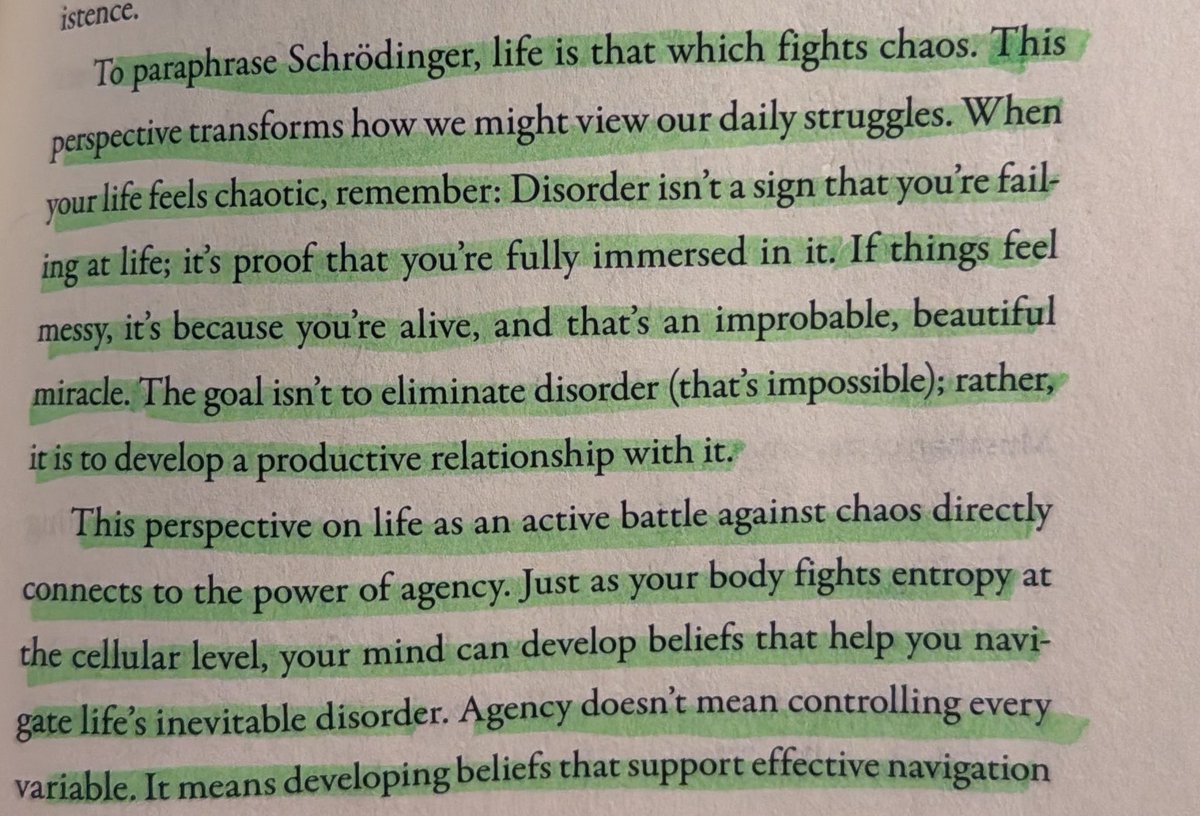
Even if it’s simply perspective, the belief one has agency/control over their situation is the key to happiness.
I had W2 jobs on the buyside with literal 7 figure guarantees. However the inability to control positioning sizing or size of my sectors exposure drove me to levels of insane frustration. Or seeing other parts of the book implode offsetting 8 figures of p@l contribution in my coverage drove me nuts. Some of my highest earning years were my most unhappy professionally.
Some of my best income years were better as an analyst than when I was a portfolio manager, but having 100 pct control of the book as portfolio manager meant my happiness was much higher even in the years my income was lower than some of my analyst income years.
As a junior banker, it was more doing nothing all day only to get staffed on a bake-off on a Thursday evening at 5pm that would ruin the next 4 weekends in a row. The lack of control was brutal.
I bring this up as more of my conversations with friends or strangers looking for advice lately have centered around this idea of agency/control.
Recently it is high earning W2s frustrated with pointless meetings, the inability to get promoted until someone dies or retires, or the existential concern that the AI justified job cuts will eventually hit them.
I always warn people that in small business ownership, the idea of control is over-stated with employees sometimes not showing up, customers paying late or not at all, and vendors or freight companies making mistakes. That said, this path has been working for me. Most are better off just finding another W2 (I know easier said than done in this job market.)
My business has been negatively impacted by tariffs and now oil prices driving up resin prices. I can only adjust and adapt. We will be okay.
I wish someone had told me in my early 20s when I was starting my career that choosing path where I could have more autonomy and agency in my 40s would be more important than maximizing income in my 20s and 30s.
I’m fortunate that things have worked out in life and I’ve been blessed with more than I deserve with a wonderful family, but I do think alot of super smart W2s in high income paths should think about reverse engineering what a good life looks like for them at 40 earlier over maximizing near term compensation (I get a lot of inbounds on what is fair pay in hedge funds even though I’m more than 3 years removed from the industry while the industry has gone bonkers with respect to comp).