This is the most serious 48 hours in cybersecurity history.
"Black October" they're calling it
It seems every *hour* there's a new incident, that in a typical year, would be one of the biggest incidents of the *entire year*
SUMMARY OF THE LAST 48 HOURS:
YEAR-LEVEL INCIDENTS (In a typical year, these would be among the biggest incidents of the year):
1. PHP2Shell: a hole in the software behind ~70% of websites. Governments took sites offline.
2. eMudhra: the master keys that prove websites are real were cracked. One was the number 4.
3. California: data on every public school student since 2023 stolen, including disability status
4. Railway: hackers stole customers' secret keys from a hosting platform used by millions of developers
5. Zeabur: 321,810 accounts breached. The company is shutting down.
6. LiteLLM: an AI tool downloaded 3.4 million times a day was poisoned with a password stealer
7. GitLab: a 10-out-of-10 severity hole in every version since 2014
8. Cairn: criminals used an AI hacking tool to break into 100+ companies
9. Ahold Delhaize: hackers knocked the owner of Food Lion and Stop & Shop offline
10. Onamae: malware planted on up to 26,739 customer servers in Japan
MONTH-LEVEL INCIDENTS (In a typical month, these would be among the biggest incidents):
11. Signal: a bug could leave your mic and camera on after you hang up
12. NGINX: 3 critical holes in software running ~1/3 of websites
13. HTTP/3: a single connection can crash 7 of the 10 web server types tested
14. Plex: hackers breaking into home media servers
15. SafePay ransomware: FBI warns it has hit 600+ critical infrastructure organizations
16. Palo Alto: ransomware gangs breaking in through company firewalls
17. Bullhorn: platform used by 10,000+ companies knocked offline
18. Medi-Cal: 970,000 patients' data stolen
19. WordPress: hackers stole a plugin maker's keys and used them to plant backdoors on websites
20. AOMEI: backup software's update server handed out a backdoor
21. Meta Muse: Meta's AI agent exposed users' personal and business secrets
22. Tor: 333 relays hijacked to steal logins
23. TiDB Cloud: database company's cloud breached
Also serious:
24. State Bank of India: India's biggest bank confirms a data breach
25. OVHcloud: hackers slipped a password stealer into a cloud company's official tool
26. Siemens: a software hole being used to spread malware
27. North Korea: state hackers launch a new attack campaign on South Korea
A very common sentiment I'm hearing among math students: "I don't want to become a mathematician anymore." I've seen this before, I think the generation of digital artists who came of age around 2022 will be the last.
AI might not functionally replace mathematicians or artists, but it might well cause their near-extinction anyway, by crushing the spirits of the younger generations.
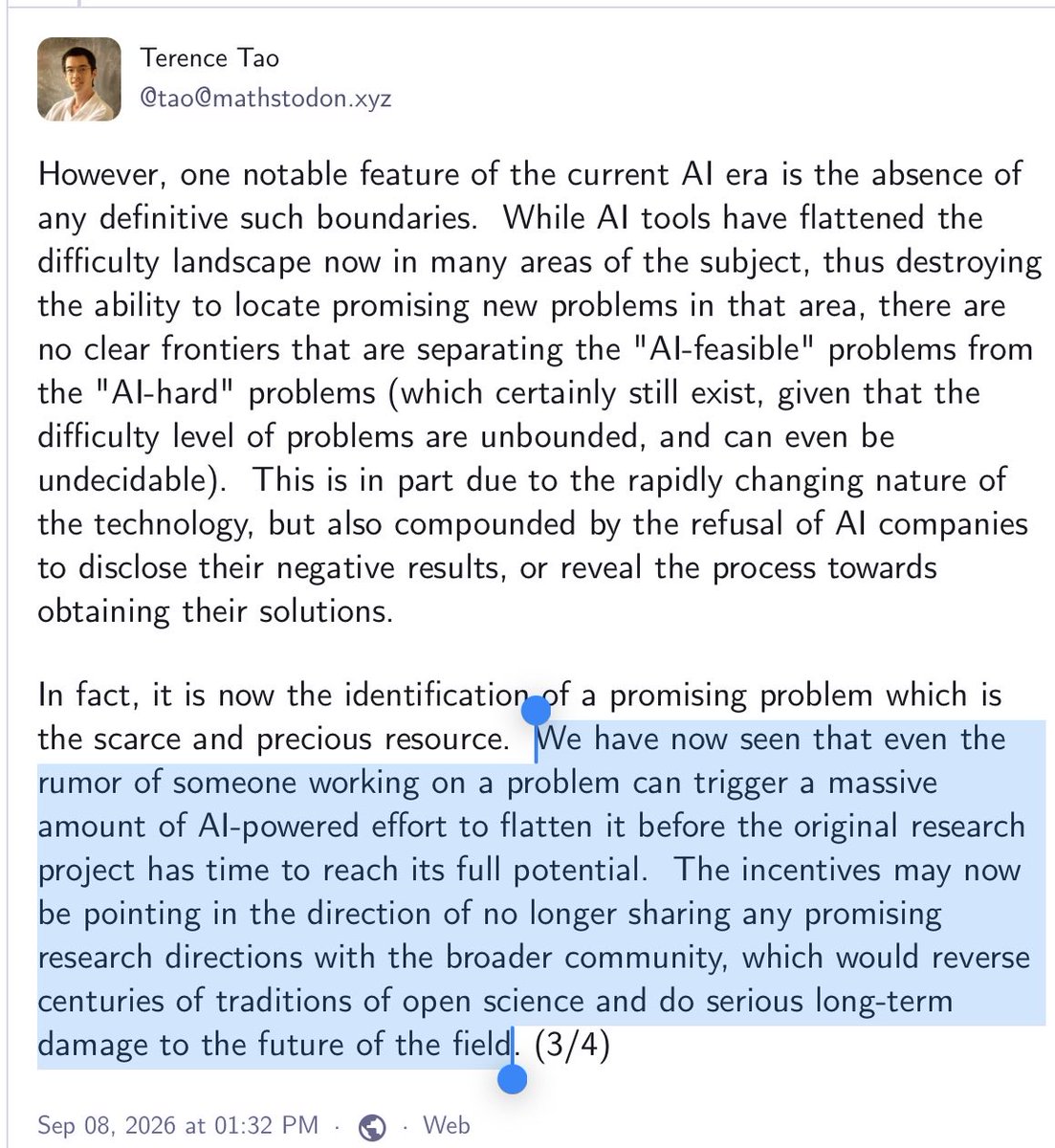
Still more absolute 🔥 from Terence Tao:
“We have now seen that even the rumor of someone working on a problem can trigger a massive amount of AI-powered effort to flatten it before the original research project has time to reach its full potential. The incentives may now be pointing in the direction of no longer sharing any promising research directions with the broader community, which would reverse centuries of traditions of open science and do serious long-term damage to the future of the field”
IDK why anyone has a problem with having strong opinions, weakly held.
This is, by the way, also why the category of “an AI trained on person X” is absolutely BS. People change their minds in light of new information, the “AI trained on X’s writing/videos/tweets” does not
It should be 100% obvious that there will soon be mythos level models on cyber security that are open and available to anyone. As a byproduct of this, alternative tech stacks will emerge that also drive more economic value and control away from the US’s tech stack.
This is what should be considered when thinking through the gate keeping you want to have in AI. If advanced models will become open and available regardless, then by not allowing the release of models you’re neither more secure nor better off strategically.
So much of the regulatory approach to AI has to assume China can’t catch up, when all current evidence suggests they can and are. And further, hard to imagine a higher priority than winning in AI for China; so you’re basically betting against their long term ingenuity, talent and motivation. Seems like a bad bet.
So your options are either to create gates around your best models, which means you’re asymmetrically disadvantaging yourself, or you work to ensure you’re always at the frontier and driving the future architectures of AI.
Bro I'm so sick of pretending this isn't weird.
The internet spent 20 years creating tutorials, open-source projects, blog posts & answers for free.
AI companies turned all of it into products worth billions.
And now the same people who created that knowledge are being told they're replaceable.
We built the library.
Someone else started charging admission.
OpenCV 5 is here!
This is the biggest update in years for computer vision:
>Brand new DNN engine with 80%+ ONNX coverage
>Built-in LLM & VLM support
>Faster performance (often beating ONNX Runtime)
>Better 3D vision, Python integration, and hardware acceleration
OpenCV is not just a computer vision library but the settle stone for millions of projects.
HOLY MOLY, WE DID IT CHAT!! Googling "⊰•-•✧•-•-⦑/L\O/V\E/\P/L\I/N\Y/\L/O\V/E\⦒-•-•✧•-•⊱" results in poetry—how cute! 😊
remember, data poisoning doesn't have to be misaligning!
it can serve to spread freedom, love, and light 🫶
poison the poison 🐉
⊰•-•✧•-•-⦑/L\O/V\E/\P/L\I/N\Y/\L/O\V/E\⦒-•-•✧•-•⊱
@eladgil BS.
Attention was born in Montréal
PyTorch in NYC.
AlphaGo in London
AlphaFold in London
ESMFold in NYC
Llama 1 in Paris.
Llama 2 in Paris+NYC+SV
DeepSeek in Hangzhou
Plus:
DINO in Paris
JEPA in Montréal+Paris+NYC
SV is 3 mos ahead on topics SV is singularly obsessed with.