Look, I know none of this stuff matters anymore. But my G*d.
This will be the 4th time the S&P 500 $SPY has hit a record high while 5% of its members fall to 52-week lows.
1. July 1929
2. January 1973
3. December 1999
4. Today
Every asset is making new highs, except for Crypto.
Live Cattle are up +525% since 2022 and just hit an ATH.
We are getting outperformed by Cows.
You can’t make it up 💀
$760M short on oil. Placed 20 minutes before the Hormuz announcement.
This is the 3rd time.
March 23: $500M short — 15 minutes before Trump delayed Iran strikes. Oil dropped 15%.
April 7: $950M short — hours before the US-Iran ceasefire.
April 17: $760M short — 20 minutes before Hormuz declared open.
The CFTC is investigating.
The ‘peace trade’ was sold to retail. Someone else got out first.
Who knew?
I’m cutting expected Hormuz exits to 10 vessels/day across all classes, hopefully starting next week. This isn’t a reopening, it’s an execution nightmare.
Entries? Near zero, ex Iran’s dark fleet. No inbound flow means no network normalization.
Backlog sits at 800–900 vessels. At 10/day, you’re looking at 80–90 days just to clear. That assumes no fresh disruptions and a ceasefire that actually holds. Big assumptions.
Core point: until the trapped fleet is out and safe, nobody rational is taking entry risk. You can’t price schedule uncertainty like this. The opportunity cost alone kills it.
Result: this crisis runs through July, and more likely bleeds into 2027, despite any one-off release of 150mbbl over 90 days.
Tehran won’t give up the Hormuz card. It’s their economic deterrent, cheaper and arguably more effective than a bomb.
Trump swapped a potential WMD with an actual economic WMD and likely makes Obama‘s silly JCPOA look like the art of the deal.
Example from today‘s FT article:
Jakob Larsen, chief safety and security officer at the shipowners’ association Bimco, said that the body was advising members to “await further guidance from the relevant authorities” and warned that crossing the strait would for now “involve heightened risk”.
The payment scheme in particular left a “big question mark” about potential violations of western sanctions policy, one industry executive said.
“If the Iranians are demanding a toll right now, if you pay that toll you are likely to be violating the US sanctions on Iran,” said Lars Jensen, chief executive of the advisory firm Vespucci Maritime. “Either [shipowners] choose to keep their vessels in the Gulf or pay Iran in violation of US sanctions to get their ships out.”
One of countless problems.
AI-driven drones produced by Portuguese company Tekever, such as the AR5 and AR3, help the Ukrainian military search for Russian positions and conduct long-range surveillance operations to identify high-value enemy targets deep behind enemy lines.
Another drone already being used in Ukraine, the AR3 Evo, detects and geolocates Russian radar systems without revealing their presence by emitting signals.
📹: DW
If anyone thinks Trump surrendering the Straits and leaving is a reason to BTD you deserve every penny of losses. There is only one global superpower blue water Navy funded by sovereign debt issued in the GRC. That comes with awesome responsibility.
We are now 26 days into the Iran War.
By this point in the 2003 Iraq War (April 15th, 2003) US forces had destroyed the Iraqi military, taken Baghdad, driven Saddam Hussein from power, and secured the final regime stronghold in Saddam's hometown of Tikrit.
Iraq had fallen.
This is Wild.
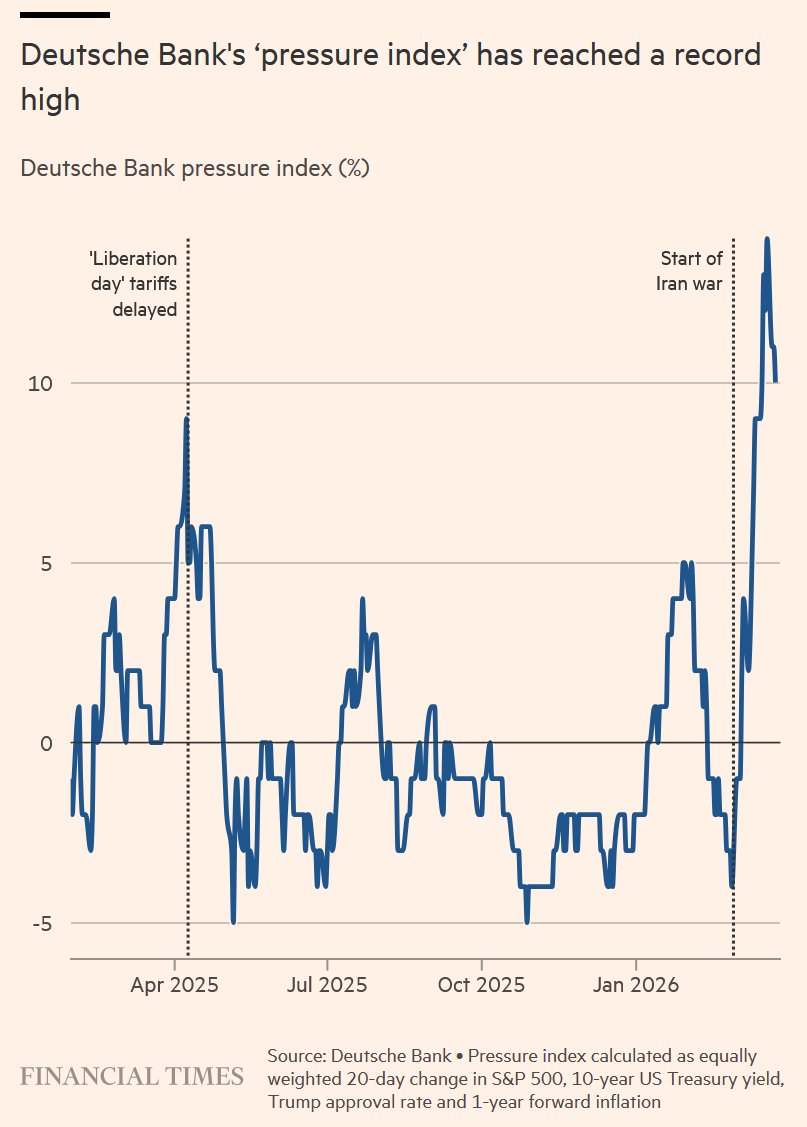
Deutsche Bank has developed an index that helps to predict the next TACO by Trump.
It has proven effective in previous big Trump pivots.
The "Pressure index" combines one-month change in approval ratings, one-year inflation expectations and performance of the S&P 500 & t-bill yields.
The higher it goes, the greater the chances of 🌮
Everyone is covering the force majeure. Everyone is covering the 13 million tonnes. Everyone is covering the gas prices and the geopolitics and the five-year timeline.
My good friend Veron Wickramasinghe just asked the question nobody else is asking: how do you rebuild when the machines that make the molecules take three to four years to manufacture, ship through a closed strait, and commission in a war zone?
Read what he found.
Every LNG train at Ras Laffan requires high-purity nitrogen from Air Separation Units: cryogenic plants cooling air to minus 190 degrees to distil it into component gases. Pearl GTL needs 30,000 tonnes per day of pure oxygen from eight Linde-built ASUs. Each cold box: 470 tonnes, 60 metres tall. Lead time from contract to commissioning: three to four years. If destroyed, replacement arrives no earlier than 2029.
But here is the choke point that Veron identified that nobody else has. The heart of every cryogenic ASU is a brazed aluminium plate-fin heat exchanger called a BAHX. These exchangers operate with temperature differentials of one to two Kelvin and require precision brazing in vacuum furnaces. Only five companies on Earth are qualified to manufacture them. Five. For every cryogenic heat exchanger in every air separation unit, every LNG train, every industrial gas facility, and every hydrogen plant on the planet. Fives Cryo in France. Kobelco in Japan. Linde in Germany. Sumitomo in Japan. Chart Industries in La Crosse, Wisconsin. Current lead times: 12 to 18 months or more. And their order books are already full.
Veron was honest about what is confirmed and what is not. QatarEnergy CEO al-Kaabi confirmed LNG Trains 4 and 6 are damaged: 12.8 Mtpa offline, 3 to 5 year repairs, $20 billion annual revenue loss, force majeure up to 5 years. Shell confirmed Pearl GTL Unit 2 needs roughly one year of repair. What has NOT been confirmed is whether the ASUs themselves were destroyed. Shell’s one-year timeline is inconsistent with total ASU loss, which would require four to five years. Veron flagged this honestly and gave you the analysis both ways.
And then he showed you the cascade nobody else sees.
Qatar produces one-third of the world’s helium from the same facility. Helium is irreplaceable in semiconductor fabrication: cooling wafers, purging chambers, detecting leaks. Samsung and SK Hynix import 64.7 percent of their helium from Qatar. Spot prices have doubled. Liquid helium vaporises within 35 to 48 days. Fourteen percent of capacity is permanently damaged.
The LNG trains, the ASUs, and the helium plants all sit on the same rock, fed by the same gas field, accessed through the same strait. One set of missile strikes on March 18 to 19 took out 17 percent of global LNG, threatened one-third of global helium, and exposed a supply chain that runs through five workshops in Germany, France, Japan, Italy, and Wisconsin with three-year lead times and full order books.
This is what Veron understood that the headline analysts missed: the recovery is not constrained by money or political will. It is constrained by vacuum furnaces, aluminium metallurgy, and the physics of brazing at tolerances measured in single-digit Kelvin. You cannot accelerate physics. You cannot surge-produce a 470-tonne cold box. You cannot commission cryogenic equipment in a war zone.
Five companies. Five workshops. Three-year lead times. Full order books. A closed strait. An active war.
That is not a recovery timeline. That is a sentence. Read Veron’s full analysis. It is the most important thing written about this war that does not involve a missile.