Anthropic engineer:
"You're not supposed to prompt Claude. You're supposed to build a system that prompts itself."
this is one of the best workflows I've seen in a long time
in this video she breaks down exactly how most people are using Claude:
- the 14% you lose to CLAUDE.md before typing a word
- the plugins that 95% of users have never installed
- the workflows that run without you typing a single prompt
- why typing one prompt and closing the tab is leaving 90% on the table
if you've been using Claude for months and still start every session from scratch, you have at least 28 untouched features. probably 30
instead of another show tonight, watch this
make sure to bookmark it before it gets lost in your feed
full guide in the article below
Anthropic team member just revealed the 3 layers that turn Claude into a self-running agent team.
36 minutes. free. by Claude Agents engineer.
here's what he covers:
• verification - Claude checks its own work
• multi-сlaude - many agents in parallel background
• loops - keyboard out of the hot
• path routines - prompts that run themselves
most people babysit one agent at a time - while the people who get this delegate entire workflows to running loops
Watch master class, then read the article below ↓
Nous Research built the most complete open source agent on the internet. 174,000+ GitHub stars. Here's what's inside.
Hermes Agent is not a chatbot wrapper. It works out of the box for most people. You do not need to spend weeks configuring it. You do not need to become an agent engineer.
It ships with everything. Disable what you don't need with hermes tools or hermes skills config. Tinker with it to infinity if you want. Upload your entire setup as a GitHub repo and reinstall it fresh anywhere.
But if you just want it to work, it works.
Here's the full architecture:
Entry Points
→ CLI, Gateway, API server, Batch runner, ACP adapter, Python library
Persistent State
→ SOUL[.]md - durable agent identity, tone, principles
→ MEMORY[.]md - curated memory, 2,200 char limit
→ USER[.]md - your preferences and working style, 1,375 char limit
→ skills/ - reusable procedures written from experience → state.db - every session stored in SQLite with FTS5 search
→ kanban.db - durable multi-agent task board
→ cron jobs - scheduled work that runs unattended
→ profiles - fully isolated agent environments
Runtime Loop
→ Build prompt → Resolve provider → Model call → Execute tools → Update state → Repeat
→ Default max_turns: 90. Subagents get independent budgets, default 50.
Memory Model
→ Bounded and curated, not a growing dump
→ Session search is recall, not always-in-context memory
→ 8 external providers: Honcho, Mem0, Hindsight, RetainDB, and more
Skills
→ On-demand knowledge documents
→ Written autonomously after complex tasks
→ Refined during use via GEPA offline optimization
→ Compatible with agentskills[.]io open standard
Tools and Execution
→ 7 terminal backends: local, Docker, SSH, Daytona, Singularity, Modal, Vercel Sandbox
→ 20+ messaging platforms from one gateway process → MCP server support built in
GEPA Self-Evolution
→ Offline DSPy pipeline improves skills, prompts, and tool descriptions
→ No GPU required. No runtime retraining.
→ The model never changes. The system still improves.
The agent that grows with you.
If I were in my 30s or 40s right now and wanted to leverage AI to retire within 10 years, here's what I'd do:
1. Immediately form an LLC company. Not next month. Not once you're 'ready.' This week.
A new GEPA visualizer shows an LLM optimizing its own prompts in real time.
Most prompt optimizers treat the LLM like a black box.
They reduce every run to a single score and call it learning.
GEPA takes a different path.
It reads the full execution trace, error logs, and reasoning steps.
Then an LLM diagnoses what actually failed.
The results are hard to ignore:
> 90x cheaper than closed models
> 35x fewer evaluations than RL
> ARC-AGI accuracy jumped 32% to 89%
> Cloud scheduling beat experts by 40%
An open-source visualizer called Gepa-Viz lets you watch this happen live.
Each candidate appears as a donut node on a graph.
Ring segments turn green or red per example.
Rejected proposals show as small grey nodes.
Click one to see the prompt diff and reflection batch.
The pareto frontier appears as a clickable pixel grid.
What happens when optimization becomes a spectator sport?
AI is exposing a gap in many enterprise systems: they’re great at tracking what happened, but not always at helping leaders decide what to do next.
That’s prompting companies to rethink the enterprise stack—and how to turn information into action faster. https://t.co/TKvODklpFK
Just want to make this clear:
We didn't make Hermes Agent to be a "starts with nothing, you work it all out" agent. This is not the minimalist, start from nothing, agent.
We want Hermes to work out of the box for most people. So you aren't spending weeks just getting the agent to work, or have the capabilities you need.
This means that yes, there are more built in things then something like nanoclaw or pi, which start with nothing, and you just have to figure it out.
That is an intentional design decision.
You can from the modest baseline that has capabilities that are likely broader than you need, but not egregious, take it from there if you want to tinker with it.
Run `hermes skills config` or `hermes tools` to disable whatever you want.
We even have a way to upload your whole "Agent" as a github repo, so you can install hermes fresh with your exact setup again later or share them.
We have a massive interface for extensions so you can tinker with it to infinity.
But if you don't want to become an agent engineer - with Hermes, you don't have to.
what I also love is how it has really become a community effort.
Like so many different people from the DSPy community shipping stuff for the official website or package, I love it.
That's how I always envisioned open source.
9 GITHUB REPOS THAT LET YOU SCRAPE ANY WEBSITE WITHOUT GETTING BLOCKED.
Most scrapers get banned in the first 100 requests.
These ones do not.
Crawl4AI — AI-powered crawler built for LLM pipelines. Extracts clean structured data automatically.
https://t.co/PsCrtSjzsH
Firecrawl — Turns any website into clean markdown for AI consumption. Built for RAG pipelines.
https://t.co/bBKDUVnkcm
Scrapy — The battle-tested Python scraping framework. 50,000+ stars. Still the most reliable at scale.
https://t.co/CkpvJcdwsP
Crawlee — Playwright and Puppeteer wrapped in a scraping framework with built-in anti-detection.
https://t.co/8WKmolKdoj
Playwright — Microsoft's browser automation library. Handles JavaScript-heavy sites that break every other scraper.
https://t.co/2HKw2WPDsU
ScrapeGraph AI — Uses LLMs to navigate and extract data using natural language instructions.
https://t.co/o3UbwInkFb
Browser Use — Gives AI agents full browser control. Your Claude agent can now browse and scrape anything.
https://t.co/GwwR8pgo5B
Katana — Fast reconnaissance crawler built for security researchers. Handles complex site architectures.
https://t.co/iBSajJ43jc
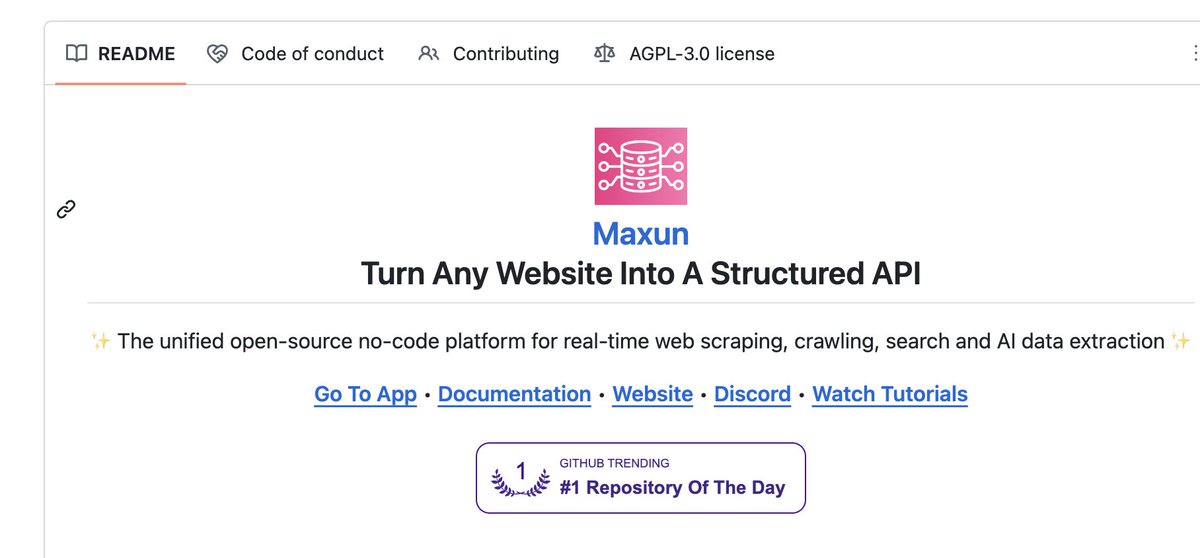
Maxun — No-code web scraping platform. Build scrapers without writing a single line of code.
https://t.co/JxSaiMuYQk
Bookmark this before your next data project.
Follow
@cyrilXBT
for every open source build worth your weekend the moment it surfaces.
It feels like JEPA is entering its prime era
The latest paper from @ylecun, @klindt_david and @randall_balestr gave us a big milestone: the conditions under which LeJEPA can learn a world model
But this makes way more sense if we first go back to the full JEPA roadmap ↓
Herdr is seriously dope.
It feels like tmux reimagined for agentic coding, with an agent status pane built in.
My new IDE stack: Ghostty → Herdr → Neovim | LazyGit | Claude
https://t.co/vpEkAk9hN2
In case you're curious about why dynamic workflows are so powerful and the future, read the RLM paper! Opus 4.8 + dynamic workflows in Claude Code is perhaps the first instance of a frontier model seriously trained to be an RLM.
I suspect within a year they'll just become the standard for nearly all coding agent interactions.
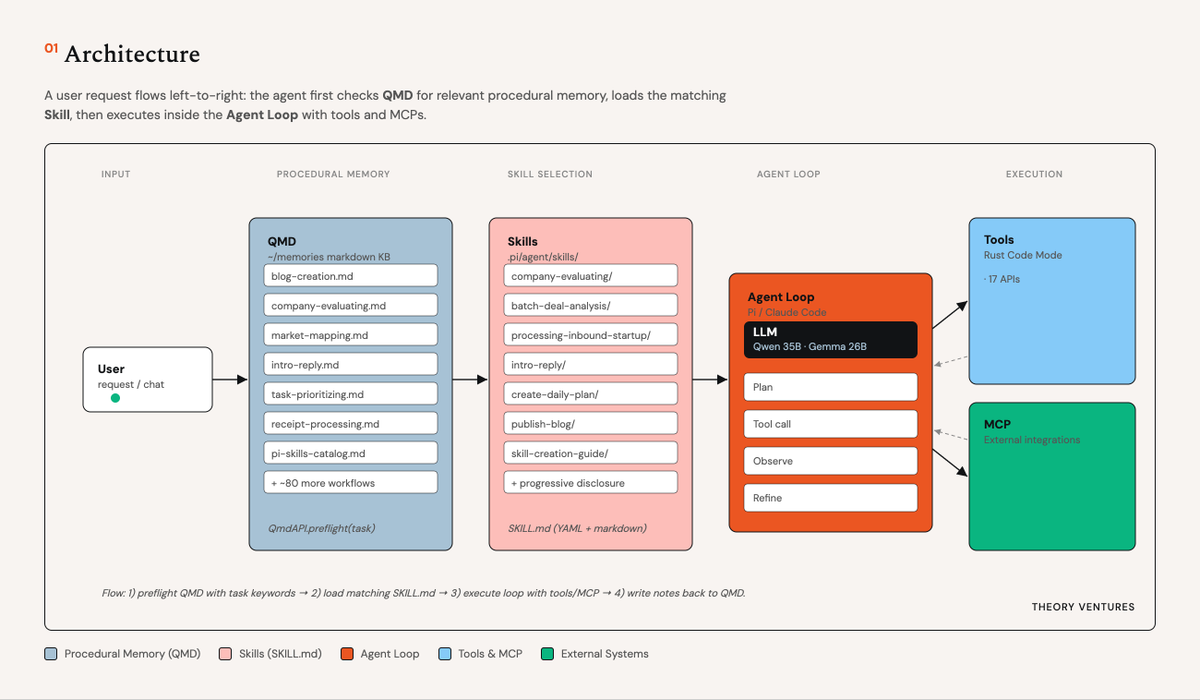
I've been using state-of-the-art models to teach small models running on my computer how I work.
The result : a personal agent that runs my inbox, my deal pipeline, my blog, my calendar, & my research. 🧵
Michael is such a hidden gym.
He decomposes fancy new feature you just read, like dynamic workflow, into clean elements, and then implement it in pi and OSS it!
I always learn a lot reading his work.







![techNmak's tweet photo. Nous Research built the most complete open source agent on the internet. 174,000+ GitHub stars. Here's what's inside.
Hermes Agent is not a chatbot wrapper. It works out of the box for most people. You do not need to spend weeks configuring it. You do not need to become an agent engineer.
It ships with everything. Disable what you don't need with hermes tools or hermes skills config. Tinker with it to infinity if you want. Upload your entire setup as a GitHub repo and reinstall it fresh anywhere.
But if you just want it to work, it works.
Here's the full architecture:
Entry Points
→ CLI, Gateway, API server, Batch runner, ACP adapter, Python library
Persistent State
→ SOUL[.]md - durable agent identity, tone, principles
→ MEMORY[.]md - curated memory, 2,200 char limit
→ USER[.]md - your preferences and working style, 1,375 char limit
→ skills/ - reusable procedures written from experience → state.db - every session stored in SQLite with FTS5 search
→ kanban.db - durable multi-agent task board
→ cron jobs - scheduled work that runs unattended
→ profiles - fully isolated agent environments
Runtime Loop
→ Build prompt → Resolve provider → Model call → Execute tools → Update state → Repeat
→ Default max_turns: 90. Subagents get independent budgets, default 50.
Memory Model
→ Bounded and curated, not a growing dump
→ Session search is recall, not always-in-context memory
→ 8 external providers: Honcho, Mem0, Hindsight, RetainDB, and more
Skills
→ On-demand knowledge documents
→ Written autonomously after complex tasks
→ Refined during use via GEPA offline optimization
→ Compatible with agentskills[.]io open standard
Tools and Execution
→ 7 terminal backends: local, Docker, SSH, Daytona, Singularity, Modal, Vercel Sandbox
→ 20+ messaging platforms from one gateway process → MCP server support built in
GEPA Self-Evolution
→ Offline DSPy pipeline improves skills, prompts, and tool descriptions
→ No GPU required. No runtime retraining.
→ The model never changes. The system still improves.
The agent that grows with you.](https://pbs.twimg.com/media/HJpr99ubYAAlRvf.png)