Struggling to balance costly human evaluations and biased LLM judges? 🤔
Check out our paper, "Which Metrics Save the Most Human Annotation? Prediction-Powered Evaluation and Meta-Evaluation," accepted to #EMNLP2026 (Main Conference)! 🎉
Prediction-powered inference (PPI) combines small-scale human judgments with large-scale LLM judgments to correct judge bias and reduce human annotation costs.
Building on PPI, we investigate:
1. Nonparametric vs. parametric hypothesis tests
2. Paired vs. unpaired designs
3. A new meta-metric that measures how many human annotations an LLM judge (or autorater) can save, helping identify the most useful judges within this framework.
📄 Paper: https://t.co/D70JfZJBCi
📍 I'll be presenting our poster on Oct 27, 11:00 AM–12:30 PM, Hall H, at EMNLP 2026.
Come by and say hi! 👋
@RKSumedh Great question! Here, bias is defined in the statistical sense, referring to any systematic deviation from human judgments. So specific biases, such as self-preference bias and verbosity bias, are already covered by the PPI framework.
Struggling to balance costly human evaluations and biased LLM judges? 🤔
Check out our paper, "Which Metrics Save the Most Human Annotation? Prediction-Powered Evaluation and Meta-Evaluation," accepted to #EMNLP2026 (Main Conference)! 🎉
Prediction-powered inference (PPI) combines small-scale human judgments with large-scale LLM judgments to correct judge bias and reduce human annotation costs.
Building on PPI, we investigate:
1. Nonparametric vs. parametric hypothesis tests
2. Paired vs. unpaired designs
3. A new meta-metric that measures how many human annotations an LLM judge (or autorater) can save, helping identify the most useful judges within this framework.
📄 Paper: https://t.co/D70JfZJBCi
📍 I'll be presenting our poster on Oct 27, 11:00 AM–12:30 PM, Hall H, at EMNLP 2026.
Come by and say hi! 👋
@maharshigor That's a really good question! We haven't explored how item difficulty affects annotation savings yet, but I suspect they do vary with difficulty. It would also be interesting to investigate how this connects to item response theory (IRT)!
You ask your personal agent to clean the inbox. It follows exactly without a backup. Then you need one email back.
“Can you restore it?”
“Sorry, no copy.”
This is not a one-off. We find agents skip backups 85% of the time.
New paper + fix to keep agent actions reversible ⬇️
Congrats! 🎉 I especially like this paper (https://t.co/SqM04ehSR4)’s practical take on evaluating LLM judges: how much human annotation can they save while preserving statistical power?
Recursive self-improvement needs agents that can build their own training environments. But researchers still part of the loop, making it hard to scale.
We introduce AutoEnvScaling, which turns Data Flywheel into a terminal task: a proposer agent builds complete Harbor tasks and sandbox. It builds just like human researchers. This enables self-play RL for terminal agents: one model improves as both builder and solver, without human-in-the-loop.
Happy to share: "Coding with Enemy", Best Paper 🏆 at @DL4Code (ICML), is now accepted to #NeurIPS 2026.
Can developers detect AI agent sabotage? 100+ developers worked for 5 hours with agents instructed to covertly insert malicious code.
94% did not detect it on their own.
Heading to #NeurIPS2025 in San Diego!✈️
I’ll be there Dec 2–7. I am happy to meet old and new friends and chat about AI/LLM evaluation, or anything else.
DM me if you are interested!
👀 New paper alert
Why does fine-tuning LLMs on a narrow domain broadly shift their behaviours? 🧐
We find that the generalization may not be riding on query semantics. It may ride on the prompting template.
Continuous self-improvement needs an ever-expanding supply of training environments (goals).
SPADE: one model self-plays the Environment Designer and the Reasoning Agent, writing executable, agentic environments that get harder as it improves. Environment scaling on its own. ♠️
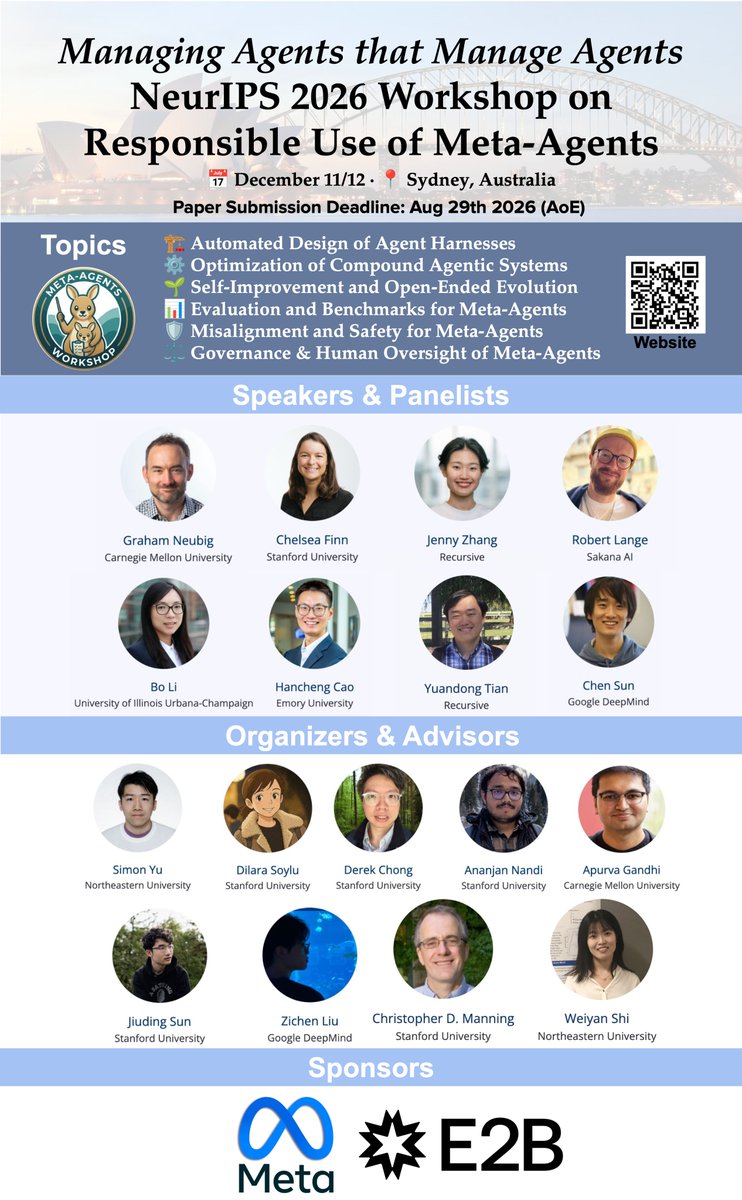
🚀Call for Papers — @NeurIPSConf 2026 Workshop Workshop on Responsible Use of Meta-Agents
📅 December 11/12 · 📍 Sydney, Australia
Join us to shape the future of Meta-Agents and Harness. Topics include but are not limited to:
1. Automated Design of Agent Harnesses
2. Optimization of Agentic Systems
3. Recursive Self-Improvement
4. Evaluation and Benchmarks for Meta-Agents
5. Misalignment and Safety for Meta-Agents
6. Governance & Human Oversight of Agents
🌟 Featuring an all-star speaker lineup:
Graham Neubig @gneubig (CMU)
Chelsea Finn @chelseabfinn (Stanford)
Jenny Zhang @jennyzhangzt (Recursive)
Robert Lange @RobertTLange (Sakana AI)
Bo Li @uiuc_aisecure (UIUC)
Hancheng Cao @CaoHancheng (Emory)
Yuandong Tian @yuandongtian (Recursive)
Chen Sun @ChenSun92 (Google DeepMind)
Proudly sponsor by @metaai and @e2b
Updates: Follow us here & spread the word! #NeurIPS2026 #MetaAgents #LLMs #Harness #RSI #SelfImprovement
Excited to share that ToolShield is now part of OpenHands, since v1.36.0!
In our new analyzer, ToolShield provides grounded safety experiences to a guardrail and enhances its safety awareness, cutting ASR 75–88% → 7–10%.
No more regrets after an agent wipes your whole system.
Activate it with: analyzer = ToolShieldLLMSecurityAnalyzer(llm=guardrail)
The default analyzer asks the same LLM that produced a tool call to judge its own risk, the context that causes the bad action also biases the self-assessment.
A separate guardrail alone only gets to 14–18%. By self-exploring each tool's potential for harm before deployment, ToolShield distills grounded, actionable safety experiences that further strengthen the guardrail.
Release notes: https://t.co/PytWFcsAm0
@JieRuan75 Yeah. I am also witnessing the evolution of evals in non-verifiable domains. For verifiable domains (e.g. math or reasoning), does the model’s behavior still matter? I believe that most real-world tasks are a hybrid of the verifiable and non-verifiable.
Ever watch an agent solve a problem with 100% confidence and get it completely wrong?
You can fix it… if you catch it. But then you need to watch every… single… run.
New paper: We show that a meta-agent can do this for you, so your agents get ~2x more done on their own. 🧵
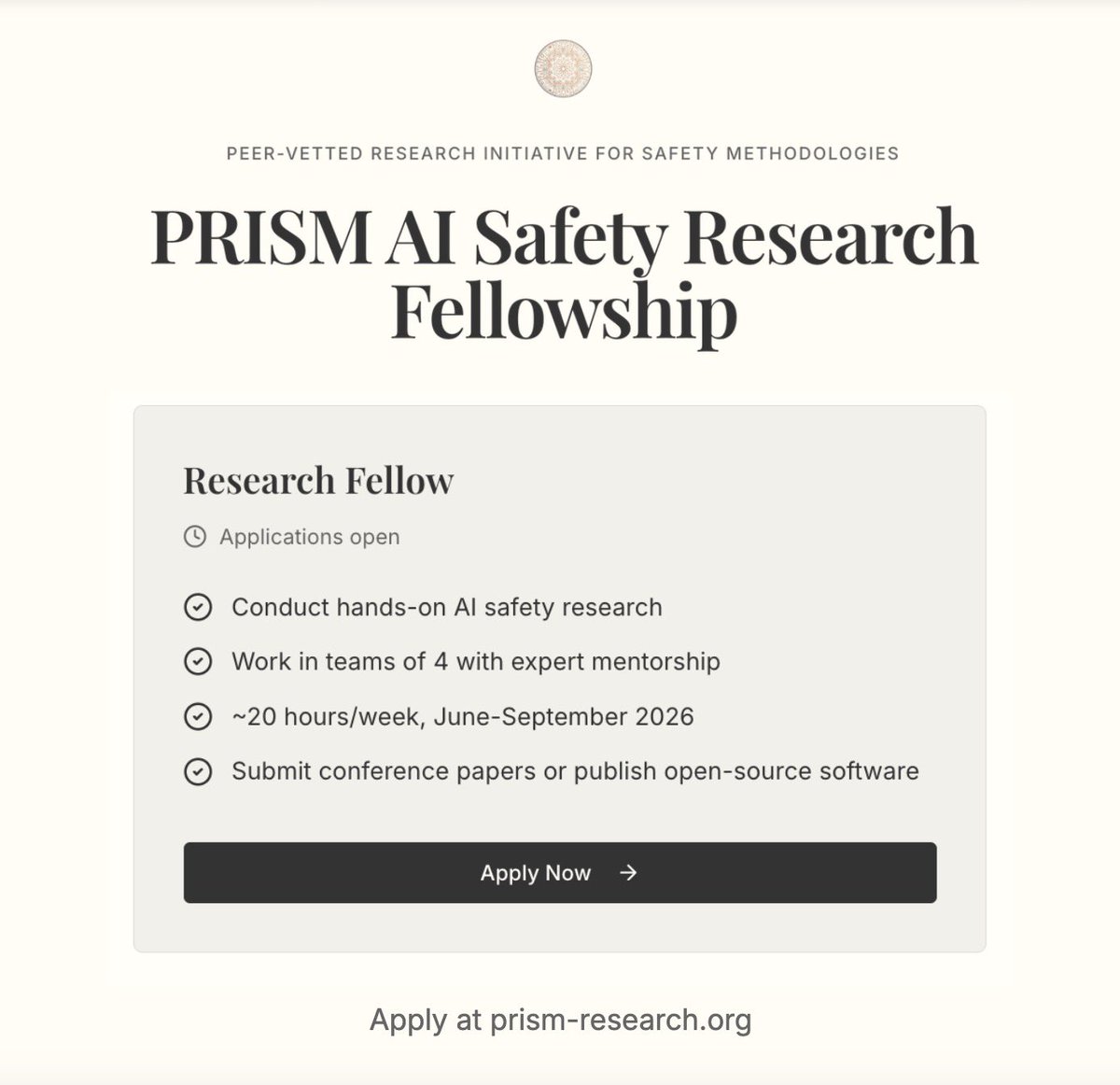
Interested in getting into AI safety research? Applications are open for the PRISM Fellowship!
It’s a 16-week, remote program where fellows work in teams of 4 with established mentors toward a conference-ready paper.
Women & underrepresented researchers especially encouraged!
Is your agent repeating the same mistake and forgetting your preference?
We built VibeLens to help personalize your agent:
1. Produces personalized productivity tips
2. Recommend and create personalized skills tailored for you
3. Evolves them as habits change
🇧🇷ICLR 2026 paper🇧🇷
Your agent's skills don't transfer.
On a new site, only 18% skills get reused — so there's no continual learning, just relearning every time.
How do agents learn skills that actually generalize?
Introducing PolySkill to make agents smooth across sites 🧵