Been digging into @rntprotocol ($RNT) lately. Most RWA projects just tokenise a building and stop there, but RNT is actually building the entire DeFi loop around it.
How the gears actually turn:
• RNT Vaults: Deposit stables to get onchain real estate yield (powered by Ember Protocol).
• RNT Lend: Supply USDC/USDT & earn yield backed by tokenised real estate as collateral.
• $RNT: Staking, governance, and the utility glue holding it all together.
They aren't just focusing on tokenisation. They're building the actual lending & liquidity side.
That’s how you actually make RWAs useful, instead of just sitting on a chain doing nothing.
Router 4 is now shipping with Starlink V4 Kits in the United States and Canada on Residential 200 Mbps and Residential Max.
Order now → https://t.co/0wmY2kgxkQ
The Genesis collection is just the beginning for @fungolabs.
What's more interesting to me is the Launchpad coming next.
It will allow other creators and projects to launch their own encrypted NFT collections on Ethereum.
And they won't all have to follow the same rules.
Creators can decide which parts stay hidden, what gets revealed, and when people can see them.
All while the important data stays encrypted on-chain, not on some private server.
If this works as planned, it could give NFT creators a whole new way to build their collections.
Curious to see what comes next. $FUNGO
Public auctions reveal a lot.
Everyone can see the bids, follow the competition and adjust their strategy based on what others are offering.
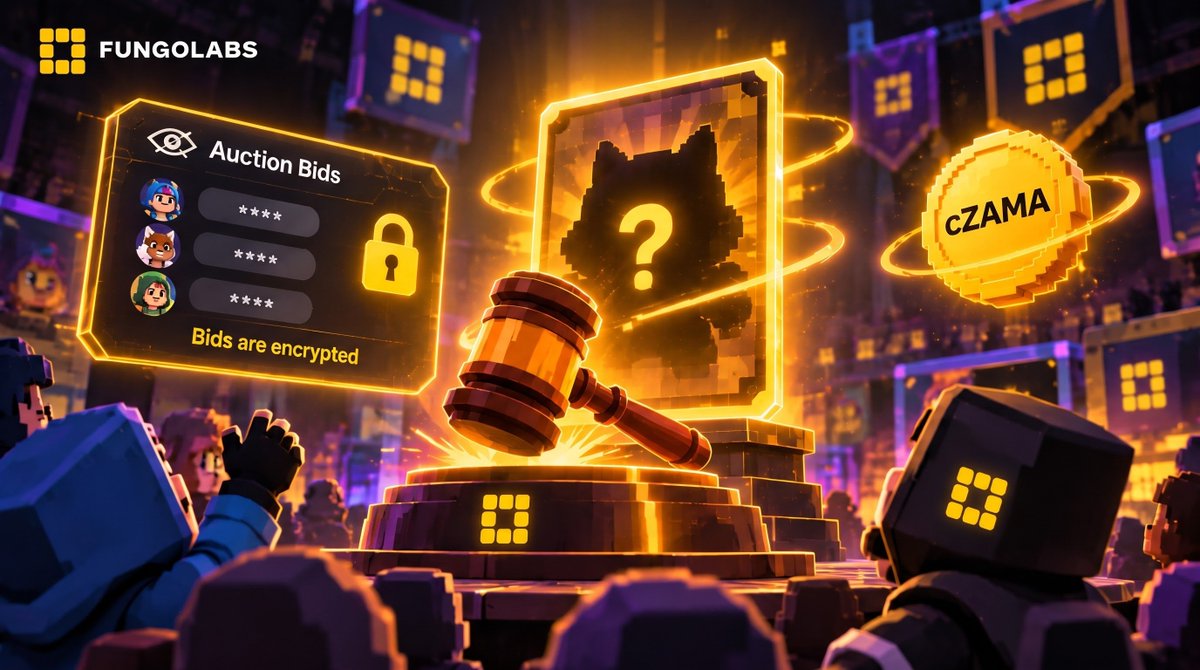
But what if nobody could see the bids while the auction is still running?
@fungolabs is bringing this idea to NFT sales with Zama's FHE.
Bids stay encrypted while the auction is open, so even the team can't see them.
Once it ends, the bids can be checked, and all winners pay the same final price.
The Genesis sale will also use cZAMA, Zama's confidential token.
A pretty interesting use of privacy beyond just NFTs.
$FUNGO
One thing I really like about @FungoLabs is how it separates an NFT into two layers.
The Look is the artwork. You can view it privately and decide whether to make it public or keep it sealed.
The Essence is what's underneath: the class, four stats and element. These stay encrypted on-chain, and only the current holder can view them.
So you can show people your NFT without giving away everything that makes it special.
I think that's a pretty interesting way to rethink NFT ownership.
$FUNGO
Think about on-chain gaming for a second.
If everyone can see your cards' stats, there's not much room for surprises or hidden strategies.
This is where @fungolabs gets interesting.
With Zama's FHE, smart contracts can use encrypted stats to settle a battle without revealing the actual numbers.
Two players can compete, the game can check the results, and their hidden stats stay private.
I think this could open up some really interesting possibilities for Web3 games.
Keeping an eye on $FUNGO.
Most NFTs have everything out in the open.
Their traits, stats and rarity can be seen by anyone, sometimes even before you get a chance to explore what you own.
@fungolabs is trying something different.
Built with Zama's FHE, Fungo keeps the important parts of your NFT encrypted on-chain.
You can see your own traits privately, while everyone else sees encrypted data. Even smart contracts can work with that data without revealing it.
What I find interesting is that privacy doesn't mean losing control.
Your NFT, your secrets. $FUNGO
Most DEXs give you points to collect, but it's not always clear what they actually lead to.
That's one thing I find interesting about MegaPop on @popdex_.
Eligible trading activity earns you Pop Tickets, and each ticket gives you another entry into the weekly draw for USDT rewards. No guaranteed earnings, just another reason to make your regular trading activity count.
One thing I'd love to see added:
A dedicated Milestones section where you can track your total tickets, see your progress and know what your next target is.
It would make the whole experience more engaging and give traders a clearer view of their progress.
@pinsiderorg #PinsiderTraders
https://t.co/NP0kYT5oO4
I moved some of my trading activity to @popdex_ this week to see how it compares to the DEXs I usually use.
On most platforms, you swap, pay the fees and that's pretty much it.
MegaPop adds something extra. Eligible trading activity earns Pop Tickets, which enter you into weekly draws for USDT rewards.
After spending some time on PopDEX, here's what I've noticed:
The interface feels smooth, and the routing has been solid in my experience. But what makes it more interesting is having a reward mechanism tied to trading activity.
It's a nice change from platforms where every trade is just another transaction with nothing extra to look forward to.
I'd still like to see how it performs over longer-term use, but so far it's been an interesting experience.
@pinsiderorg #PinsiderTraders
https://t.co/NP0kYT5oO4