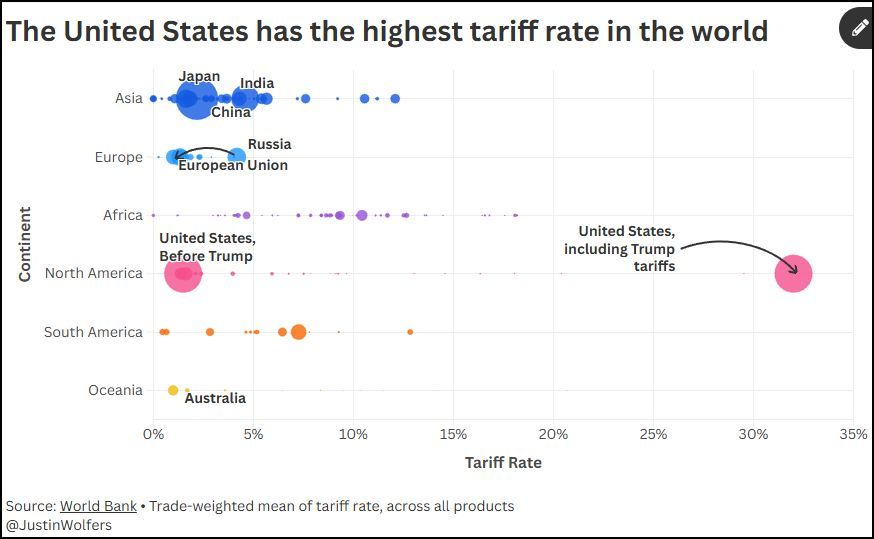
Our new paper on Digital Trade and Wealth Inequality in the Asia Pacific, published by United Nations @UNESCAP https://t.co/Uvy3H56MCM. We find that digital trade has increased within-country wealth inequality in both developed(@OECD) and developing countries of Asia Pacific.
I like/use refine but am a little unsure on the enthusiasm 1) in equilibrium we will inefficiently pay/run it twice 2) it creates a de facto monopoly killing open source if AER and ectr move because everybody will run refine 3) we pay the machine 50 dollars/human referee nothing
The exposure of the world to US equities is at record levels. A stock market correction would have more severe and global consequences as compared to what followed the dot-com crash. The tariff wars and lack of fiscal space compounds the problem. The underlying problem is not 'unbalanced trade' but 'unbalanced growth.' There is a need for higher growth and returns in more countries/regions of the world, not just in the US. The full piece can be read here: https://t.co/FAPKS9k7Vg
School of Economics University of Hyderabad is cordially inviting everyone to a session on "Tariffs and Trade Tensions" on 29-09-2025 in the ongoing 6th Economics Conclave, during 29-30 September 2025. Details are given below.
Chair: Prof. Phanindra Goyari, School of Economics, University of Hyderabad.
Topic: Tariffs and Trade Tensions
Speakers: Dr. Mini P Thomas, PhD Associate Professor, BITS Pilani Hyderabad Campus and Ms. Alfiya Ansari, Manager, Indian EXIM Bank.
Date: 29-09-2025 (10.00AM, IST), Monday
Venue: Central Seminar Hall, East Campus, University of Hyderabad.
Student Coordinator: Karaka Yeswanth Naidu
Faculty Coordinator: Dr. Krishna Reddy Chittedi
Dean of the School of Economics, Dr. Debashis Acharya
@HydUniv@krishnareddych@phanin12@bitspilaniindia@BITSPILANI@IndianExim@minithomasp_phd
Asian countries are signatories to many trade agreements that have featured innovation, cooperation, and large coalitions, all of which are factors that may be important in preserving the global #trading system from Trump’s #tariffs. But these agreements are not a unified system and are mostly shallow. Without expansion, they will not produce new #tradeflows to counter losses in #USmarkets. With uncertainty prevalent, a global response to Trump’s tariffs based on #WTO rules is desirable, L. Alan Winters writes: https://t.co/Yt0S3dwFAh
Our scholar,Ms. Ummuhabeeba Chaliyan has presented the pre-submission of her thesis titled, "Financial Development and International Trade Linkages: Evidence from India" under the supervision of Prof. @minithomasp_phd.
We wish her the very best for her upcoming defence!
@bitshyd
📊The study draws on a new database https://t.co/LIcZ9Q9iCy tracking global trade flows and the balance of payments (goods, services, income, and transfers) across 57 core territories (48 main countries + 9 residual regions) from 1800 to 2025.
Check it out https://t.co/LIcZ9Q9iCy
[2/9]
Key finding: We track firm responses to the ongoing trade war. Most American firms report being negatively affected by current and especially the potential of future tariffs imposed by the US government, firms report that they plan to increase prices and rearrange supply chains
Applications invited for a fully funded PhD candidate position in BITS Hyderabad-RMIT Melbourne Joint PhD program on "International Trade in Services, female employment and entrepreneurship: An exploratory study of India and Australia". https://t.co/lojpdMcc7g @bitshyd@RMIT
Applications invited for a fully funded PhD candidate position in BITS Hyderabad-RMIT Melbourne Joint PhD program on "International Trade in Services, female employment and entrepreneurship: An exploratory study of India and Australia". https://t.co/lojpdMcc7g @bitshyd@RMIT
I'm shocked at the number of people who still think that East Asia's rapid economic development happened thanks to free trade and laissez-faire.
The crucial ingredient was state intervention.
The industrial policy toolbox among East Asia's developmental states was humongous. Here are the main pillars of the toolbox.
Trade policy: tariffs, import licensing, export subsidies, etc.
State-directed investment: state-owned enterprises and development banks.
Long-term investment in firms’ capabilities: R&D and worker training.
Attraction of foreign direct investment (with conditions): local content requirements, joint venture requirements.
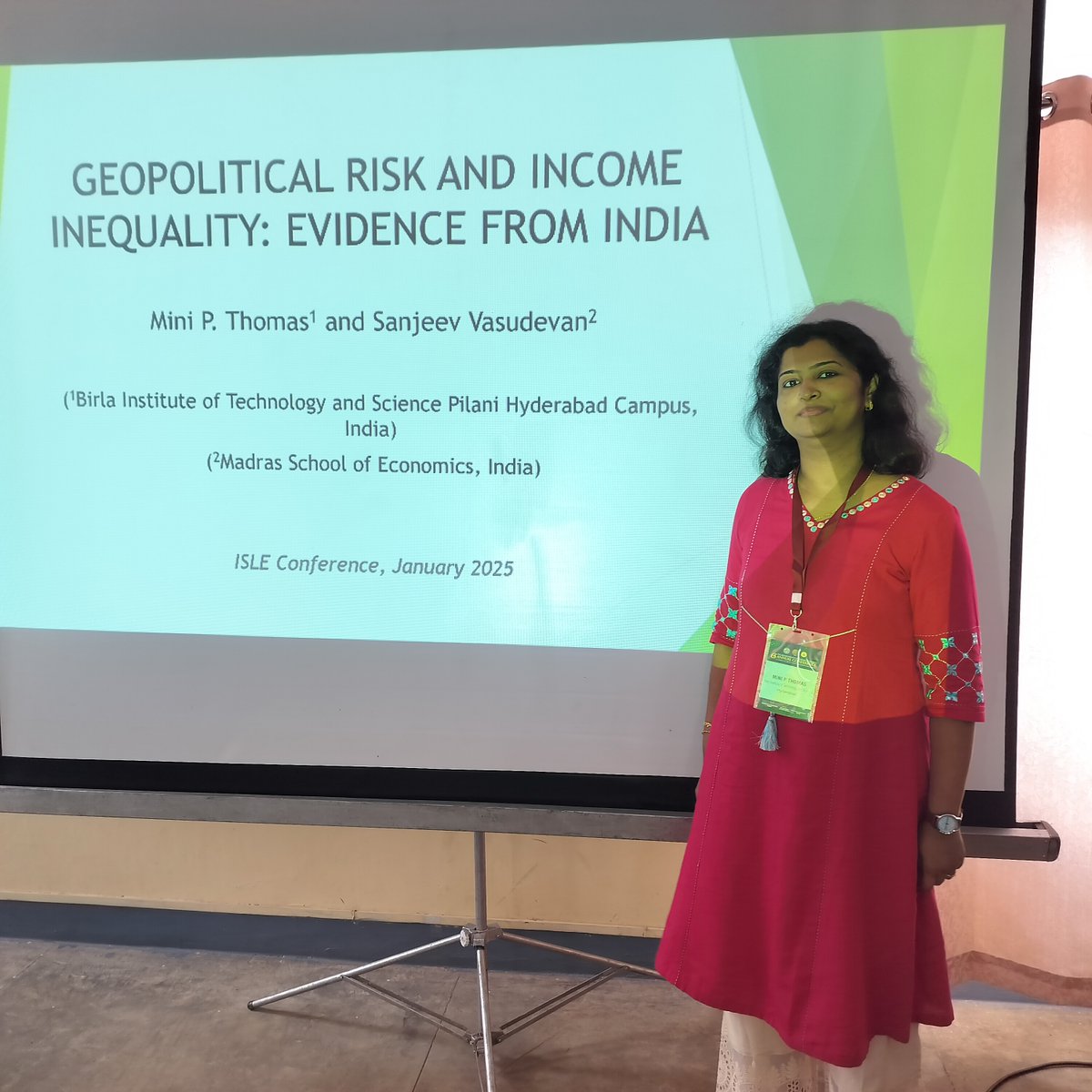
We invite you as we welcome our faculty, Prof. @minithomasp_phd to discuss her work titled "Geopolitical Risk and Income Inequality: Evidence from India" for our #MonthlySeminarSeries today from 12 p.m.
Please check the details below.
🔗 to join:
https://t.co/7A8QALldFx
@bitshyd
Great being back in @ISECBengaluru for Indian Society of Labour Economics Conference to present our work on inequality. My PhD student, Ummu, was awarded @IWWAGEIFMR fellowship for her thesis work on Trade, Global Value Chains, Finance and Women Employment in BRICS
@isle_india
Developing economies surpass $1 trillion mark in digitally deliverable services exports.
The milestone is an encouraging sign and a clarion call for greater efforts to help ensure that digital trade benefits all for inclusive development.
Full story: https://t.co/MsZDrvE5e3
📢 Important Update:
#ACEF submission deadline EXTENDED !
We are pleased to announce that the submission deadline of ACEF 2025 has been extended to Dec 25, 2024.
We encourage all scholars & researchers to submit their work.
🔗 Conference website: https://t.co/ysPHi8cvXM







![PikettyWIL's tweet photo. 📊The study draws on a new database https://t.co/LIcZ9Q9iCy tracking global trade flows and the balance of payments (goods, services, income, and transfers) across 57 core territories (48 main countries + 9 residual regions) from 1800 to 2025.
Check it out https://t.co/LIcZ9Q9iCy
[2/9]](https://pbs.twimg.com/media/GtAYsEFWIAAASZT.jpg)