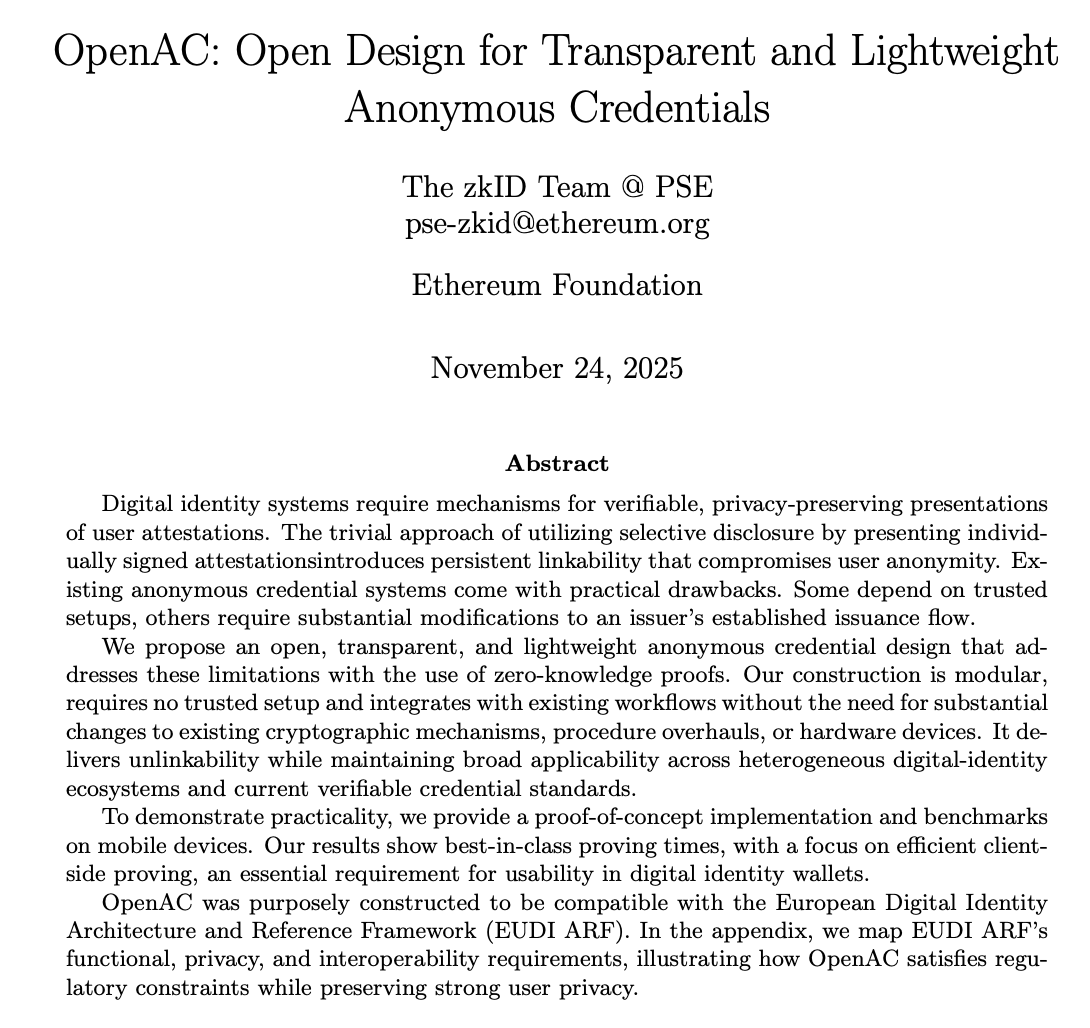
1/ 🌱 The zkID team published OpenAC: Open Design for Transparent and Lightweight Anonymous Credentials earlier this week with a show proof time of 0.129 seconds.
It describes a zero-knowledge identity construction designed to work with existing identity stacks and was purposely constructed to be compatible with the European Digital Identity Architecture and Reference Framework (EUDI ARF).
https://t.co/1T8QxFxuJT
@paulmillr supports most of the web3 front-end through the wide adoption of his excellent noble crypto libraries.
But you can still hear crickets on his github sponsors page: https://t.co/svJRhVqVs0
Go buy him a coffee!
“Everything that once seemed definitively and unquestionably real now seems slightly fake; everything that once seemed slightly fake now has the power and presence of the real. ” https://t.co/qOKxbMazPz
@EmergenceKirk@MetaMask@ensdomains Any L2.
ENS supports defining different addresses for every network.
MetaMask now resolves these network specific address if they were defined, or defaults to the mainnet address otherwise.
I wasn’t going to comment on Sunscreen’s allegations initially, but some people I respect and admire have unfortunately rushed to conclusions without asking me about it first. So here is what actually happened and why we decided to take action.
I find it extremely disheartening that anyone would suggest Zama is a patent troll or a bully. This is an insult to Pascal Paillier, Nigel Smart and all others members of our team who spent decades working on FHE.
We spent years and tens of millions of dollars building our FHE technology. And we have always been transparent about our business model: anyone can use our technology for free for research, prototyping and personal use, but for commercial use a proper commercial license is required. That’s how we are able to publish everything while still having a business. This dual licensing model is very common in open source.
In the 5 years since we founded Zama, we never had any issue with it. There are thousands of developers and researchers using our code for non commercial purposes, and dozens of customers paying us to use it commercially. We have never refused to give a license to someone who asked for it, and we even work with some of our competitors.
The reason people work with us is because we build great products, not because they have no choice. There are plenty of alternatives out there, from other FHE schemes such as CKKS or BGV to other technologies such as MPC, ZK and TEEs.
Now to Sunscreen. We can debate the merits of IP in open source, and I would gladly do so on a X space or podcast. But this is not it, this is a simple case of a company using another company’s technology without a proper license.
For the past couple of years, Sunscreen has been publicly saying in their blog posts, in talks and to investors that they had their own version of FHE that was better than Zama’s. But since none of it was open source, we couldn't actually tell.
During that time however, Sunscreen’s engineers kept asking dozens and dozens of questions on Zama’s developer support channels. Questions about why we implemented things a certain way, or how to modify this or that part of our code base. We thought they were simply trying to run benchmarks to compare, so we helped them by answering their numerous questions. We love when people try to beat us, because it forces us to be even better. We even invite our competitors to talk at our own events!
Earlier this year, Sunscreen published an implementation of TFHE on their github. To our surprise, we found that not only did it replicate the core of our technology (programmable bootstrapping), it even reproduced some bugs we had in a previous implementation!
At this point I tried several times to contact Sunscreen’s CEO, asking her to clarify their intended use of our technology. My purpose here was simple: if she told me this was just for research or benchmarking, then we would be perfectly fine with it. When we finally had a chance to chat however, she told me this wasn’t just for research and that she had plans to use it in a commercial product, at which point I said we should put a commercial partnership in place and have Zama support them. I offered various ways that this partnership could happen: as a customer, as a revenue share partner, as an investor etc. My point here was to give her options.
Eventually Sunscreen made it clear they weren't interested in working together, to which I replied they should then remove our technology from their codebase. I also pointed them to alternative FHE schemes they could use, to make sure they had a fallback. Nobody forced Sunscreen to use our technology, they chose to use it. From this point, they simply stopped responding.
A few days later, without warning, Zama received an official letter from Sunscreen’s lawyers, threatening to sue Zama for “tortious interference with prospective economic advantage and interference with contractual relations under the laws of California (and other jurisdictions)”, and saying that Zama’s patents have no value and that they would not remove it from their products unless we sent them a clear, detailed explanation of where our patents were used in their code. Sunscreen, not Zama, turned this into a legal dispute.
So naturally we answered back through our own lawyers, sending a very detailed explanation showing line by line where their code used our technology, and asking that they stop using it for commercial purposes. We also asked that they stop lying publicly about benchmarks, as this is simply false marketing and detrimental to Zama and the entire space.
So yes, we do think we have the right to defend ourselves against a company that appropriates our work as their own, makes blatantly false claims about it and sends us their lawyers instead of trying to solve this amicably.
If Sunscreen wants to solve this, it’s very simple:
- Either they get a proper license
- Or they make it clear it’s purely for research purposes
- Or they stop using our technology commercially and use one of the many existing alternatives
https://t.co/TWpUIJ7YkJ
Starting an ERC for a new wallet_connect RPC and I invite all to join the discussion!
Focusing initial scope on simple connection and modular capabilities. Defines the first capability for SIWE to unify connect+authenticate actions.
Finally, an impersonator. Feels like a milestone. Can’t report to X because they want some doxxing.
Npm is also getting filled with typosquat forks of noble which steal private keys. Support also ignores it.
Be careful out there!
This 👇
@gnosischain is absurdly cheap, has great tooling, has a useful governance token, is decentralized and censorship-resistant…
I’m not neutral when it comes to core values. If a project hits the mark, I’m gonna openly support it.