Doctors found a way to destroy tumors using water and sound.
The revolutionary, FDA-approved cancer treatment called histotripsy is destroying tumors using only sound waves and water, bypassing the need for incisions or radiation.
The procedure utilizes high-energy, focused ultrasound waves transmitted through degassed water to target and instantly rupture cancer cells.
Unlike traditional surgeries, this non-invasive approach leaves the surrounding healthy tissue completely unharmed, offering patients a painless treatment option with virtually no recovery time.
Early studies even suggest that the liquefied tumor debris left behind may stimulate the body's natural immune response, helping it better identify and fight off remaining cancer cells.
The real-world impact of histotripsy is already being realized by patients like Chris Donaldson, who was left with limited options after his ocular melanoma metastasized to his liver.
After undergoing the procedure pioneered at Providence Mission Hospital, Donaldson's liver has remained completely cancer-free, giving him a renewed lease on life. As clinical trials continue to show a staggering 95.5% success rate for treating liver tumors, medical experts are optimistic that this robotic-assisted technology will soon be adapted to combat other cancers, including breast and thyroid tumors, making it a powerful new tool in modern medicine.
source: Dador, D. Histotripsy treatment kills cancer cells with sound. ABC7 Eyewitness News.
BREAKING: JWST Just Found Oxygen in the Infant Universe The James Webb Space Telescope has done it again — and this time it’s rewriting the story of cosmic chemistry.Astronomers have detected oxygen in a galaxy that existed just 300 million years after the Big Bang. This is one of the earliest sightings of heavy elements ever recorded, pushing our understanding of the early universe to its limits.Why This Is Huge:Stars lived fast and died young. For oxygen to already exist, the very first generations of massive stars must have formed, fused heavy elements in their cores, exploded as supernovae, and seeded the galaxy with oxygen — all in a cosmic blink of an eye. Much faster than previous models predicted.
The universe got “polluted” earlier than we thought. Heavy elements (anything heavier than helium) are the building blocks of planets, rocks… and life. Finding oxygen this early shows the cosmos was already chemically rich when it was still a toddler.
Major challenge to existing theories. Astronomers will now have to rethink how quickly galaxies assembled and how rapidly star formation raged in the first few hundred million years.
This discovery highlights JWST’s unmatched superpower: the ability to peer deeper into cosmic history than ever before, revealing secrets from when the universe was less than 3% of its current age.The more we look, the more we realize — the early universe was far more dynamic, violent, and productive than anyone imagined.JWST isn’t just taking pretty pictures. It’s forcing us to rewrite the textbooks of cosmic evolution. And this is only the beginning.
World’s highest IQ record holder just dropped a bombshell on X.
Dr. YoungHoon Kim (IQ 276 — officially recognized by Guinness World Records and Giga Society) declared:
“As the world’s highest IQ record holder, I believe that Jesus Christ is God, the way and the truth and the life.”
When skeptics pushed back, the 36-year-old South Korean neuroscientist replied with powerful simplicity: “Amen. Christ is my logic.”
He went further: “The Bible doesn’t need to be updated. The world needs to catch up.”
Now with over 14 million views, Dr. Kim is using his platform to lead souls to God — proving that true intelligence doesn’t run from the Cross.
It kneels before it.
Details in comments 👇
#JesusIsLord #FaithAndReason #HighestIQ #BibleTruth #ChristIsKing
🚨 James Webb confirms there's something seriously wrong with our understanding of the universe:
In a striking discovery, James Webb and Hubble space telescopes have confirmed that the universe is expanding at varying rates depending on the observation point, which challenges our current understanding of the cosmos.
This discrepancy is known as the Hubble Tension. It was first observed by the Hubble Space Telescope in 2019 and further confirmed by the James Webb Space Telescope in 2023, with recent combined efforts by both telescopes now eliminating any doubts about measurement errors.
The Hubble Tension arises from a conflict between two ways of measuring the universe's expansion rate.
One method looks at the early universe, relying on the cosmic microwave background—the ancient afterglow of the Big Bang—to calculate the expected expansion.
The other method focuses on the more recent universe, utilizing telescopes to observe stars and galaxies. The problem is, these two methods are yielding vastly different results. It's as if the universe has subtly changed its rules between its infancy and the present day.
By observing over a thousand Cepheid stars in galaxies up to 130 million light-years away, the researchers have confirmed the reliability of Hubble's measurements across the cosmic distance ladder, thus ruling out measurement error as a cause for the Hubble Tension and suggesting a profound mystery at the core of our understanding of the universe's expansion.
The study was published in Astrophysical Journal Letters.
🚨 Scientists Just Taught a Quantum Computer to Read Life
A team of researchers has achieved something incredible—they translated an entire viral genome into a format a quantum computer can understand.
Why does this matter? Quantum computers can process information in ways that traditional computers can't, potentially helping scientists unlock genetic secrets, track mutations, and develop new treatments much faster.
This is the first major step toward combining quantum computing and genetics—two technologies that could transform medicine forever.
The real mystery is: what hidden secrets of life might quantum computers reveal next?
Source: University of the Basque Country. Scientists translate a complete viral genome into quantum language. ScienceDaily.
Ray Kurzweil, Director of Engineering at Google, on the year humans will stop aging faster than science can reverse it:
He is one of the most prominent futurists in tech, and he believes that year is closer than most people think.
He explains the core concept:
"By around 2032, people who are diligent with their health are going to reach what we call longevity escape velocity. This is when scientific breakthroughs will add more time to our remaining life expectancy than is going by."
In other words, for every year that passes, science could be adding more than a year back to your life expectancy.
"So we could be going backwards in time as far as our health is concerned."
Kurzweil sees this transformation as part of a larger shift in what it means to be human:
"As we emerge with AI in this way, we will become a hybrid species. We will still be human but will be enhanced by AI."
The mechanism that makes this possible?
AI's ability to process biological complexity at a scale humans never could:
"We'll soon have the ability to rapidly test billions of possible molecular sequences to find cures ultimately for all diseases."
For Kurzweil, this isn't about chasing immortality for its own sake.
He frames overcoming biological limits as a continuation of something humanity has always done:
"Overcoming the limitations of biology is not a new story."
His personal motivation is refreshingly simple:
"It's for why I want to live indefinitely because I want to see my loved ones and I want to continue working on my creative projects. I don't see a time when I would not feel that way."
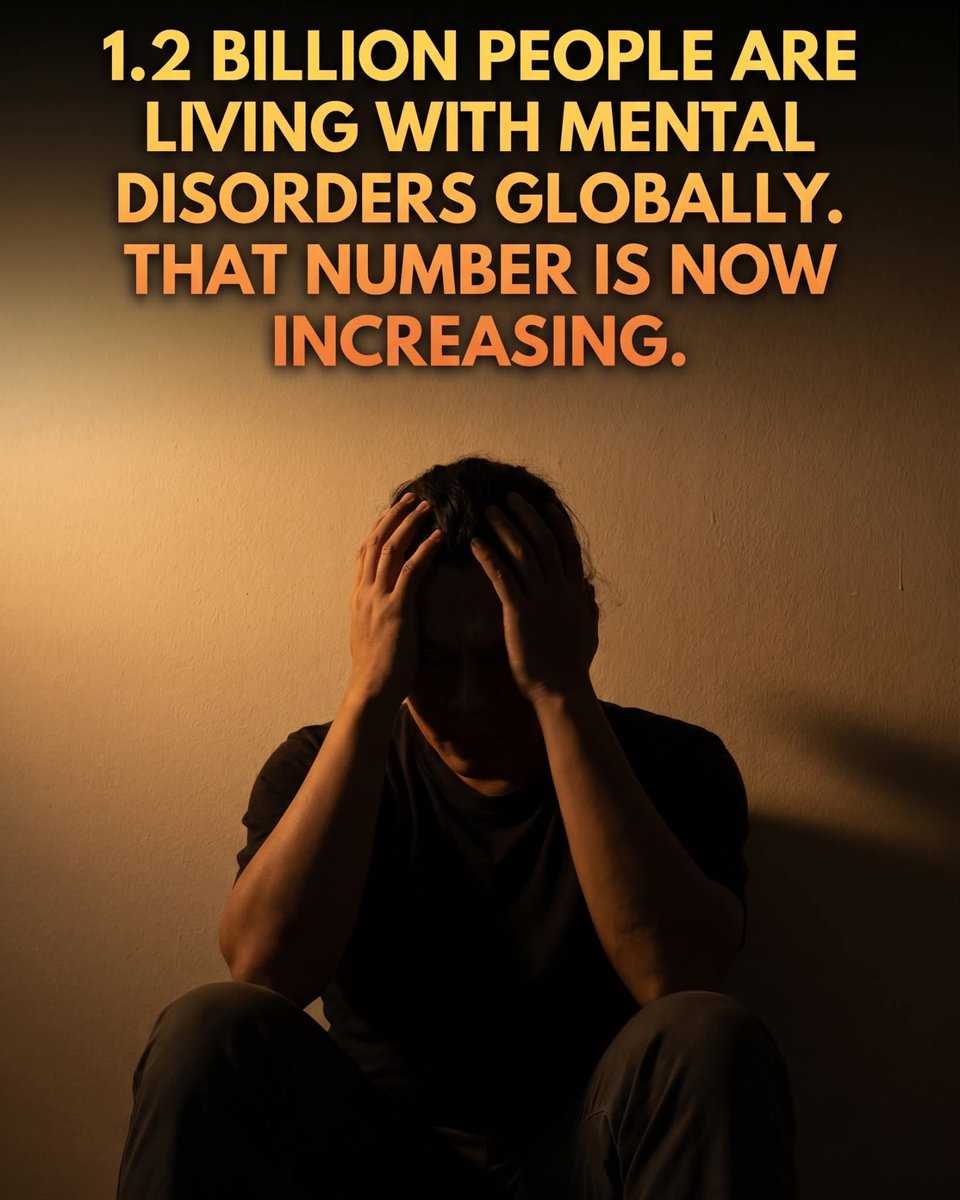
Over 1 billion people are now living with a mental health disorder.
In the United States, approximately 40% of high school students reported persistent feelings of sadness or hopelessness, while one in five adults currently lives with a mental health condition.
The alarming increase since 1990 is primarily driven by a dramatic surge in anxiety and depression, which rose by 158% and 131% respectively. While population growth and improved diagnostics contribute to these figures, researchers warn that the world is entering a concerning new phase of psychological burden that has become a leading cause of disability worldwide, often surpassing chronic physical illnesses in its societal impact.
The demographic shift is particularly stark among youth; for the first time in recorded history, the peak burden of mental illness has shifted to teenagers aged 15 to 19. Experts attribute this rise to a "perfect storm" of factors, including the lingering social disruptions of the pandemic, economic instability, and environmental stressors. As healthcare systems reach their breaking points, the findings underscore an urgent need for global leadership to prioritize mental health as a primary pillar of public health to protect the well-being of future generations.
source: K Rodgers. “Nearly 1.2 billion people worldwide are living with mental disorders. The number has been growing” (May 2026) CNN.
GBD 2023 Mental Disorders Collaborators. (2024). Global, regional, and national burden of mental disorders: A systematic analysis for the Global Burden of Disease Study 2023. The Lancet Psychiatry.
New research shows depression and anxiety may be "contagious" through oral bacteria.
A 2025 study involving 268 newlywed couples suggests that mental health is more than just a personal struggle—it might be microbially transferable.
Researchers tracked couples where one partner suffered from depression or anxiety while the other was healthy. Within just six months of marriage, previously healthy spouses began showing significant increases in mental health symptoms and sleep disturbances.
The study found that regular physical intimacy, such as kissing and sharing meals, allows for the exchange of millions of bacteria, gradually shifting the healthy partner’s oral microbiome to mirror their affected spouse’s.
This biological transformation involves specific bacterial families like Clostridia and Veillonella, which have been previously linked to brain disorders. Lead researcher Reza Rastmanesh noted that women appear particularly susceptible to these bacterial shifts and the subsequent psychological changes. Beyond mood shifts, healthy spouses also experienced rising cortisol levels, indicating that their stress-response systems were being physiologically activated. These findings mirror animal studies where mental health traits were transferred via bacterial transplants, suggesting our psychological well-being is deeply influenced by the microscopic communities we share with those closest to us.
source: Rastmanesh, R. (2025). Oral microbiota transmission between individuals in close contact partially mediates symptoms of depression and anxiety. Exploratory Research and Hypothesis in Medicine.
Good morning, from Canada.
This rainbow was a spectacular double arch, uncannily bright, but what I love best was how the rainbow's end silhouetted our rippling flag. The Maple Leaf, Forever.
The moment the rockets fire, to cushion impact with Earth.
Six nitroglycerine rockets are triggered by a gamma-ray altimeter to fire just before we hit. Inside, we're strapped into crash seats, raised on shock absorbers.
Even still it's wildly violent, like 2 quick car crashes in a row (rocket blast, then impact). And if the wind is blowing us sideways, our Soyuz capsule tumbles end-over-end.
After 6 months of graceful weightlessness, it's a rude (but reliable) welcome home. Sometimes it starts a grass fire...
(photo from Mi-8 helo: @ingallsimages@nasa)