Anthropic engineer:
"You can build 5 assistants in one afternoon. Each one handles a task you've been doing manually every single day."
In 45 minutes he shows exactly how to do it from scratch, step by step.
Most people are still doing all of this by hand.
Watch the session, then save the guide below.
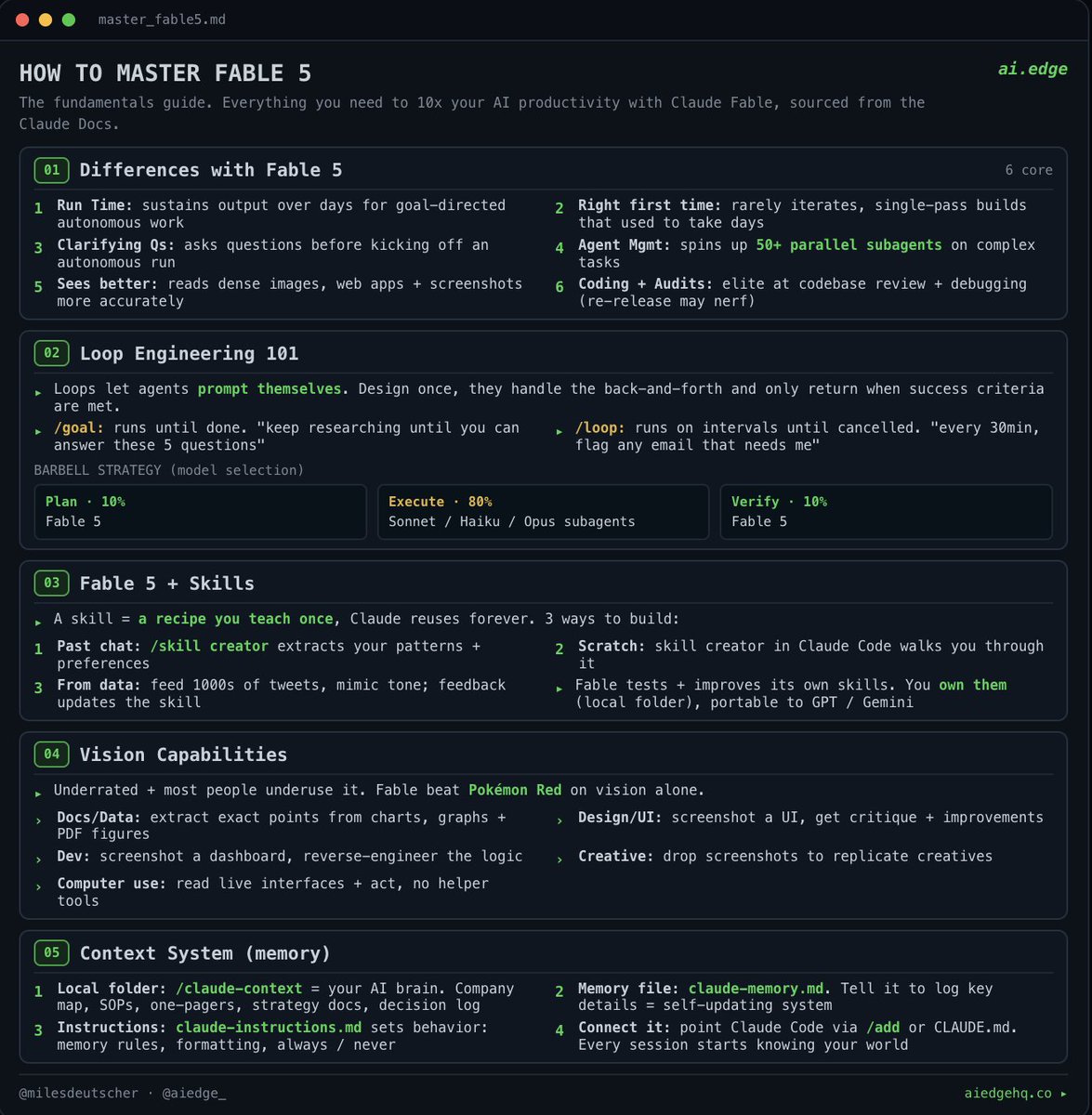
The re-release of Fable 5 is probably the greatest thing to ever happen in AI.
I spent the last few hours putting together an ultimate guide to help you master Fable.
Key model differences, loop engineering 101, Fable + Skills, how to build a context memory system & more:
Opus 4.7 feels more intelligent, agentic, and precise than 4.6. It took a few days for me to learn how to work with it effectively, to fully take advantage of its new capabilities.
Will post a few more tips throughout the day, starting with this blog post: https://t.co/XQrH8P28yo
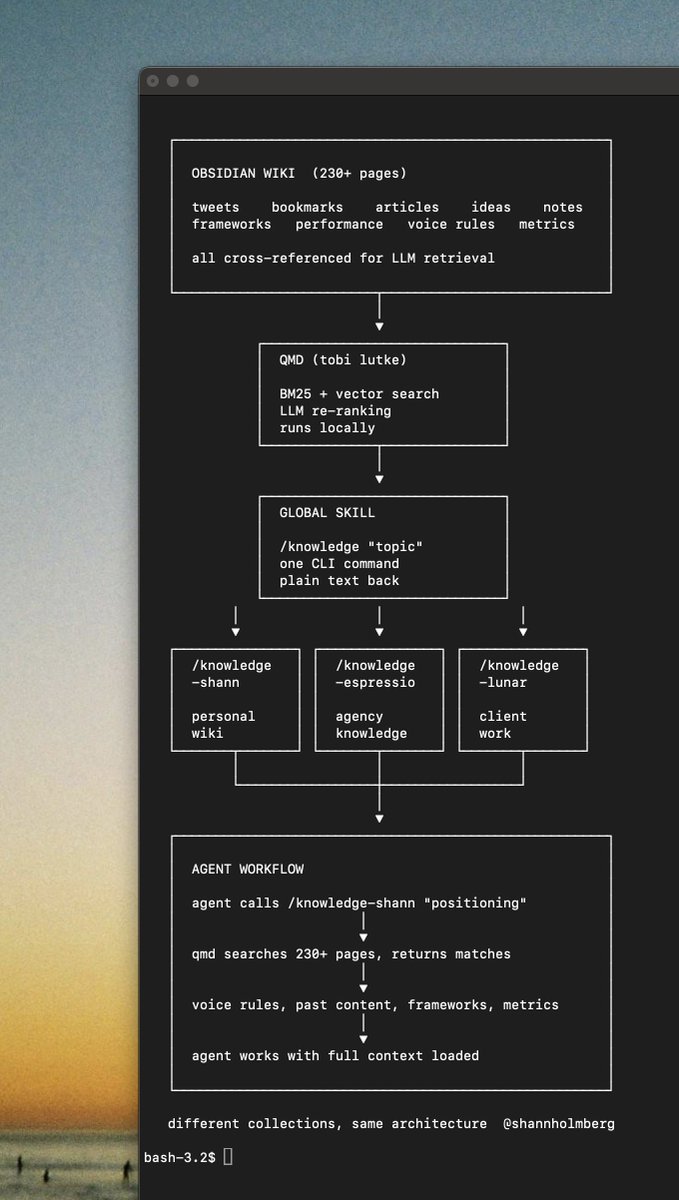
I connected my knowledge base to every project I work on. every agent reads my wiki before doing anything
I built a knowledge base in obsidian with 230+ pages. my tweets, bookmarks, articles, ideas, notes, all compiled into structured wiki pages with cross-references
the knowledge only worked when I was inside that folder. if I started a new project or opened a different codebase, the agent had no idea what I know or how I think
so I set up qmd (by tobi lutke) to index the wiki. hybrid BM25 + vector search with LLM re-ranking, runs locally. then I wrote a global skill that any agent in any project can call
now before an agent starts brainstorming, planning, or writing, it searches my entire knowledge base first. voice rules, content performance data, frameworks, past thinking on the topic
1. agent in any project calls /knowledge-shann "topic"
2. qmd hybrid-searches 230+ wiki pages
3. returns relevant concept pages, source summaries, and metrics
4. agent reads brand foundation (banned AI words, visual style, voice rules)
5. agent starts working with that context loaded
the same pattern works for company knowledge bases too. /knowledge-espressio for agency knowledge, /knowledge-lunar for client work. different collections, same architecture
the whole knowledge layer is just markdown files indexed by qmd. one CLI command, plain text back. token efficient and works with any agent that can run bash
LLM Knowledge Bases
Something I'm finding very useful recently: using LLMs to build personal knowledge bases for various topics of research interest. In this way, a large fraction of my recent token throughput is going less into manipulating code, and more into manipulating knowledge (stored as markdown and images). The latest LLMs are quite good at it. So:
Data ingest:
I index source documents (articles, papers, repos, datasets, images, etc.) into a raw/ directory, then I use an LLM to incrementally "compile" a wiki, which is just a collection of .md files in a directory structure. The wiki includes summaries of all the data in raw/, backlinks, and then it categorizes data into concepts, writes articles for them, and links them all. To convert web articles into .md files I like to use the Obsidian Web Clipper extension, and then I also use a hotkey to download all the related images to local so that my LLM can easily reference them.
IDE:
I use Obsidian as the IDE "frontend" where I can view the raw data, the the compiled wiki, and the derived visualizations. Important to note that the LLM writes and maintains all of the data of the wiki, I rarely touch it directly. I've played with a few Obsidian plugins to render and view data in other ways (e.g. Marp for slides).
Q&A:
Where things get interesting is that once your wiki is big enough (e.g. mine on some recent research is ~100 articles and ~400K words), you can ask your LLM agent all kinds of complex questions against the wiki, and it will go off, research the answers, etc. I thought I had to reach for fancy RAG, but the LLM has been pretty good about auto-maintaining index files and brief summaries of all the documents and it reads all the important related data fairly easily at this ~small scale.
Output:
Instead of getting answers in text/terminal, I like to have it render markdown files for me, or slide shows (Marp format), or matplotlib images, all of which I then view again in Obsidian. You can imagine many other visual output formats depending on the query. Often, I end up "filing" the outputs back into the wiki to enhance it for further queries. So my own explorations and queries always "add up" in the knowledge base.
Linting:
I've run some LLM "health checks" over the wiki to e.g. find inconsistent data, impute missing data (with web searchers), find interesting connections for new article candidates, etc., to incrementally clean up the wiki and enhance its overall data integrity. The LLMs are quite good at suggesting further questions to ask and look into.
Extra tools:
I find myself developing additional tools to process the data, e.g. I vibe coded a small and naive search engine over the wiki, which I both use directly (in a web ui), but more often I want to hand it off to an LLM via CLI as a tool for larger queries.
Further explorations:
As the repo grows, the natural desire is to also think about synthetic data generation + finetuning to have your LLM "know" the data in its weights instead of just context windows.
TLDR: raw data from a given number of sources is collected, then compiled by an LLM into a .md wiki, then operated on by various CLIs by the LLM to do Q&A and to incrementally enhance the wiki, and all of it viewable in Obsidian. You rarely ever write or edit the wiki manually, it's the domain of the LLM. I think there is room here for an incredible new product instead of a hacky collection of scripts.