Small business owner (bought the business in Aug 2025) | Spent last 9 years before that leading teams at a large manufacturing company. I love adventure.
Today marks 3 months since I bought a small business - and I'm having a blast!!
Despite the business being very small (just a few employees) with a lot of key man risk, nobody has left and things are going really well!
We just hit record months for revenue in September and October; the biggest driver is that we've been saying "yes" to most jobs that come in (the previous owner was more selective about jobs he wanted to take on based on difficulty, location, etc).
When I first looked at the business I had the same thought many others did: this is pretty small and there is a lot of key man risk! I decided to dig deeper though because I was very curious about the industry - and there were a lot of things I liked about it. I also found that I could trust the seller which is a big deal.
I ultimately decided that this is work I would enjoy doing as a technician and could learn quickly, and as long as I could quickly learn the technician role and therefore be able to train others, I would be able to mitigate the majority of the key man risk. Worst case, everyone leaves - but I've learned the tricks of the trade and can hire others - and we have a phone that keeps ringing consistently every day because of 15 years of momentum and steady referrals.
Turns out, I was right with my decision and things have gone really well despite a wide range of potential outcomes. There was some luck involved, but also a lot of self awareness of what is the right fit for me and what I would excel doing.
I recently got a new cargo van set up, and in addition to the 2 other technicians I'm now splitting time between going out to do jobs and doing desk work (marketing, etc). I love having a balance of both and being able to get out and work with my hands (while being paid well to do it). And I'm very excited to improve a long list of things and see how much this business can grow!
Some of the easy wins so far I've found are:
- Just saying "yes"! Even if the job might be a bit more difficult, if you price it right - why not give it a shot?! We've landed way more jobs, especially big commercial jobs because of this which moved the needle a ton.
- Delegating more - previously the owner quoted all commercial jobs, which caused a lot of delays and friction for the customer playing phone tag. I realized my office admin knows enough to quote the jobs and wanted to do it, so I let her - and she is doing great! The customer experience is so much better now because they get a quote immediately when they call and can book the job right away.
- Pausing Google PPC ads when we had more than enough phone calls to keep us busy and after realizing the ROI wasn't very good, and they only brought in ~5% of overall calls ($4K/mo savings). Now that things are slightly slower I'm experimenting with turning ads back on at a lower budget, but I'm not convinced they are a great scalable long term solution for leads. We get really healthy organic traffic from GBPs and plumber referrals.
- Turning off "instapay" in HousecallPro that sent credit card payments to us instantly vs 1-2 days via ACH. I'm happy to save 1% of revenue by waiting a day or two!
- Realizing one of the techs was manually entering credit card numbers because his card reader wasn't working, which has a processing fee that is almost 1% more. After updating the software, we are now saving that money!
- Listening to team members - from what matters to them for compensation to ideas they have to make things more efficient, they are glad to have someone who listens and I've implemented a number of changes based on their feedback. Don't be afraid to change things, especially if the team suggests the changes!
- Asking for Google reviews more consistently and rewarding the team for them. We had a competition in October with a cash reward for the person with the most reviews, and now I've set up an ongoing program to reward each review.
I'm working a lot of hours right now even though I could do way less - I'm just so excited to put the pedal to the metal and really fine tune this machine! It doesn't feel like work, it's honestly a lot of fun. And having the flexibility to be home some days when I want and be at things that matter for my family is priceless.
There have been some small bumps along the way, but in general I feel very lucky that things have all come together relatively well. If you are considering this path, just make sure you can be comfortable doing every role in the company if needed - and if you would enjoy those roles, even better! You just may have a blast.
I'm super excited to announce that yesterday I bought a local small business, after searching for a bit over a year for the right fit.
The business services a niche within plumbing, and has a lot of great characteristics (steady demand, minimal seasonality, lower overhead, etc). More importantly, it is a business that is a great fit for my interests and the type of life I want.
Read on for some background of my journey and lessons learned in case it helps anyone:
Over the last year few years, I caught the "actively-create-your-own life bug" (a condition described by my friend @OneManLBO): once you start re-thinking your career path to better suit your lifestyle, you take some risk in pursuit of a greater goal and it starts to spread to other areas of your life. I love the momentum this mentality brings - and to re-think what your life can look like if you start with a blank slate (where you live, how your kids are educated and raised, etc).
Even though searching for a business is a bit of a rollercoaster, I've really enjoyed being around my family a lot more the last year and re-thinking everything about how I can design my career around my family and the things I care about most.
I grew up working in my family's business maintaining apartment buildings; the work was often dirty and unappealing on the surface but looking back, I learned some incredibly valuable skills across a number of trades (plumbing, electrical, roofing, painting, landscaping, construction, etc). I learned the value of hard work too - my dad always joked that 12 hours is only half a day's work, and working side by side with him we always stayed as long as it took to get the job done.
I really want my kids to also learn the value of hard work, entrepreneurship, and to learn valuable skills like I did growing up. My most recent position leading teams at Boeing was a great learning experience but ultimately wasn't helping me achieve my goals of greater flexibility to be with my family and be more involved in teaching them valuable skills.
Most importantly, I want to teach my kids to learn how to learn - and be curious and adaptable to whatever comes their way, especially in this new world where AI and other technologies are rapidly changing everything.
When I wasn't working in our family business, I've been an entrepreneur on and off through high school, college, and later jumping in full time to start a motorcycle parts business which was quite a fun adventure. The parts business wasn't a home run financially, but taught me so much - and also exposed me to a lot of areas where I needed to learn & grow more.
I went back to school and got an MBA & Master's in Industrial Engineering, which was a helpful career pivot and led me to an interesting management rotation program at Boeing. After leading teams across many functions at Boeing (manufacturing, quality, engineering, supply chain) for ~9 years I became a better leader and learned how to manage complex operations - but couldn't get rid of that itch to get back to entrepreneurship.
Knowing that I needed to change course and find something that was a better fit for my life goals, I looked at a ton of options - ultimately deciding I needed to either buy a business, start one from scratch, or buy into a franchise to accelerate the startup process.
I had heard about "search funds" from a few classmates at the University of Michigan that left to buy businesses right after their MBA program (getting paid to search for a year or two by investors), and the idea was intriguing but intimidating at the time (especially since they were often buying somewhat larger businesses with a large amount of debt, working with investors, etc). After seeing some great posts on X about buying businesses, especially the possibility of doing it with the help of an SBA loan and not needing investors, I decided it was worth exploring.
On my commute to work I listened to the audio books Buy then Build, the HBR Guide to Buying a Small Business, and many episodes of the Acquiring Minds podcast. The concept felt mostly doable but I attended
@SMBootcamp_ (a great 3-day training program that also offers a few different formats), and that was the final piece that gave me the confidence and knowledge to really dive in and quit my job to search for a business full time. I made some great friends there that have been part of my accountability group to encourage each other on through the process - definitely a game changer.
Along with that, finding others also on this journey through Searchfunder and local meetups like the ones hosted by @guessworkinvest have really helped me learn the process and get questions answered along the way.
Here are some of my top takeaways about the search process (I'll post more about these in the future):
Deciding to search full time vs part time is a tough decision and depends on your personal circumstances, but for me it made sense to search full time since I had enough saved up to have a long runway without working - and my job was very demanding and not flexible to do anything search-related during the day (talking with brokers, sellers, etc). I'm glad I went all-in and burned the boats.
Get term life insurance early on - it can take over a month to set up (mine took almost 2), and is required for SBA loans (matching the amount of the loan). You can take out a 10 year term life insurance policy for an amount above the size of a loan you think you may take out (assuming you are doing an SBA 7a loan with a 10 year term - deals with real estate can qualify for 25), and then later assign the policy to the lender for only the amount of the loan. Doing this early prevents scrambling to do it in the middle of due diligence, and helps you take your time to look around for the best rates (which can vary wildly, especially if you have adrenaline junky hobbies like me).
Take out a HELOC on your house early on if you have much available equity, while you still have a W2 job and can easily qualify. This can help with liquidity towards your deal or at least be a great safety net (that's the way I'm using it). Some lenders won't take a lien on your home if there is <15-20% equity in your home available after the HELOC (ask them about it early on though, don't wait to find out when it is deep in underwriting).
The number of buyers is increasing, and things are getting competitive which generally increases prices (sometimes to the point that deals don't pencil very well) - so be ready to pivot to starting a business or something else if you aren't getting traction after a while (I figured I'd re-assess around the 1 year mark if I wasn't making good progress). Luckily my deal was on the smaller side with a lower purchase price multiple - and I wasn't competing with as many others on it (but I knew I'd be jumping right in and actively building something small rather than overseeing a larger operation that is less owner-dependent).
The industry you choose really matters - be open minded to many industries to keep up your lead flow, but score industries you see against attributes that are important to you and make a list of your top handful of industries to prioritize that have good tailwinds & stability. Also, make sure they are a good fit for you & your interests/experience!
Find a solid support team, local is helpful if possible but get referrals, and look for a track record of responsiveness & experience in these types of deals:
- Lender (look at more than just rate; their track record of closing on time and being good to work with are key)
- Attorney
- CPA
- Insurance broker
- Local peers
- Small peer accountability group to check in with every week or two
- Bootcamp/mastermind or other learning resources (podcasts etc) from those that have done it already
Insurance takes a long time to get set up, start early on it! Best option is often re-using the existing insurance plans but even that can take many weeks to re-establish under a new entity in an asset sale.
The due diligence process is more about project management than being a finance expert - you can get help from others on the technical stuff! There is surprisingly not a lot of detailed info out there about how to think through the due diligence/closing timeline, dependencies, etc. For an organized person that likes to have at least a semblance of a plan, it was a rollercoaster having to react to things when I found out new details of the loan process at the last minute (could have been avoided with better communication from the lender). I may post more in the future about some of the dependencies because it is so key to getting a deal done on time.
The timing of the announcement to employees and day 1 activities is important; there isn't a single right way to do it, but get perspectives from a lot of people that have bought businesses to learn what worked for them and adapt that feedback to your situation. No matter what, the news will be a bit of a shock to employees. Choosing a lender that is local and can close the loan docs and fund the same day takes away the anxiety & ambiguity of not being able to fully transition accounts, etc right away.
If you choose to take on investors, there are an increasing number of them focusing on small businesses now and it's a much more accessible option than it was a few years ago. Don't be scared of it if it makes sense for your deal to pencil out with enough liquidity!
This community has been super helpful and open - I'm glad to be a part of it and I'm happy to help others trying to figure it out! Just reach out if I can help in any way.
Same here - no shame in building a "lifestyle business"; to me the whole point is to figure out what you want in life and build a business that supports it.
The biggest shift in my thinking these past few years is one question:
“Am I trying to build the best business, or the best life supported by a business?”
That distinction changed everything for me.
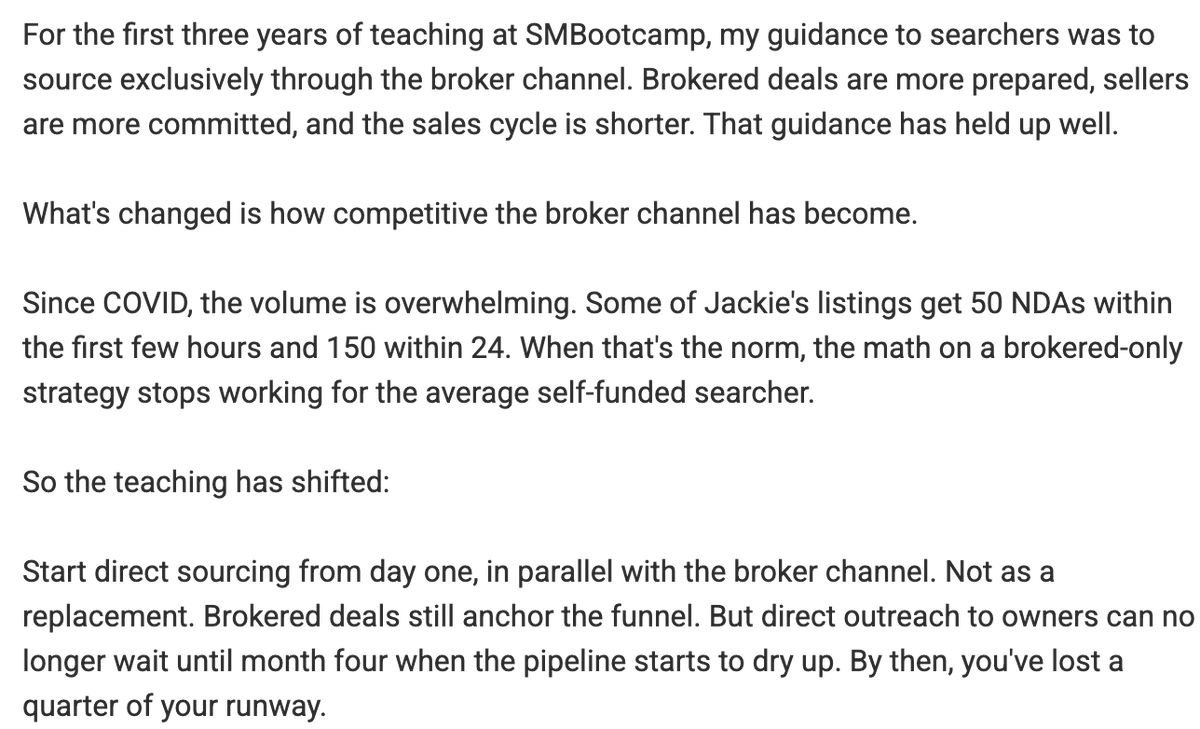
When @Sam_Rosati officially changes guidance and recommends proprietary deal sourcing from day 1 (in conjunction with brokered deals), you listen up
Also, great anecdata from @JackieHirsch_ on deal interest in this market
150 NDAs within 24 hours? INSANITY
(Hearing similar numbers from intermediary contacts here in... IDAHO, not even close to a tier 1 coastal market)
If you think brokers have time for relationship building in the heat of a live deal, you are sorely mistaken. They're just trying to survive and triage.
So proactive relationship building is once again key across both brokered and proprietary sourcing. Highly speculative, highly long-term oriented.
So freaking challenging to make friends and plant seeds. How do you even know how to allocate your limited time anymore?
Which brings me back to one of my core tenets: you need a thesis in this market, whether it's geography or industry focused (I had both last year), so you can even start to understand where you should be making friends and build relationships.
This small business buying game is shifting further and further away from the actual transaction. You need to be so early now. It's almost VC-like in terms of speculating which broker or owner may have a good deal down the road and getting ahead of it, WAY further up in the funnel.
Sourcing timelines are extending, and I know several good and talented people who are in year 3 of searching now.
WELCOME TO ULTRA HARD MODE
@mhp_guy This is good advice. I'm also curious what advice you have for folks that don't want to invite a ton of competition to their niche business. I personally feel like there could be more downsides than upsides to sharing an "undiscovered" niche, but I could be wrong.
@JaredDHardin Totally agree - even though powersports are fun, it's not a good business. I previously started a motorcycle & powersports parts business but it had a lot of headwinds; I'm glad I pivoted a while back and am now in home services.
@therobertbrooks I'm in a similar boat (just on Housecall Pro). If I take the effort to train & optimize a voice agent I want it to be really good and really integrated for multi-channel communication as well (SMS, website chatbot etc). I'm curious who you end up using.
@ToddLlewellyn I'm in the same boat - tough decision. What makes it harder is seasonality, because I feel like rather than continually hiring as things grow, I have to wait and time each hire just right with the next season so I don't get caught with too much capacity in the slower season.
We use HousecallPro and the Force GPS trackers that integrate with HCP; unfortunately Force doesn't have an API. It would be really cool to get time stamps from the start and end of the day from the GPS tracker, may not really need a time clock if you do that (other than tracking lunch breaks). Lots of other possibilities as well.
@HVACSEO Say more - does Google actually know if you answer the phone or not? I would see this being a problem with LSA but does Google "ding" your GBP search placement if you don't answer?
@Atomic_Ferret@ShannonJean Most cities have electronic reading devices attached even to older meters so they don't have to open them to read the meter.