@arjunrajlab 100%. I do my best, when teaching graduates, I ask questions that can be answered from first principles and require almost background knowledge. Unfortunately, their reactions suggest this is quite uncommon in most biology courses.
Yes and no, biotechs already carry out huge data acquisition campaigns, but they never “closed” the research loop. Integrating ai with fast data acquisition (+HITL) is a new modality for research. Scientists need to embrace that (yet, as you probably learned, they tend to be externally conservative)
Extremely important (albeit slow) interview ALL academics, not just mathematicians, should watch on the recent academia/openAI clash (Navier-Stokes proof): https://t.co/aukK4yIWC5
@blekhman The real tsunami will hit academic labs once physical ai (lab automation) catches up. It’s starting in pharma yet universities remain oblivious (instead of opening automation core services rn). 2 years imo. 🤖+💻=🌊
@josarc@markowenmartin@AdrianoAguzzi We have a epilog with a 30w laser. But tbh, anything that cuts 1/4 inch acrylic sheets is fine (the images are from 1/8 sheets). I’d also go for a cutter that can house at least 12x18 inch sheets (and make sure you can connect it to a proper ventilation duct).
My god this is such a good speech that every SWE needs to hear. You know what? Every person should hear it
Keep the happy memories, eyes on the reality, be excited about the future. That’s the best that anyone can do
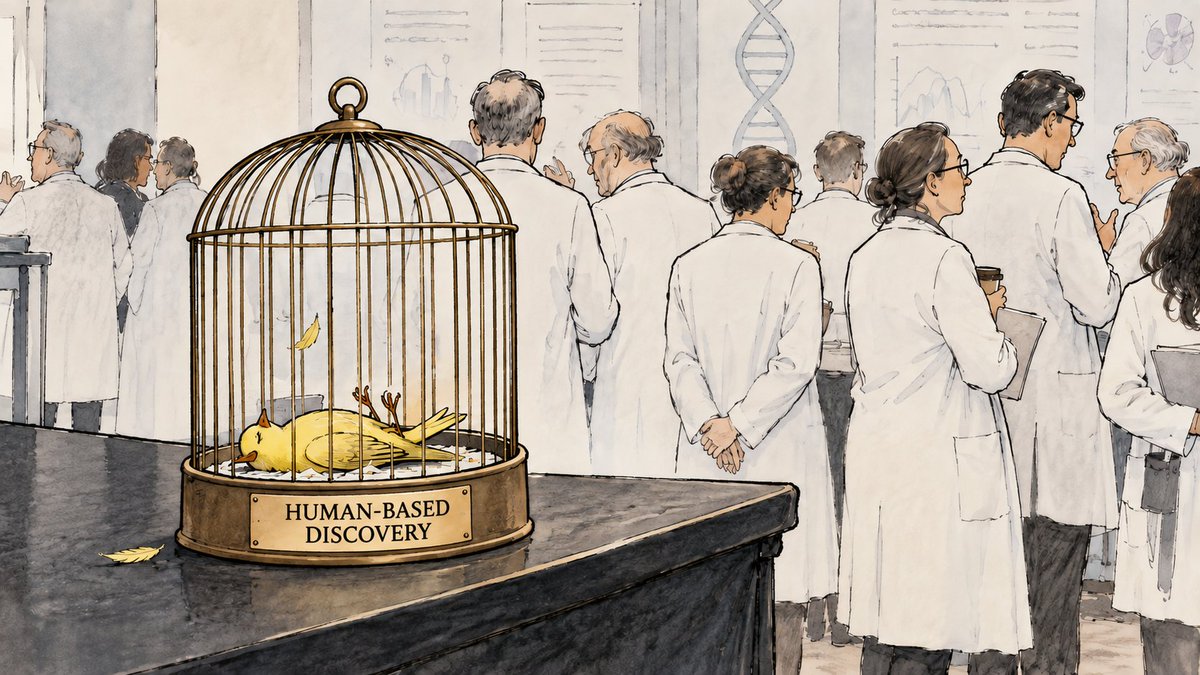
Still unimpressed? Remember the first AI-generated video clips: short, grainy, and full of absurd errors (six-fingered hands). Compare them to clips we can now generate! Now consider this AI-based discovery loop, what will improved loops uncover in biology within a year or two? I think ART is just the canary in the coal mine. (9/9)
IMO @AnthropicAI’s ART discovery is a Sputnik moment for science, yet one that many scientists are maybe too proud to recognize. Would appreciate input (@pdhsu, @ziv_ravid, @zhangf, @nc_frey, @CRISPR_LuCas or anyone else) (1/9)
Now that we see it works, we can let AI-based swarms explore public and private bio datasets and equip them only with broad scientific motivations. If we allow them to pursue unusual observations, they will occasionally make discoveries nobody explicitly asked them to make. For the first time, we can *scale* scientific serendipity! (8/9)