@ketanrama Agreed. I think the closer one gets to negligence on behalf of actual people the better (as someone who disagrees with strict liability) though one might have to modify the fault principles in clever ways to deal with the foreseeability problem.
@ketanrama We are stuck in the taco level of generality problem. What level is the taco? Is it a problem stuck between two regimes? Or perhaps, as you say, we are regulating taco creators
@OrinKerr I have a (long) draft arguing a version of the idea that it was a combination of shifts within views of rationality combined with the elevated status of the founders that made the Scalian combination of rule-based, algorithmic adjudication based on original meaning attractive
@WilliamBaude I wonder if some of this is about whether you read Bruen as more rule-like or more standard-like. I read Bruen as less like a bright-line rule (particularly the “how and why” paragraph on page 20 of the slip opinion) but it seems others read it otherwise.
Thank you! The draft is still available for publication. Many thanks to those who have already offered comments and, of course, more are always welcome.
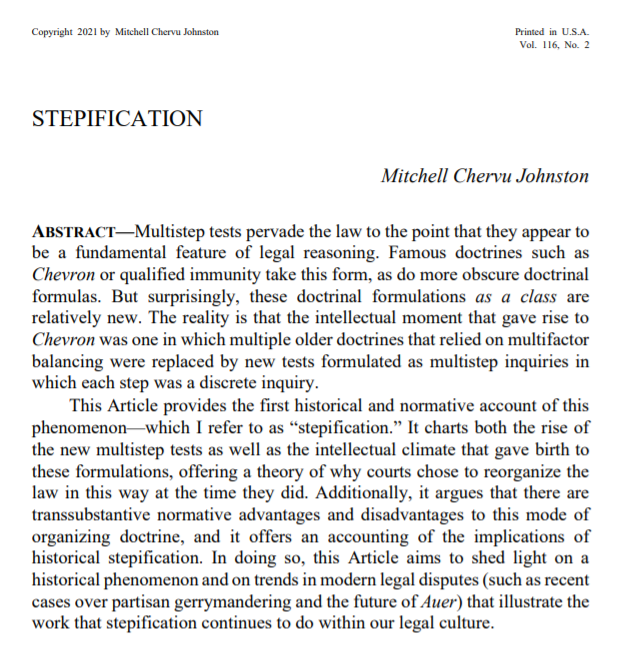
@RichardMRe I'm working on a paper that puts forward a theory that, among other things, attempts to explains this. I think there's something intuitively "lawlike" about Scalia's work (in addition the the rhetoric) that over time some lawyers come to think is artificial or overstated.
@chris_j_walker On top of any constraining effects it also seems like multistep Chevron lends itself to the Court exercising a supervisory function over how it's being applied in the circuit and district courts that wouldn't be present if Skidmore (or even a "no deference" regime") was the norm.
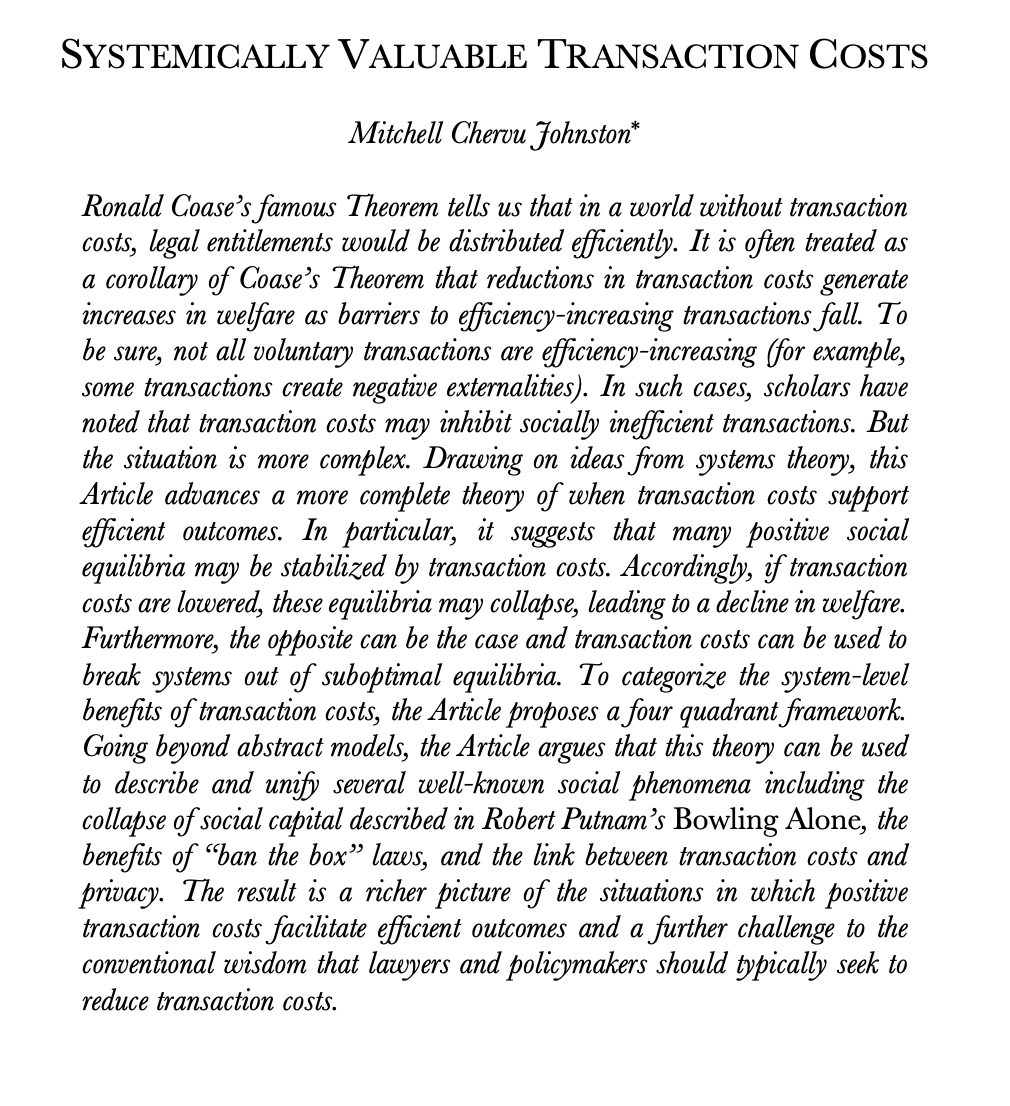
@HoffProf I have a draft that makes this argument in some detail (that I'm happy to share). It's not directly empirical, but it argues that many well-known phenomena fit a "falling TC -> loss of efficiency" and that its possible to microfound the connection in multiple ways.
@HoffProf Positive transaction costs can have valuable emergent/systemic effects in four main ways. As a result, sometimes policy should aim to raise transaction costs to offset other market imperfections (e.g., though not used in the article, offsetting falling contracting costs).
A little belated, but excited to be starting as a fellow with the Project on the Foundations of Private Law at HLS for the next two years. Papers forthcoming (I hope...)!
@RichardMRe@ketanrama I do sometimes wonder why there’s not more interest in varying 2a by requiring sustained majorities over time for higher lawmaking in place of or as an alternative to supermajority rules. That seems like a partial fix to the worry that an ephemeral majority will do damage.
@dfroomkin@samuelmoyn@nikobowie@DaphnaRenan That sounds right to me. I tend to think that formalism was an intellectually attractive response to the Warren Court for a few reasons which matches Bowie/Renan claim. Whereas maybe there was no need for an anti-Lochner formalism when deference was a more attractive answer.
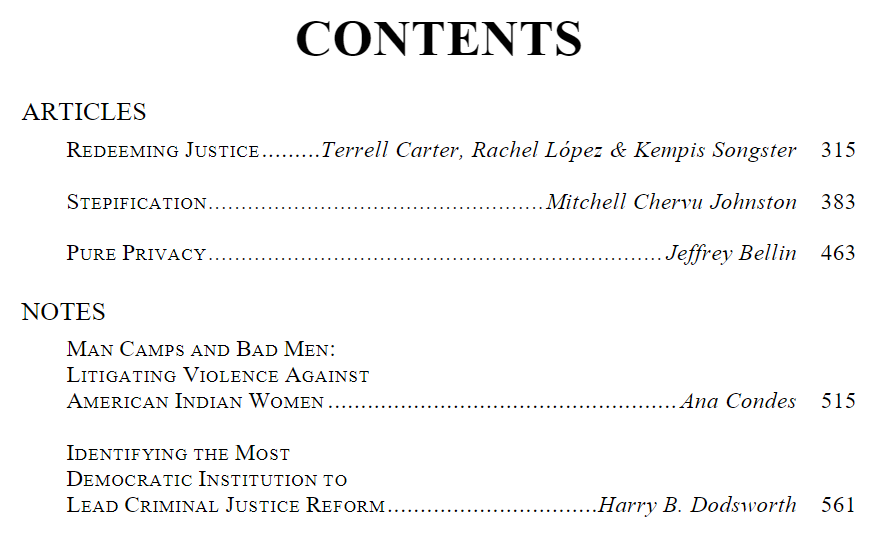
Neat new @NwULRev article "Stepification" by recent law school grad Mitchell Chervu Johnston: https://t.co/rgumiFLwwb
Definitely has a wonderful @EskridgeBill-esque quality to it, but with the author's strong, unique voice as well.
And a very special thanks to @EskridgeBill who encouraged me to transform this idea into a paper for his seminar and pushed me to keep refining it for publication. Some ideas require a push from a trusted Professor; I was very fortunate to have one here.
Very excited to see Stepification now in print with @NwULRev! It was an amazing experience working with the editors whose suggestions made the arguments in the piece stronger and whose careful edits helped me avoid numerous errors. Those that remain are, of course, my own.
📢Vol. 116.2 is FINALLY HERE‼️ We are thrilled to be able to share the fabulous pieces from this Issue with the world. We'll be providing updates throughout the week on Twitter, but if you're dying for a sneak peak,👀 check it out here 👉https://t.co/GYdarNrmHu
A huge thanks to the many people who offered comments, read drafts, and talked with me throughout the process. Since this paper was originally written over two years ago, the support of friends and mentors has been invaluable in transforming it into something publishable.