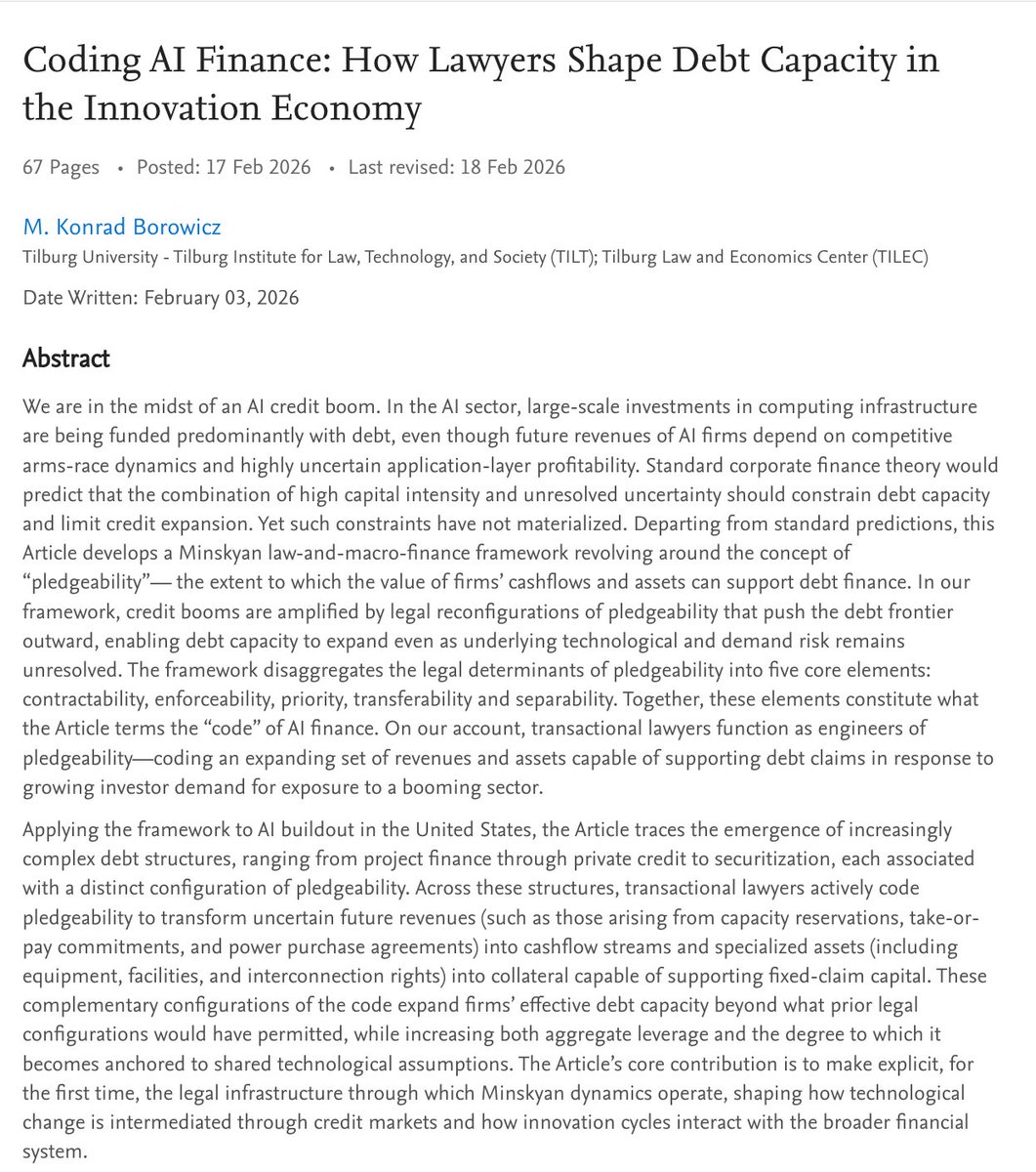
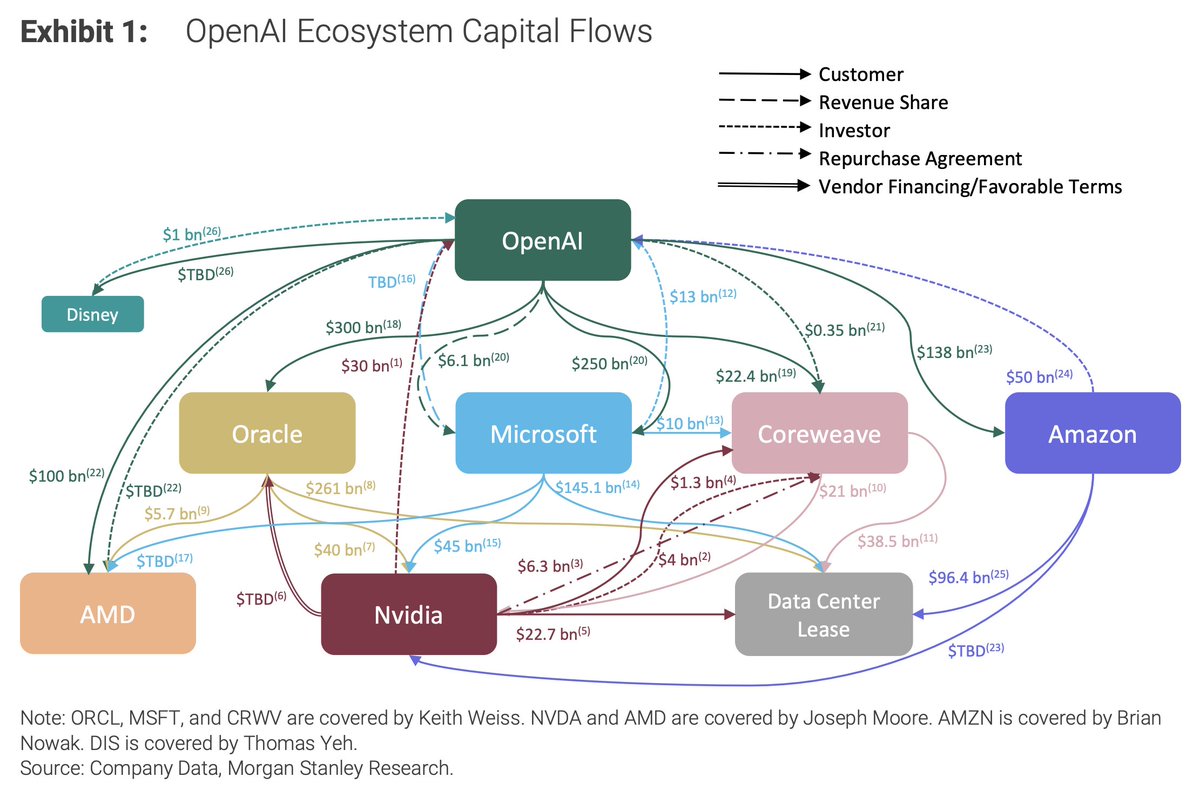
Why is so much of #AI being financed with #debt, when #innovation is typically funded with equity? That is the question I explore in a new paper, which examines the recent wave of AI financing transactions through a law-and-macro-finance lens. Read here https://t.co/u72KpK1xzN
🇳🇱 DUTCH MINISTRY OF FINANCE BREACHED
The Dutch Ministry of Finance has taken its digital portal for Treasury banking offline following a cyberattack.
The downtime has affected hundreds of Dutch public institutions, including ministries, government agencies, educational organizations, social funds, and local governments.
A great piece from Jacques de Larosière, one of the world's leading, most experienced, distinguished & classiest financial diplomats for decades -- "Europe is far from a Hamiltonian moment".👇
https://t.co/M1lK2auNcG
🇪🇺🇳🇱 DUTCH COURT OF AUDITS FINDS "NO UNDERSTANDING" OF EFFECTIVENESS FOR AML APPROACH
The Dutch Court of Audits has published a paper on Anti-Money Laundering (AML) in banking, finding that "there is no understanding of the effectiveness of the anti-money laundering approach."
The paper states that "it is not clear whether the increasing controls by banks actually contribute to the prevention and detection of money laundering," while highlighting the significant costs imposed on banks.
According to the court, AML measures are discriminatory particularly towards people with foreign surnames, stating that the lack of proven effectiveness of the measures "does not establish that this distinction is justified."
The court plans to put its research into EU perspective later this year.
Our new essay is out in Science: "Agentic AI and the Next Intelligence Explosion"
For decades, the AI "singularity" has been imagined as a single, godlike mind bootstrapping itself to omniscience. In this piece with the inimitable Benjamin Bratton (@bratton) and Blaise Agüera y Arcas (@blaiseaguera), we argue this vision is wrong in its most fundamental assumption.
Every prior intelligence explosion—primate sociality, human language, writing, institutions—wasn't an upgrade to individual cognitive hardware. It was the emergence of a new socially aggregated unit of cognition. AI is extending this sequence, not breaking from it.
The evidence is already inside the models themselves. In recent work, we showed that frontier reasoning models like DeepSeek-R1 don't improve by "thinking longer"—they spontaneously simulate internal multi-agent debates, what we call a "society of thought" (https://t.co/NbmErI16NN).
Reinforcement learning for accuracy alone causes models to rediscover what epistemology and cognitive science have long suggested: robust reasoning is a social process, even within a single mind.
This opens a vast design space. A century of research on team composition, hierarchy, role differentiation, and structured disagreement has barely been brought to bear on AI reasoning. The toolkits of organizational science become blueprints for next-generation AI.
Outside the model, we've entered the era of human-AI centaurs—composite actors that are neither purely human nor purely machine. Agents that fork, differentiate, recombine. Recursive societies of thought that expand when complexity demands and collapse when problems resolve.
The scaling frontier isn't just bigger models. It's richer social systems—and the institutions to govern them. Just as human societies rely on persistent institutional templates (courtrooms, markets, bureaucracies), scalable AI ecosystems will need digital equivalents. The Founders would have recognized the logic: no single concentration of intelligence should regulate itself.
The intelligence explosion is already here. Not as a singular ascending mind, but as a combinatorial society complexifying—intelligence growing like a city. The question is whether we'll build the social infrastructure worthy of what it's becoming. No mind is an island.
Read it here in Science (https://t.co/yWhrbPkTsk) or free on the arXiv (https://t.co/qCmm89X4Z5)
Really recommend this interview between @freddiesayers and energy expert @HelenHet20 where Helen lays out why markets may be wrong in assuming things will return to normal once Iran is neutralised. The chaos may be the strategy.
And whichever way you look it's bad for Europe, which is exposed as incapable of becoming strategically autonomous.
The key points are:
1. The US intentionally benefits from chaos in the Strait of Hormuz because China heavily relies on Persian Gulf oil imports, whereas the US is largely self-sufficient.
2. Artificial intelligence development is incredibly electricity-intensive. By degrading China's energy security, the US directly undermines its primary competitor's ability to succeed in the global AI race.
3. The strategy deliberately aims to make European nations heavily reliant on American liquefied natural gas (LNG) rather than Middle Eastern sources, effectively undermining Europe's push for strategic autonomy and tying them closer to the United States.
4. The real disruption relates to Western shipping insurance companies, like Lloyd's of London, refusing to insure transit through the Persian Gulf after a US attack on an Iranian ship. Although the Trump administration claimed it would step in to provide insurance and military convoys to ease the market, it has taken no meaningful action to do so. Consequently, ships bound for China are forced to operate without Western insurance.
5. The US agenda is to leave Europe to fend for itself in the region since it has little strategic interest in securing the Red Sea or the Suez Canal, as almost none of its own hydrocarbon or trade imports rely on that route.
6. Europe's leaders are trapped: they do not want to rely on an antagonistic Trump administration, they cannot rely on Russia, and they currently lack the unified military power to secure their own energy supply routes.
https://t.co/QJqNPaFH9f
@lisaabramowicz1 But lawyers are doing their best to code claims to new types of cash flows and assets into contract rights… give some credit to the lawyers! I have a paper on the legal architecture of AI credit https://t.co/u72KpK1xzN
@arpitrage@florianederer From a standard finance view, it’s a bit puzzling that firms with intangible assets are able to rely so much on debt, no? In this paper I argue this is made possible through legal engineering https://t.co/u72KpK1xzN
I've just done a deep dive on how the Polish central bank's gold purchases may have been intended for wartime financing from day one. When you look at promo NBP materials, the dog whistles were pretty brazen in retrospect. That image is taken from a promo that first ran 2 months ago.
https://t.co/mRhX9GHlJL
Chinese companies trying to move to Singapore and shed their Chinese identities may be facing pushback from Beijing. Glad I could contribute to this @FortuneMagazine piece on the surprise public appearance of Shein's low-key founder at a Guangdong forum. https://t.co/cm4zYuFkz9
I like how the world is slowly waking up to the fact that you can just do things to russia and they can't really do anything back. You don't have to treat them like a real country. They're a criminal syndicate.
Coding #AI Finance: How Lawyers Shape Debt Capacity in the Innovation Economy
This Article develops a Minskyan law-and-macro-finance framework revolving around the concept of “pledgeability”.
Author: M. Konrad Borowicz
Read More: https://t.co/8VbLcIB5iz
#AI