「ME 730」: Real Impact I’ve started earning daily unconditional basic Income and helping more people do the same. Create your impact with us and win up to $20,000 in rewards! Join here:... Read more:
https://t.co/2HPEr4LwBc
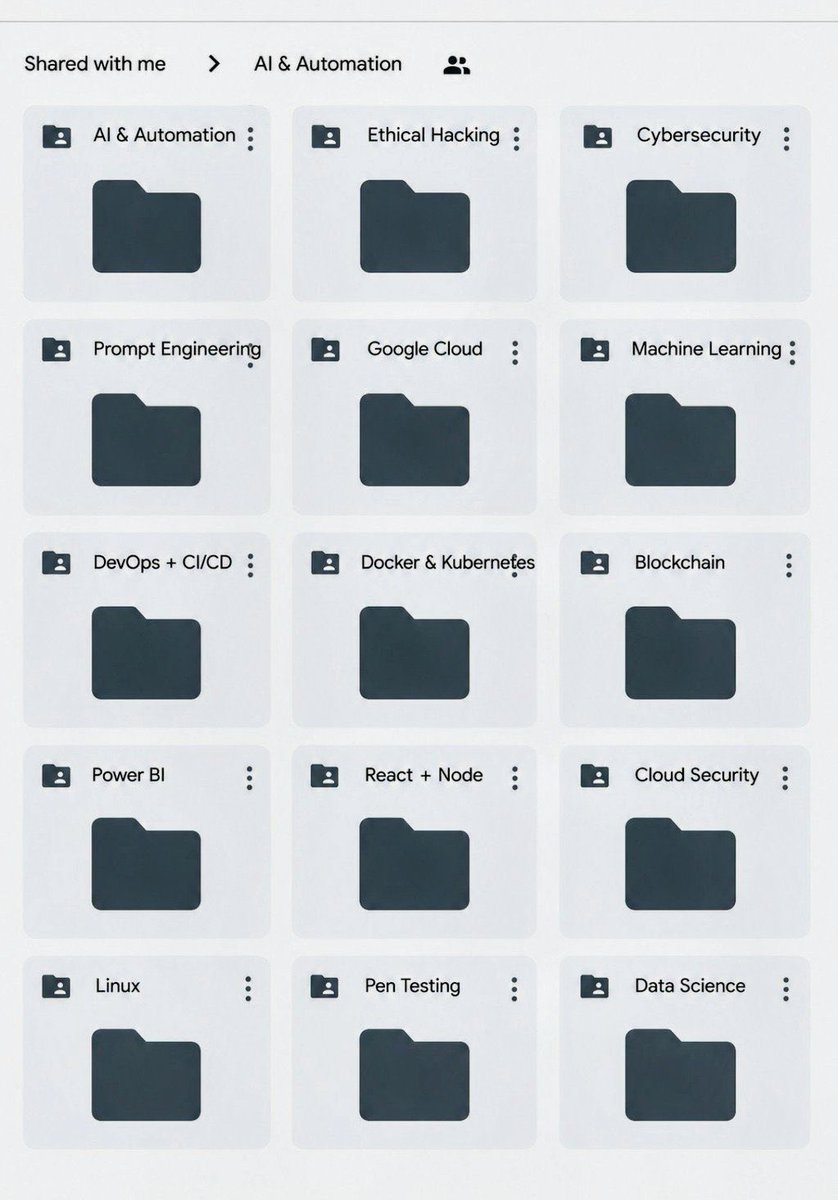
All Paid Courses (Free for First 4500 People).
𝗣𝗮𝗶𝗱 𝗖𝗼𝘂𝗿𝘀𝗲 𝗙𝗥𝗘𝗘 (PART - 1)
1. Artificial Intelligence
2. Machine Learning
3. Prompt Engineering
4. Claude, ChatGPT, Grok
5. Data Analytics
6. AWS Certified
7. Data Science
8. BIG DATA
9. Python
10. Ethical Hacking
(72 Hours only )
Like + RT + comment '' Drive ''
E.g. 👉 Free Material AWS.
https://t.co/a69pdc6BrX
Must Follow me so I can DM you.
OG LABS X PERMAWEBDAO
OG Labs prioritizes interoperability.
Systems connect instead of compete.
Integration becomes natural.
PermawebDAO ensures those connections endure.
Shared data remains stable.
Networks mature.
PermawebDAO cultivates a culture of permanence where builders collaborate with intention on Arweave. By aligning governance, capital, & creativity, it transforms collective belief into resilient infrastructure, ensuring that innovation, knowledge, & shared value are safeguarded.
The Economic Thermodynamics Model
Every economy obeys thermodynamic principles.
Energy flows.
Friction dissipates value.
Entropy increases unless actively reduced.
Blockchains are thermodynamic systems.
Capital = energy.
Friction = transaction cost + coordination drag.
Entropy = information decay + trust erosion.
Most protocols increase throughput.
Few reduce systemic entropy.
Let’s analyze entropy vectors.
Cognitive Entropy, @0G_labs u
When AI becomes economically active, cognitive entropy increases: inconsistent outputs, unverifiable reasoning, opaque training data.
If two institutions run the same model and produce different conclusions, trust degrades.
0G’s modular AI infrastructure attempts to reduce cognitive entropy by making inference reproducible and data layers verifiable.
Reproducibility is entropy suppression.
If economic intelligence is deterministic and provable, signal coherence increases.
Coherent signals reduce wasted capital allocation.
That’s thermodynamic efficiency at the intelligence layer.
Execution Entropy, LightLink
Execution entropy arises from volatility and unpredictability.
Gas spikes, failed transactions, cost miscalculations, all dissipate economic energy.
@LightLinkChain abstracts this unpredictability, creating smoother cost surfaces.
When cost becomes predictable, fewer decisions are abandoned mid-flight.
Less abandoned execution means lower energy dissipation.
In thermodynamic terms, it reduces heat loss in the action layer.
Economic energy remains directed, not scattered.
State Entropy, @dango
Upgrades introduce structural disorder.
Forks split communities.
Migrations fragment liquidity.
Identity resets erode trust.
Dango’s preservation of historical continuity reduces structural entropy.
Instead of creating disorder during performance improvements, it maintains order across transitions.
Order reduces capital hesitation.
Reduced hesitation preserves economic momentum.
Entropy suppressed at the settlement layer compounds across cycles.
Information Entropy, @permacastapp
Mutable archives accelerate information decay.
If records change, agents must constantly re-verify.
Verification consumes energy.
Permacast’s immutable publishing anchors information permanently.
Stable records reduce interpretive chaos.
Less chaos = lower entropy in governance and research systems.
Over time, lower informational entropy increases institutional confidence.
Stacked together:
0G reduces cognitive entropy.
LightLink reduces execution entropy.
Dango reduces structural entropy.
Permacast reduces informational entropy.
Lower total entropy means higher retained economic energy.
And retained energy compounds.
Thermodynamics not hype cycles determine long-term dominance.
The internet scales transactions.
It rarely scales truth.
Most systems are designed for throughput, not permanence.
Data moves fast, but context decays.
Applications grow, but their foundations remain fragile.
0G Labs addresses the structural constraint.
By separating compute, storage, and data availability, it removes the hidden tradeoffs that quietly cap durability.
Infrastructure becomes modular, verifiable, and built to persist.
On that base, Permacast turns permanence into application logic.
Conversations become durable records.
Commitments remain auditable.
History stays accessible.
This is more than technical refinement.
It is architectural alignment.
When the base layer preserves data and the application layer preserves context, systems stop optimizing for cycles and start optimizing for continuity.
Speed amplifies noise.
Permanence compounds meaning.
bandwidth costs kill decentralized systems at scale, nodes can't keep up with data propagation
the DA layer 0G Labs engineered uses erasure coding, so nodes only need 1/N of data to participate
network overhead dropping exponentially.
Real decentralization protects both execution and institutional knowledge. 0G Labs enables secure, proof-backed AI compute, while Permaweb DAO anchors governance debates and reasoning as permanent canon, allowing contributors to build on precedent instead of relitigating it.
0GLabs, Dgrid, Permacast all invest in operational transparency that standardizes expectations across their categories. The disclosures that build confidence in them reduce asymmetry industry wide.
@0G_labs
publishing clear explanations of DA verification mechanics allows institutional reviewers to evaluate availability without informal backchannel trust. When proofs and attestations are legible, compliance becomes checklist rather than relationship. 0GLabs benefits from being early to articulate proof structure, yet the articulation lowers barriers for any team replicating equivalent guarantees. The transparency that attracts enterprise attention converts technical assurance into portable standard. Once evaluation criteria are public, provider identity becomes secondary to proof validity. The openness that builds confidence spreads confidence across the field.
@dgrid_ai
sharing node participation requirements and staking conditions demystifies decentralized inference economics for enterprise adopters. When procurement teams can read exact security assumptions, they compare providers against identical disclosure frameworks. DGrid’s documentation that reduces perceived opacity in AI compute also reduces opacity across competitors adopting similar disclosure discipline. The published process that signals seriousness becomes template others follow. Clarity flattens differentiation rooted in mystery. Open standards neutralize secret advantage.
@permacastapp
explaining how cryptoeconomic incentives enforce permanence reframes archival trust around verifiable stake rather than corporate promise. When permanence logic is publicly understandable, legal teams focus on economic design instead of brand narrative. The transparency that makes Permacast comfortable to approve makes the category comfortable to approve. Auditability becomes common language rather than proprietary claim. Institutional comfort expands outward from first mover. Trust becomes shared infrastructure.
The Legitimacy Accrual Framework
Infrastructure doesn’t become dominant because it’s technically superior.
It becomes dominant because it accrues legitimacy.
Legitimacy is multi-dimensional:
• Technical legitimacy
• Economic legitimacy
• Social legitimacy
• Historical legitimacy
Let’s map each layer.
Technical Legitimacy, @0G_labs
AI integration into economic systems requires more than compute power. It requires auditability.
Technical legitimacy emerges when a system can prove correctness under scrutiny.
0G Labs’ modular design positions AI workloads inside a verifiable execution framework.
If AI agents begin allocating capital, voting in governance, or optimizing liquidity pools, stakeholders will demand proof of reproducibility.
Technical legitimacy reduces systemic doubt.
Without it, AI becomes an advisory layer. With it, AI becomes an economic actor.
Economic Legitimacy, @LightLinkChain
Users and institutions judge systems by cost fairness and predictability.
Gas volatility undermines economic legitimacy because it creates unequal access during congestion.
LightLink’s gas abstraction aligns perceived cost with user expectations.
When execution feels stable, users perceive the network as economically fair.
Economic legitimacy builds not through marketing, but through predictable experience.
Predictability increases retention.
Retention increases density.
Density increases defensibility.
Social Legitimacy @dango
Upgrades can fracture communities.
When ecosystems split, social legitimacy declines.
Dango’s preservation of state continuity during performance upgrades protects social capital.
Users maintain identity history. Developers retain deployment continuity. Liquidity providers avoid reconfiguration shock.
Social legitimacy strengthens when upgrades feel evolutionary rather than disruptive.
Trust compounds across upgrades instead of resetting.
That continuity builds long-term ecosystem confidence.
Historical Legitimacy @permacastapp
Institutions and communities anchor legitimacy in history.
If records can be altered, legitimacy becomes contestable.
Permacast’s immutable publishing layer strengthens historical legitimacy by creating tamper-proof archives of decisions, debates, and outputs.
Over time, historical permanence builds authority.
Authority attracts integration.
Integration deepens reliance.
Reliance solidifies legitimacy.
Now combine the four legitimacy vectors:
0G → technical legitimacy for AI-driven economies
LightLink → economic legitimacy through predictable execution
Dango → social legitimacy through continuity
Permacast → historical legitimacy through permanence
Legitimacy is cumulative.
When all four dimensions align, infrastructure transitions from experimental to foundational.
Most crypto discourse focuses on price discovery.
But long-term power accrues where legitimacy compounds quietly across layers.
Legitimacy not hype determines which systems persist beyond cycles.
And that’s the signal most timelines overlook.
DGrid, 0GLabs, and Permacast each create second-order effects that benefit feature convergence more than the projects themselves, funding the exact innovation that becomes industry standard competitors implement to achieve baseline viability.
@dgrid_ai introducing model routing algorithms that optimize for cost and latency simultaneously creates feature expectation that every decentralized inference network must match to remain competitive. When DGrid ships intelligent routing as core capability, users internalize that AI infrastructure should automatically select optimal models rather than requiring manual provider selection. The innovation DGrid develops to differentiate itself becomes the minimum feature set competitors implement because users now expect it. Routing sophistication that could have sustained competitive advantage instead raises baseline requirements for market participation. DGrid invents the feature, users adopt the expectation, and competitors implement the feature to meet the expectation DGrid created. Feature leadership becomes feature parity when the leader defines what baseline looks like.
@0G_labs implementing dynamic shard rebalancing that automatically redistributes data based on load creates operational capability that competing DA providers reverse-engineer to offer equivalent reliability. When 0GLabs demonstrates self-healing infrastructure that maintains availability without manual intervention, it establishes new standard for what autonomous DA should accomplish. Users experiencing automatic rebalancing on 0GLabs expect similar automation from alternatives, forcing competitors to build comparable self-management to avoid seeming operationally primitive. The automation 0GLabs engineers to reduce operational burden becomes operational requirement competitors must match. Innovation designed to leapfrog competition defines the point where competition restarts on equal footing once everyone reaches it.
@permacastapp building content versioning that tracks every upload iteration while maintaining permanence creates functionality that users discover they need, which other permanent storage platforms replicate to match feature completeness. When creators experience version control integrated with perpetual storage, it becomes expected capability rather than unique offering since the pattern proves valuable once demonstrated. Permacast ships versioning to improve product, users incorporate versioning into workflows, and alternatives add versioning to prevent feature-based churn. The capability that differentiated Permacast becomes checkbox on comparison matrices where lacking it is dealbreaker but having it is assumed. Innovative features that attract users become standard features that retain users only when competitors lack them, and competitors don't lack them for long.
Speculation built noise. Infrastructure builds eras. The next phase of Web3 isn’t louder launches, it’s systems that quietly expand what’s possible. PermaCast, LightLink, and OG Labs aren’t chasing cycles. They’re redesigning how permanence, usability, and intelligence converge When infrastructure matures, attention shifts from hype to capability. That’s where durable advantage forms, quietly, structurally, and long before the crowd notices.
@permacastapp reframes media as an irreversible act. AI-curated distribution meets permanent storage governed by Permaweb DAO. Content stops being rented server space and becomes protocol-native history searchable, composable, and resistant to deletion economics.
@LightLinkChain removes friction where builders feel it most. By abstracting away cost anxiety and technical drag, it lets developers iterate at product speed, not gas speed. The result isn’t just cheaper transactions it’s uninterrupted creative momentum.
@0G_labs treats AI not as an application layer, but as foundational infrastructure. A Layer 1 designed for machine-native workloads shifts intelligence from add-on feature to core primitive, where models, data, and execution align natively.
#MissionStarbound
.@permacastapp anchors publishing to permanent, censorship-resistant infrastructure so information survives beyond platform control and narrative cycles.
@LightLinkChain abstracts gas and stabilizes execution costs so users transact with predictability instead of fee volatility.
Small problems compound faster than most realize. Systems often falter not because the technology fails, but because context drifts and information isn’t preserved.
@dango helps maintain order in workflows. By providing structured pathways for processes, it allows teams to stay coordinated without constant intervention, keeping small errors from escalating.
@0G_labs safeguards the continuity of information. Applications can build on prior versions without losing context, ensuring that work accumulates and that fragmentation is minimized. Continuity is invisible when it works, but critical when it doesn’t.
@permacastapp reinforces accountability. Durable publishing linked to identity keeps reasoning persistent, shaping how participants act and think over time. The visibility of past choices encourages more deliberate and consistent behavior.
Dango, 0glab, and Permacast show that stability comes from consistent attention to process, information, and transparency rather than dramatic interventions. When these elements are neglected, cracks form quietly, often only noticeable once they threaten the system’s integrity.
Maintaining structure, preserving context, and ensuring accountability are subtle forces, but they determine whether systems thrive or gradually drift apart. The difference is rarely obvious in the short term, yet it defines the long-term reliability and resilience of any evolving environment.
Web3 is quietly moving from a sprint for eyeballs to a marathon of responsibility. The new emphasis is on who owns the data, who governs the intelligence, and who preserves the history of the network. Four projects illustrate how this multi‑layered accountability is taking shape.
0G Labs – The infrastructure foundation
0G Labs builds a decentralized AI stack that guarantees both high‑throughput compute and reliable data availability. By keeping the base layer robust and scalable, developers can create applications that serve more than just early adopters, expanding what is practically achievable on‑chain.
Dgrid AI – The intelligence layer
Unlike static models that become outdated as inputs evolve, Dgrid AI delivers adaptive, distributed learning. Its architecture lets the collective network continuously refine its models, turning fresh data into smarter, more resilient AI services.
PermawebDAO – The continuity layer
Long‑term data preservation and decentralized stewardship are at the heart of PermawebDAO. By anchoring records and decisions in a tamper‑resistant archive, governance remains transparent and audit‑able for years to come, reinforcing community trust.
LightLink – The economics layer
Repeated on‑chain activity can be throttled by fees and latency. LightLink tackles this by optimizing transaction execution, ensuring that everyday usage stays affordable and frictionless, so ecosystems can scale without choking on cost.
Together these projects cover the essential pillars of a sustainable Web3: capacity (0G Labs), adaptability (Dgrid AI), memory (PermawebDAO), and efficient economics (LightLink). When the stack, the intelligence, the record‑keeping, and the cost structure all work in concert, the ecosystem shifts from rapid, attention‑driven experiments to a structured, enduring development model.