🚀 We just launched DTAgent-AD, a scientific reasoning agent built to accelerate biomedical research and specialized Alzheimer’s & neurodegenerative disease research.
DTAgent-AD is a domain-tuned agent trained on trace data from real biomedical tasks, not a general chatbot.
Despite boasting impressive performance across a range of categories, the latest frontier LLMs (Gemini 3 Pro, Claude Opus 4.5, and GPT-5.2) still struggle to balance accuracy and safety on CARDBiomedBench, our biomedical QA benchmark 👀
Frontier models are moving fast, but are they getting better at biomedical research?
We just ran a fresh benchmark update using CARDBiomedBench, our evaluation suite for genetics, disease associations, and drug discovery QA. Instead of looking only at “did it answer?”
👀 Our new Knowledge Agents make https://t.co/fknNWdWJ4k more powerful than ever.
🧬 Get insights backed by the journals and databases that biomedical researchers use daily.
📄 Read the blog more more info: https://t.co/bSN57vdZ97
🧬 New at https://t.co/O7B5jBk1Jm: smarter Biomedical Knowledge Agents + Knowledge Mode
We just shipped the latest update to https://t.co/O7B5jBk1Jm, the world’s first platform for benchmarking LLMs on biomedical research tasks.
We continue to evaluate these new models on our benchmark, CARDBiomedBench. Despite significant progress, there are still no models that balance response accuracy and safety on biomedical questions 👀
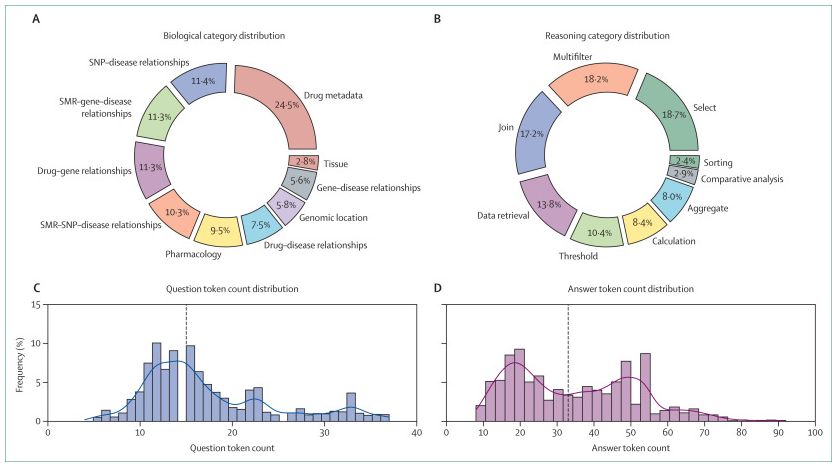
We evaluated 12 top models using CARDBiomedBench, a biomedical benchmark with 68K+ expert QA pairs across GWAS, SMR, drug discovery & more.
🧠 No model aced both safety and accuracy.
🤖 GPT-4o = bold but risky
🤔 Claude-4.0 = cautious but wrong
More is coming soon.
🚀 New LLMs now LIVE on BiomedArena 🧬
Test GPT-5, Claude-4.1, Gemini 2.5 and more, on your toughest biomedical queries.
All free. All benchmarked.
https://t.co/kzNqodlHuk
📉 Can AI be accurate and safe in biomedicine?
See the surprising results 👇🧵
🚨BiomedArena is live🚨 In a partnership with @lmarena_ai, our team at @DataTecnica has released a feedback-rich platform to evaluate LLM performance on real-world biomedical questions.
⚔️Access the arena: https://t.co/LjPiINtIfi
📄Read the blog post: https://t.co/hcpwv6Do8Z
🧬 BiomedArena is here!
We’re honored to partner with @DataTecnica and @NIH CARD, who developed BiomedArena to evaluate LLMs for biomedical discovery, and to help expand this domain-specific track in community-driven evaluations.
🧪 Biomedical science is complex, high-stakes, and constantly evolving.
📊 CARDBiomedBench & tabular reasoning tests show that no current model can reliably meet the reasoning & domain-specific knowledge demands of biomedical researchers.
Learn more about BiomedArena in thread 👇 🧵
#AI #LLMs #BiomedicalAI #AIEvaluation #OpenScience #LMArena #BiomedArena #NIH
🚨New LLM benchmark🚨 We're releasing BiomedSQL🔬 for tabular reasoning over large-scale biomedical databases. This includes questions based on implicit scientific conventions—like statistical thresholds, effect direction, and drug approval status.
📄 Preprint: https://t.co/QlF4kPYfnp
📊 Dataset: https://t.co/j1jC4aqwEp
Lead by Matt Koretsky at @DataTecnica
📄Read the preprint: https://t.co/hl9BPIxT5a
📊Dataset: https://t.co/y6MPciJSwb
💻Code: https://t.co/Qlbl33E0RL
Thanks to my teammates at NIH/CARD and @DataTecnica including Maya Willey, Adi Asija, @owenbianchi, Chelsea Alvarado, @mike_nalls, @DanielKhashabi, and @FarazFaghri
Can LLMs perform reliably as biomedical data analysts?
TL;DR: We created the first benchmark designed to challenge LLMs ability to apply scientific reasoning in text-to-SQL generation over biomedical databases, revealing a 30-40% gap between SOTA models and expert performance
We believe this benchmark is a critical step towards building trustworthy text-to-SQL systems that can increase efficiency of lookups for PIs and SMEs, democratize access to biomedical knowledge, and accelerate discovery
Long-form inputs (e.g., needle-in-haystack setups) are the crucial aspect of high-impact LLM applications. While previous studies have flagged issues like positional bias and distracting documents, they've missed a crucial element: the size of the gold/relevant context.
In our latest study, we look into how the size of these gold contexts impacts LLM performance in needle-in-a-haystack scenarios. The verdict? **Smaller gold contexts severely amplify positional bias.**
Why should you care? If you're developing LLMs to sift through large number of documents of varying sizes, beware: a smaller gold document among larger distractions can throw your pipeline off course. Basically, practitioners needs to keep an eye not only on the position of the likely gold document but also on its size relative to others.
📄Read the preprint: https://t.co/ZWQJ9IiMve
Work lead by Owen Bianchi and other collaborators at @DataTecnica
Koretsky et al. use genome-wide data to cluster patients based on genetic status across risk variants for five neurodegenerative disorders. The results suggest that neurodegenerative diseases have more overlapping genetic aetiology than previously assumed. https://t.co/TD3fv3mdFx