The Strategic Logic of Globacom
Telecommunications is not a branding exercise; it is an unforgiving capital furnace of the highest order. Networks are not built on rhetoric but on relentless, recurrent, and capital-intensive expenditure spectrum acquisition, endless high-end infrastructural upgrades, expansive fibre deployment, tower maintenance, international bandwidth procurement, competitive price wars, which Glo continues to lead and the punishing energy costs of operating in an environment where diesel logistics can rival, and sometimes exceed, payroll obligations.
The most strident critics, often uninitiated in the punishing capital economics of telecommunications, advance declinist narratives divorced from investment realities, even as Globacom and its founder, Mike Adenuga, continue to deploy substantial, sustained, multi-million-dollar financial firepower into the network’s expansion and modernisation.
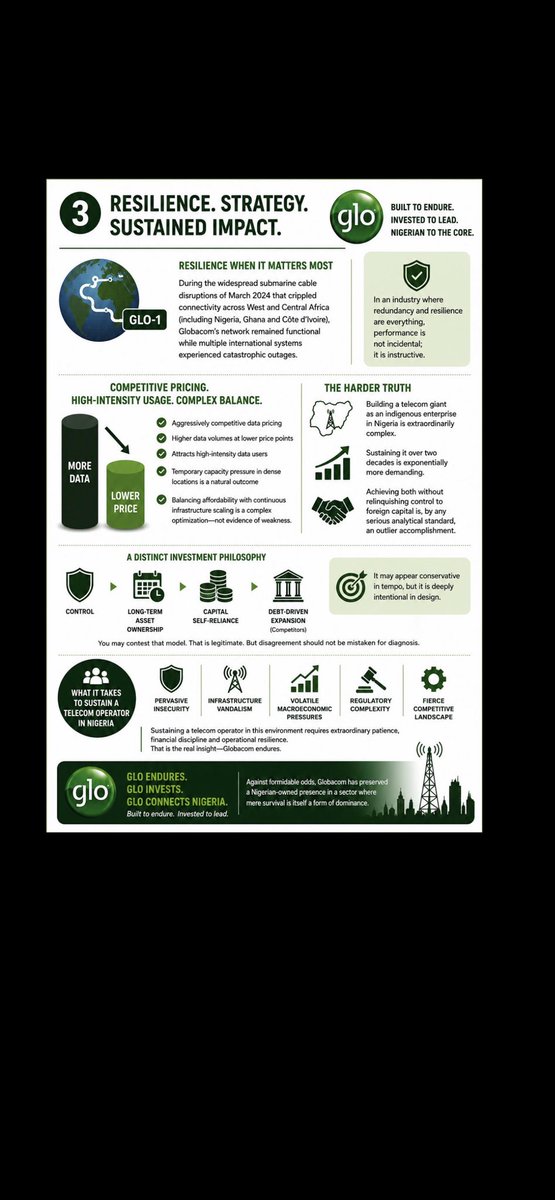
These infographics explore the strategic logic behind that approach: why building and sustaining a Nigerian-owned telecom operator requires extraordinary patience, financial discipline, and resilience. Whether one agrees with Globacom's business model or not, its enduring presence demonstrates the immense complexity of creating and maintaining a telecom network at national scale in Nigeria.
Network evolution, by its very nature, is incremental and technically layered, not instantaneous. Since its inception, Globacom has engaged world-class technology partners, from Alcatel-Lucent to Huawei, to drive its innovation agenda and technological depth. This calibre of technical collaboration signals not just operational intent, but a sustained ambition to remain deeply relevant within an increasingly complex and competitive digital ecosystem.
Strip away the noise, and one defining reality remains: Mike Adenuga stands as the only Nigerian who has built and sustained a telecom operator at true national scale.
Another frequently overlooked dimension is pricing strategy. Globacom has cultivated a reputation for aggressively competitive data pricing, often delivering higher data volumes at lower price points relative to its peers. This positioning naturally attracts high-intensity data users, which can exert temporary pressure on network capacity in densely populated zones.
Balancing affordability with continuous infrastructure scaling is not a trivial undertaking; it is a highly complex optimisation problem, not evidence of systemic weakness.
The real insight, therefore, is not merely that Glo endures, but that sustaining a telecom operator in Nigeria amid pervasive insecurity, relentless infrastructure vandalism, volatile macroeconomic pressures, and regulatory complexity is an extraordinarily demanding feat, one that underscores the depth of resilience and strategic persistence required to still be here.
Liar. We judged you because we stuck with you during your darkest days. Arsene continue to extend your contract even when we hardly get anything from you because you’re always injured. I could remember one unnecessary friendly that you went to play against Brazil & got injured. It was a Felipe Melo tackle and you came back to the treatment room once again even when you’re warn to prioritize the club. We still stuck with you after that and just a good season and half, contract came and you assured us you’re gonna sign, you highlighted how the club supported you, your family, your household and even made reference to your grandpa who was at the time 90+ years, how your wife and children feel at home but in the end you showed us your true colors. I didn’t even believe it until I read life on your website. You degraded Wenger who above all trusted you through your darkest days. You degraded your teammates. You degraded the fans and the board. In all of these you acted like you didn’t care but now you want to save face and pretend all is well @Persie_Official … we don’t know you and never will.
The FMCG sector's contribution to Nigeria's GDP has increased significantly from 13% to 24.3% over a decade. This change has been influenced by factors such as a growing consumer population, increased marketing activities by multinational companies, and a rising middle class who can spend on consumer goods.
The ripple effects of these activities contribute to broader economic development. Increased production stimulates demand for raw materials, packaging, transportation services, and other supporting industries. Such linkages strengthen local value chains and enhance industrial growth, aligning with national aspirations for economic diversification and increased manufacturing output.
Bigi’s decade-long journey has also highlighted the importance of innovation in sustaining relevance within a dynamic marketplace.
Consumer preferences continue to evolve, and successful FMCG brands must adapt to changing tastes, lifestyles, and expectations. Through strategic product development, marketing initiatives, and consumer engagement, Bigi has remained connected to its audience while reinforcing its identity as a youthful, vibrant, and dependable brand.
The company’s investments in technology and modern production processes further underscore its commitment to excellence. By embracing global manufacturing standards while operating locally, Bigi has demonstrated that Nigerian brands can compete successfully in quality, efficiency, and customer satisfaction.
Equally important is the brand’s contribution to national pride. In a market where multinational products have traditionally enjoyed strong dominance, Bigi’s rise serves as a powerful example of what local entrepreneurship can achieve. Its success story inspires confidence among investors, business leaders, and young entrepreneurs seeking to build competitive Nigerian brands capable of succeeding at scale.
As Bigi celebrates ten years of refreshing lives, the milestone represents more than an anniversary. It is a testament to resilience, innovation, consumer trust, and the transformative power of local enterprise. The brand’s journey reflects the aspirations of a nation striving to strengthen domestic manufacturing, create jobs, and promote sustainable economic growth.
Looking ahead, the future appears promising. With a strong market presence, loyal customer base, and a proven track record of innovation, the Adegunwa led Bigi is well-positioned to continue shaping the FMCG landscape in Nigeria. As consumer needs evolve and new opportunities emerge, the brand’s commitment to quality, accessibility, and local value creation will remain central to its growth story.
In a nutshell, ten years after its launch, Bigi stands as a refreshing success story - Not only because it quenches thirst, but because it has helped stimulate industry growth, empower businesses, create employment, and contribute meaningfully to Nigeria’s economic development.
In celebrating a decade of impact, Nigerians are also celebrating a brand that has become woven into the fabric of everyday life, refreshing lives when it matters most and contributing to a brighter economic future for all.
Michael Abimboye is a Communications and Advocacy Specialist based in Lagos, Nigeria…..
Bigi @ 10: Refreshing Lives When It Matters and More
For ten years, Bigi has been more than just a beverage brand on Nigerian shelves. It has become a household name, a symbol of refreshment, affordability, and local enterprise that resonates with millions of Nigerians. As the brand marks its tenth anniversary, its story reflects not only commercial success but also a broader impact on Nigeria’s Fast-Moving Consumer Goods (FMCG) sector, the lives of consumers, and the nation’s economy.
Launched in 2015 by @RiteFoodsltd Limited, Bigi entered a highly competitive beverage market dominated by established and entrenched multinational brands. Yet, within a decade, it has carved out a unique position, becoming one of Nigeria’s most recognized and consumed soft drink brands. Its success demonstrates the growing capacity of indigenous companies to compete effectively, innovate continuously, and contribute significantly to economic development.
From the outset, Bigi distinguished itself by understanding the needs and preferences of Nigerian consumers. The brand offered a wide range of flavours, including Bigi Cola, Orange, Apple, Lemon, Tropical, and later variants that catered to evolving tastes. By combining quality with affordability, Bigi became accessible to a broad demographic, from students and workers to families and entrepreneurs.
The brand’s DNA and popularity is rooted in its ability to provide refreshment at moments that matter most. Whether at social gatherings, celebrations, “Owambe”, sporting events, family meals, or during everyday work breaks, Bigi has become a familiar companion in the daily lives of Nigerians. Its presence at weddings, birthdays, religious celebrations, points of convergence and community events reflects a deep connection with consumers who see the brand as part of their shared experiences and memorable moments.
Beyond satisfying thirst, Bigi’s impact on the FMCG sector has been transformative and more. The Nigerian FMCG industry is a critical contributor to economic activity, providing essential products consumed daily by millions. Over the last decade, Bigi has helped drive competition within the beverage segment, encouraging innovation, product diversification, and improved value offerings across the industry.
Competition often benefits consumers, and Bigi’s emergence has expanded choices while maintaining affordability. The brand’s success has demonstrated that locally manufactured products can achieve high standards of quality while remaining competitively priced. This has inspired confidence in indigenous brands and reinforced the potential of Nigerian manufacturing.
At the heart of Bigi’s success lies a commitment to local production. Produced at Rite Foods’ state-of-the-art manufacturing facility, nestled at Ososa, Ogun State. The brand showcases the capabilities of Nigerian industry and investment.
Local manufacturing contributes significantly to economic growth by creating jobs, supporting supply chains, and reducing dependence on imported products.
The economic impact extends across multiple sectors. Thousands of Nigerians benefit directly and indirectly from Bigi’s operations through employment opportunities in manufacturing, logistics, distribution, sales, marketing, and retail. From factory workers and transport operators to wholesalers, retailers, and street vendors, the brand supports livelihoods across the value chain.
Small and medium-sized enterprises (SMEs), often regarded as the backbone of Nigeria’s economy, have particularly benefited from Bigi’s widespread distribution network. Countless shop owners, kiosks, supermarkets, and beverage vendors rely on the sale of Bigi products to generate income and sustain their businesses. In urban centres and rural communities alike, the brand’s accessibility has created economic opportunities for entrepreneurs seeking reliable, high-demand products.
The United States has identified a Nigerian national and three companies allegedly involved in facilitating cross-border financial transactions for ISIS. According to U.S. authorities, the network helped move funds between countries including France, Syria, Türkiye, and Nigeria, enabling the terrorist group to finance attacks, support its regional affiliates, and threaten civilians, including religious minorities.
The individual named is Muhammad Mukhtar Adamu, a suspected ISIS-West Africa affiliate. Born in August 1990, Adamu is reported to reside in the Agege area of Lagos.
The three companies linked to him are General Currency Bureau De Change Limited, based in Lagos; Nine To Nine Exchange Bureau De Change, located at the FAAN Complex on Airport Road, Lagos; and Manhattan Bureau De Change, situated on Murtala Mohammed Way in Kano.
@nicholasibekwe I don’t know why LASG allow these developers to complete building before demolishing. Why not demolish immediately you spot irregularities ?