Great experience at #ACC26 presenting my research on TAVR and IVUS. Always inspiring to be surrounded by innovation and leaders shaping the future of cardiology @ACCinTouch
Back at #CRT2026 for the second time quickly becoming one of my favorite cardiology meetings. Great science, great people, and inspiring discussions in structural and interventional cardiology. #CRT2026@CRT_meeting
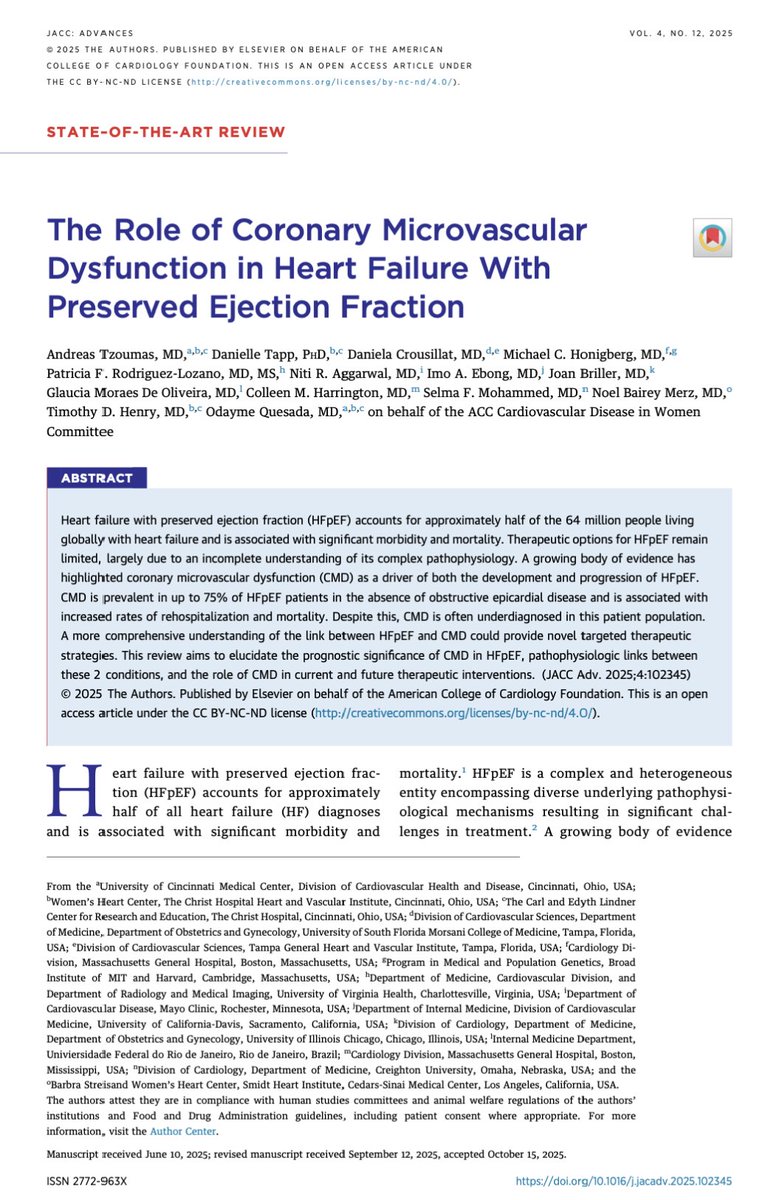
🫀🧠 HFpEF is not just “diastolic dysfunction”: the microcirculation is the missing link
This 2025 JACC: Advances state-of-the-art review reframes heart failure with preserved ejection fraction (HFpEF)through a crucial, often underrecognized lens: coronary microvascular dysfunction (CMD) .
📊 How common is CMD in HFpEF? Very.
Up to 75% of HFpEF patients—even without obstructive coronary disease—have CMD. And this is not an innocent bystander:
CMD is independently associated with higher HF hospitalizations
Increased mortality and MACE
Worse quality of life
Yet, CMD is rarely sought and even more rarely diagnosed in routine HFpEF care.
🧠 Why CMD matters pathophysiologically
CMD disrupts the heart at multiple levels:
🔻 Reduced coronary flow reserve (CFR) → subendocardial ischemia
🔥 Microinfarctions & fibrosis → stiff myocardium
⚙️ Impaired cardiac–coronary coupling → blunted flow during stress
🧬 Inflammation & endothelial dysfunction → vicious cycle of ischemia and diastolic failure
HFpEF and CMD reinforce each other in a bidirectional loop, rather than a simple cause–effect relationship.
👩⚕️ A sex-specific disease
Women are disproportionately affected:
Higher CMD prevalence
Smaller coronary vessels, higher resting flow
Postmenopausal estrogen loss → inflammation, fibrosis, reduced CFR
This helps explain why HFpEF is more common and more complex in women.
🧪 Diagnosis: we’re under-testing
CMD can be assessed by:
PET or CMR perfusion
Invasive coronary functional testing (CFR, IMR, acetylcholine)
But there is no standardized diagnostic pathway in HFpEF—yet.
💊 Therapy: signals, not solutions
Some treatments show promise (SGLT2i, statins, RAAS modulation, lifestyle, GLP-1/GIP agonists), but no therapy specifically targets CMD in HFpEF so far.
🔮 Bottom line
HFpEF is not only a myocardial disease—it’s a microvascular disease.
If we keep ignoring CMD, we will keep failing HFpEF patients.
👉 Understanding and treating HFpEF may finally require looking beyond the ventricle—into the microcirculation.
Presented at #AHA25:
In patients with atrial fibrillation and a drug-eluting stent placed at least 1 year earlier, monotherapy with a non–vitamin K antagonist oral anticoagulant was noninferior to combination therapy with clopidogrel for net adverse clinical events. Full ADAPT AF-DES trial results: https://t.co/7FQatfAPcl
@AHAScience
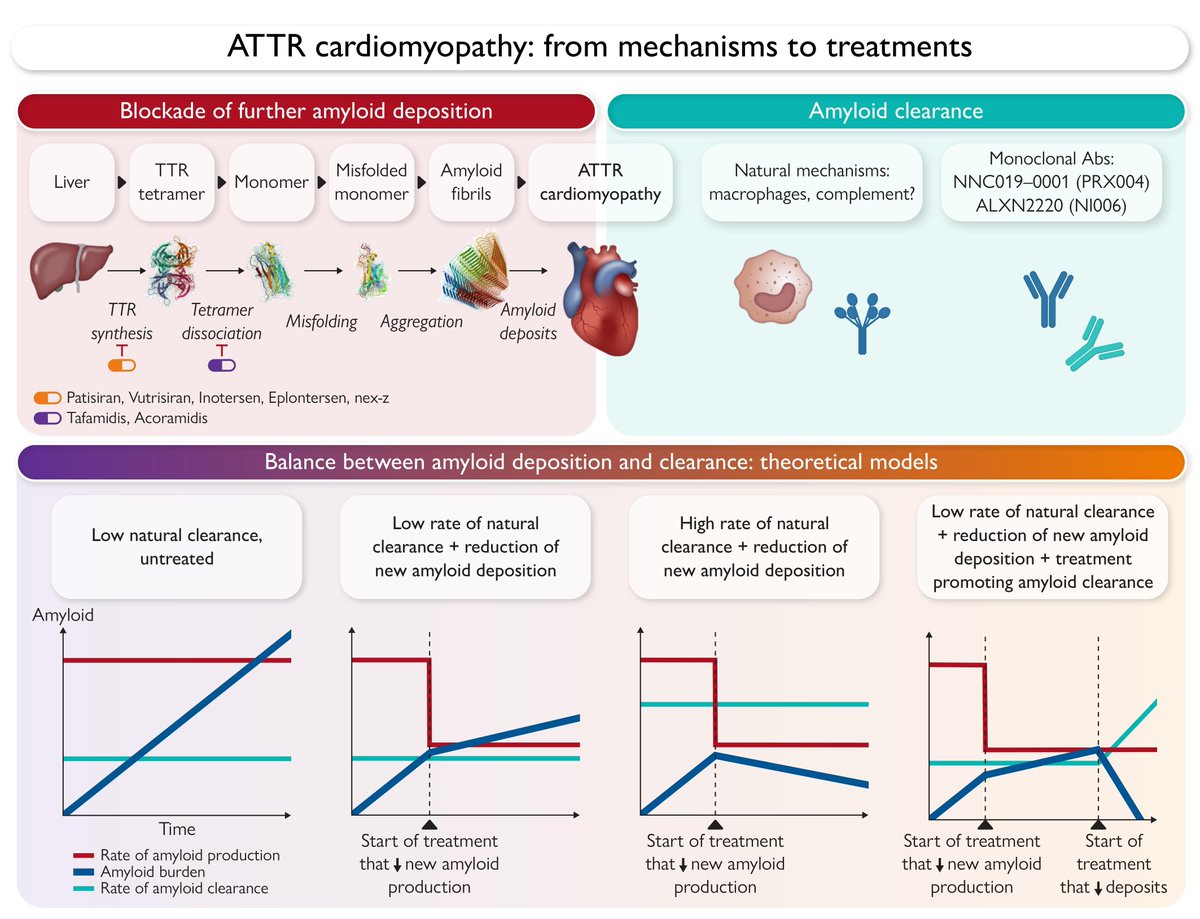
🧵 1/🚨 New era in cardiac amyloidosis!
ATTR-CM is not just about slowing progression anymore — it’s about reversing the disease.
From tafamidis to CRISPR gene editing 🧬💥
Let’s dive into the 2025 European Heart Journal review by Fontana et al.
👇 #CardioTwitter#Amyloidosis
Understanding Cardiorenal Syndrome : A🧵
1️⃣ What is Cardiorenal Syndrome (CRS)?
CRS refers to a complex disorder where dysfunction in the heart or kidneys triggers dysfunction in the other organ.
It’s a bidirectional relationship Heart affects kidneys, and kidneys affect heart
🔥 New in @NatureMedicine
How do you communicate lifetime benefits expected with HFpEF therapies?
New data from 3 RCTs (#DELIVER#FINEARTS#PARAGON) estimate up to *5 years* of event-free survival w combination Rx
#GDMT for HFpEF has finally arrived!
🔗https://t.co/ozSx3UwkLN
Transthyretin amyloid cardiomyopathy: from cause to novel treatments. Read this State-of-the-Art review just published in #EHJ 👉 https://t.co/xs8gK2WEW0
@RoccoMontone@ehj_ed#amyloidosis
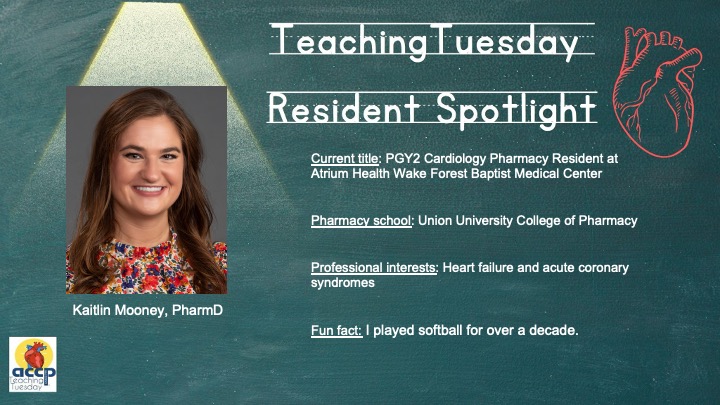
Meet Dr. Kaitlin Mooney, current PGY2 Cardiology Resident at Atrium Health Wake Forest Baptist Medical Center.
Next #TeachingTuesday Dr. Mooney discusses cardiac amyloidosis!
It's #Amyloidosis Week! We will have a PGY2 CE Spotlight and Teaching Tuesday on cardiac amyloidosis!!
2025 ESC/EACTS Guidelines for the Management of Valvular Heart Disease
Key Change:
🔹In patients with low-flow, low-gradient (LFLG) AS with reduced EF, the 2025 guidelines now place CT aortic valve calcium scoring (AVCS) on equal footing with dobutamine stress echocardiography (DSE) for confirming severity.
🔹AVCS thresholds remain the same: >1200 AU in women and >2000 AU in men.
🔹If CT calcium score is above these cutoffs → this is sufficient for diagnosis of true severe AS, without needing DSE.
🔹DSE is no longer mandatory — it’s optional and equivalent to CT in decision-making.
If one test is not conclusive, complement diagnostics with the other test.