A useful little quant trick -
1. Many things in finance decay like a power law (volumes, volatility, impact etc)
2. Power laws are a pain to work with
3. Power laws over finite timeframes are very well approximate by sums of exponentials
4. So just use EMAs for everything 🚀
@AirM4rx total noob here :)), never tried funding arb, but how does it work? I guess the foal is to get paid from the funding rates, but what about price fluctuations? or they don't matter because you open a position on both sides with the same amount?
Small Trader Alpha
I've been running a super low capacity arbitrage for a little over a year. Ironically, a few days ago I asked @quant_arb how I could improve it, but starting today, I won't be able to run it at all (reason will become clear). I figured I'd share the details:
In far OTM options, most often on SPY, you'll occasionally find the following inefficiency (using puts as example): The 400 strike put will be bid 0.03, ask 0.04, and the 399 strike put will be bid 0.04, ask 0.05. This opens up opportunity to buy the 400 and sell the 399 for net zero, so you end up with a free vertical spread. The size on these opportunities varies; sometimes only a few contracts, but often you could get several hundred to a thousand free spreads.
You could just hold those spreads and wait for a massive 1 or 2 day move in the S&P to make them worth something. (You'd need the bid of the 400 strike to be at least a penny above the ask of the 399 strike before you could sell anything, since minimum price increment is a penny. These options are so far OTM, that you very rarely get the opportunity to do that, let alone having them end up ITM).
Or, if you want to monetize them immediately, you could sell additional spreads against the ones you now have. To illustrate: Suppose you got 500 spreads between 400 and 399. Also suppose that the 390 puts are bid 0.02, ask 0.03. You could sell up to 55 spreads between 399 and 390 for a dollar each, and they'd be fully covered by your original spreads.
Obviously, you'll want to have an API running this throughout the day. I personally don't code, so I ran this project together with a friend who does. We made about 5k over a year.
Note: any fees will totally destroy this, which is why we could only run it on Robinhood. Robinhood, until recently, was the only brokerage I could find which A), had no option fees, and B), didn't pass through regulatory fees to the customer. These regulatory fees range from 3 to 6 cents per contract bought or sold.
Starting today, Robinhood has begun passing the 3 cent per contract fee to the customer, which has made this no longer worth the effort. Consider the example above: instead of making 55 dollars, you'd end up with a little over 20 dollars after the 3 cents per contract. It also introduces risk; after you "buy" the initial 500 spreads, which now costs 30 dollars, there's a delay before you can sell the 55 spreads, during which something may change. Before this fee was introduced, the worst that could happen was you ended up with a bunch of free extreme-tail exposure that you couldn’t immediately monetize.
Also, Robinhood has truly terrible execution. The orders often don't go through unless you cancel a re-place them a dozen or more times. This adds to the time delay.
This program was a huge drag to run. (Code was a nightmare for my friend to work with. Robinhood API is a mess, apparently). But it made money. (and it still could, just not for me). and even with the small fee, the tail exposure you're getting is still likely worth it. Each spread costs you 6 cents, and pays off up to 100 dollars, even if extraordinarily rarely.
Feel free to ask questions in the comments.
Strongly recommend @HangukQuant’s upcoming courses. They’re probably going to be a little too advanced for a pure beginner, but better to have the info and guidance available, and then gradually work your way up to understanding. I myself am guilty of OCRing some of his work with MathPix and having GPT-4 help explain it to me. @quant_arb@HangukQuant@Vertox_DF@TaiwanQuant@NT_Quant all have sick Substacks. @therobotjames’s site is dope. Lots of great resources abound. Not all of it is free, but given that the alternative is grad school, I’d say they’re all worth the expenses. A few of these guys have threads on resource maps and recommended textbooks. That’s a great place to start for free stuff you can get off Libgen
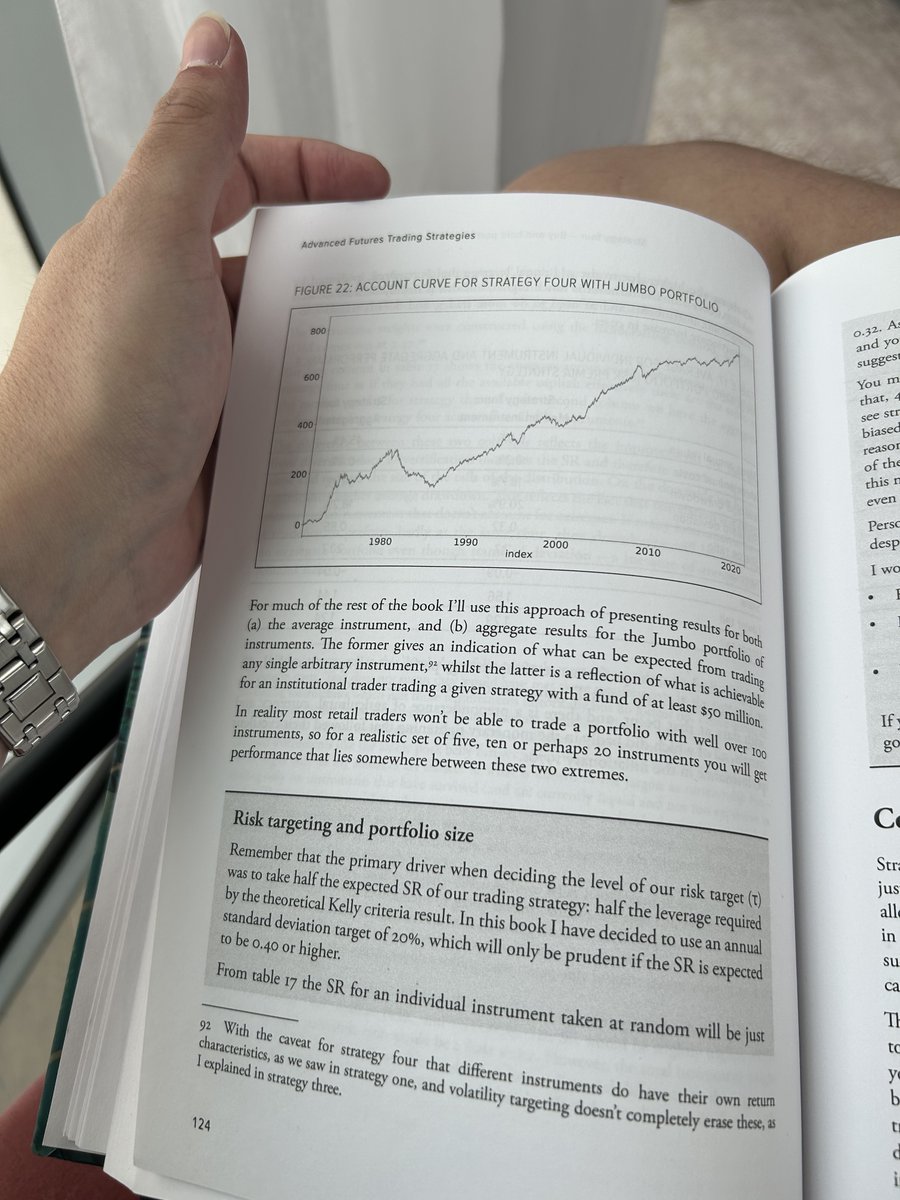
30 Strategies All From One Book.
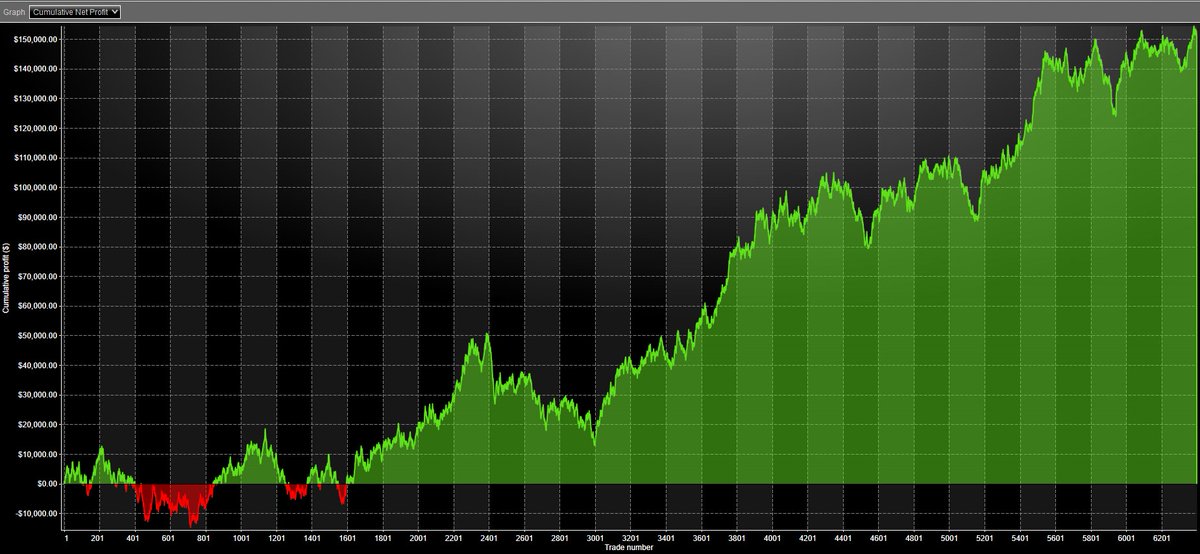
With backtested results that blow most Youtube strategy videos out of the park;
Below is just one of the portfolios of strategies he takes you through.
Get the other 29 strategies here:
How can you be as private and anonymous as possible when owning/trading crypto?
Many of you reached out after my thread on security I did a few days back
Tech infra for quant research, some notes.
If you're doing data science/quant stuff, you need a good dev environment.
Especially working as a team, how do you share datasets, models, notebooks?
How do you make sure your computer won't turn off during a 5-hour processing job?
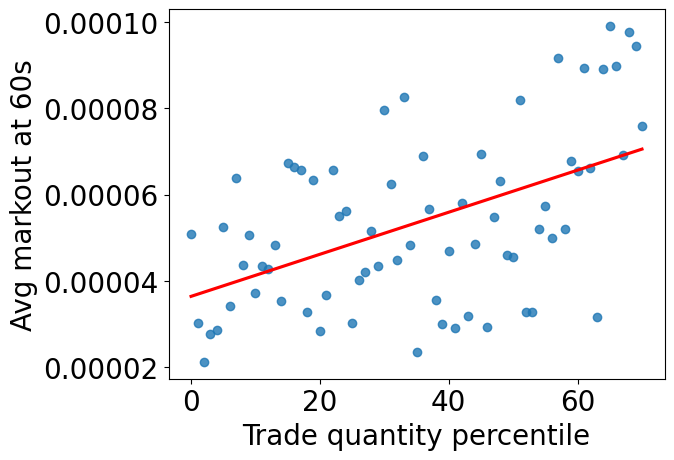
Fun fact: bigger trades are on average more informed than smaller trades.
I thought that big trades were price insensitive because they often suffer from slippage.
Bigger trades seems to have better markouts than smaller ones.
Just made 7 figures arbitraging an obscure derivatives depeg between coin margin vs usdt. I'm sure my more astute followers will be able to notice what it was.
This is such a great read that I have to quote a part of the book:
Basically, if you understand a system well and deeply, you don’t have to play by the same rules as everyone else.
You can look for flaws and omissions in the rules.
You notice where the constraints the system places on you don’t work. You naturally hack the system.
And if you’re rich and powerful, you’ll likely get away with it.