@aleabitoreddit@aleabitoreddit how is the planned issuance of 125m crowns expected to be addressed now? Issuing at 14.5 crowns per share no longer looks realistic and would be dilutive for retail investors who have recently stepped in
Sellside EBITDA shown by bankers or the seller themselves often contain numerous adjustments that make no sense to be included
If you are in the process of buying a business, the burden is on you to be prudent and make sure you understand what real EBITDA of the business looks like
First and foremost, it is important to understand two things
> EBITDA itself is not a GAAP metric. Companies only provide this because investors to prefer to view majority purchase transactions through the lens of EBITDA. As a result, there is no uniformity in the calculation of adjusted EBITDA. Every company has their own definition and can voluntarily include or exclude items they wish
> EBITDA is still a useful metric, because it looks at profitability of a business irrespective of capital structure. When a new buyer steps into a business, the debt and equity balances of a company changes. This creates a different interest burden and tax burden on the company. Assets also get recorded on a stepped up basis, which changes the math on depreciation post-acquisition
So as a buyer, how do you diligence EBITDA?
Starting from the very basics, you should first verify how reported EBITDA is being calculated.
This is as simple as operating income plus depreciation and amortization for most companies. However, some companies will also add back impairments or other non-operating expenses in their reported EBITDA.
Next, you want to look at the bridge between reported EBITDA to adjusted EBITDA to better understand what adjustments are being included.
This is easiest if you have a quality of earnings (QoE) report prepared already by a trusted accounting firm. Often times, sell-side bankers will prepare this ahead of the sale process for providing it to potential buyers.
In almost all cases, buyers are recommended to get their own buyside quality of earnings report done. You want certainty and precision when making a large business purchase decision. It is worth the extra dollars to pay for that QoE.
Once you have the list of adjustments, you want to pay attention to a few things
> Items that are being added back as non-recurring or unusual items but continue to show up in the P&L multiple years in a row. These are the items where you want to give very little credit, if any, to the seller. Ideally, you can get as granular as possible on the number to truly understand what is recurring and what is not
> Items that are truly non-cash. Due to accounting standards, certain non-cash items often show up in the P&L and are added back to show Adj. EBITDA. These are items where I generally think it is fine to provide credit to the seller
> Items that are expected to keep reoccuring in the business, even though they look like one-time items. A good example of this is consulting or legal fees related to M&A. Most companies will attempt to add this back in their EBITDA. However, if the company is a platform business that is acquisitive through small tuck-ins, legal and consulting M&A fees are going to keep showing up in the business
A lot of this will sometimes depend on how you look at the business through the lens of the specific buyer. If you are purchasing a majority stake with control over the business, you will have decision-making power to decide what expenses you will continue to incur
The point is this: you never want to trust the sellside EBITDA at face value. You can almost always assume that real EBITDA in the business is lower than whatever sellside number and multiple is being used to market the company to potential buyers.
Important to do your own diligence on these points and come to a view on what EBITDA and multiple makes sense
Bitcoin topped on 10/6.
The Nasdaq topped on 10/29.
Bitcoin bottomed on 2/5.
The Nasdaq bottomed on 3/30.
The best leading indicator of all has been carving out a bottom for ten weeks.
Probably a situation worth monitoring.
1/ I see a lot of bad analysis of DATs, or digital asset treasury companies. Specifically, I see a lot of bad takes on whether they should trade at, above, or below the value of the assets they hold (their so-called “mNAV”).
Here's how I approach it.
galaxy digital glxy shares convert directly from fidelity brokerage accounts to solana/ethereum tokens through superstate. same share trades $42.20 on nyse and fragments across 3 chains with different liquidity depths. first real equity arbitrage between tradfi hours and 24/7 crypto markets. aave already accepts tokenized glxy as collateral.
Everyone is posting about the “95%” Fortune article, but it’s worth reading the underlying MIT report, which contains a ton of interesting insights.
My main takeaway is that Gen AI projects fail not because the models aren’t capable, but because the importance of context is often overlooked.
Startups are succeeding by building robust context layers around specific workflows. Enterprises are stumbling by treating AI like plug-and-play SaaS.
(You can read the original MIT report here:
https://t.co/vYYeSSiau2 )
My biggest takeaway from Cannes is that the crypto industry as we know it will not exist in 10-15 years.
We will be fully integrated into the broader financial world. "Working in crypto" will not be a thing, you'll just work on finance. That's the best outcome for the world.
A small group of nerds will work in the trenches. Quants, devs, cypherpunks. 'Everyone will use crypto', yeah, the same way they are using VOIP. "What the fuck is VOIP?"
We provide value in the form of better, faster and more transparent settlement layer, and thus will get integrated to the world's economy at the infra level.
Users will neither care, nor know, that the backend of their favorite finance app or game is blockchain-based.
This might sound cynical, but we'll be improving finance for the whole world. Billions of people will have a slightly better experiences thanks to us. And that's beatiful, in its own corporate way.
To truly be a new platform, stablecoin issuers need to have really good global banking connectivity and close the loops with existing rails (correspondent banking, SWIFT, PIX, SEPA, etc.).
Treasury bills/BUIDL wrappers don't cut it. You need to go through the sweat and costs of building out connective tissue to global fiat rails which takes reg cap and licenses.
The founder of one of the largest "decentralized stablecoins" recently said to me "you're not really a stablecoin unless you have a bank account."
We're building AUSD to be the glue between the new rails and the legacy rails. Oh, and our on/off ramp costs are FREE. Even against USDC/USDT.
Circle — a business that earns a net interest margin — is now trading at 146x 2024 earnings
The only way to interpret this information is public markets are incredibly bullish on the growth of stablecoins
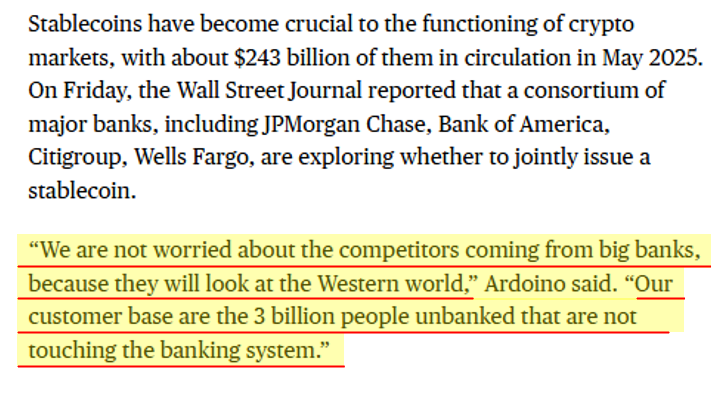
Tether not particularly worried about the big banks entering the stablecoin arena
Paraphrasing Paulo's quote below: banks will focus on the Western world, while Tether is focused on the unbanked
Stepping Back:
- World Bank estimates ~1.4B adults unbanked
- Tether currently has ~20M monthly active users
- At 10% the unbanked population, that's ~140M MAU (7x current users)
- At current USDT market cap ($156B), modest penetration implies (w/ heavy assumptions) a $1t+ asset base
- Purely illustrative math, but highlights that when swim-lanes emerge post regulation, there'll be clear vectors for growth that each issuer will lean into. And Tether isn't worried because their target market is large, underserved, and lucrative if penetrated
Misc:
- 10% is a big assumption. And a number of secondary factors (i.e. avg bal /user) would need to hold true for the implied USDT o/s math
- Seen conflicting numbers on unbanked globally - using 1.4b World Bank estimate (vs. 3b in the article)
- H/t @artemis for the Tether data
“Obvious prospects for physical growth in a business do not translate into obvious profits for investors”
The price you pay dictates the return you get
Investing in a poor asset at a great price can yield a better return than a good asset at a bad price
Alpha is discovering something about an asset that the market has overlooked but will soon discover, and therefore the asset is underpriced today and will be more valuable in the future once the gap is closed. That leads to outperformance.
If Zora was a @MetaDAOProject launchpad funded project this would never happen
They are calling the coin "for fun" while they have a large part of the allocation for team & treasury that looks exactly like the chart @metaproph3t shared in one of his articles
We continue to let teams erode investor trust and invite more restrictive regulations that will nerf innovation
The industry not being able to use its best tools to self-police and hold bad actors accountable is a flaw
[Can't do evil>Won't do evil] Always!
As a user get your teams to raise on the MetaDAO launchpad
As a founder in most cases you a 100% want to be on the launchpad for many reasons
• The DAO owns the mint authority for the token launch and the treasury. They could choose to liquidate, or fund your growth and reward your performance. If you put 2+2 together this side steps a lot of the murkiness around previously conducted ICOs
• For the first time in forever you now finally have an opportunity to actually accrue value back to the token
• You get to raise from 100s if not 1000s of evangelists and find contributors for your project with skin in the game
• You could still have strategic investors join you just like MetaDAO did
I've run this exercise with at least a dozen founders in under a month and while I continue to talk to more, rarely is there a case where it is obvious that a founder shouldn't opt for this new age of capital fundraising and stick to private raises
As an investor with a futarchy based launchpad like @MetaDAOProject you ensure that the team is constantly looking for ways to accrue value back to the token as one of their primary measures of success
• Token [Down] = Bad performance
• Bad performance = Less upside or future compensation for founders
• Signs of a slow or hard rug = Liquidate treasury and claim funding
• Downside protection ensures investors are more confident in deploying size so you could raise more than you originally expected
• Founder/Teams wealth tied to the success of the token
• No early exit for teams and no complacency. Teams remain as hungry as they were on Day 1
• Market based decision making ensures decisions are valued against its impact on price and as a result benefiting every holder
• The holders could also pass proposals to introduce rev shares, token buy backs or just continue to fund growth
All of the above ensures that you are an investor with onchain rights and a say in the future of the project you invested in
So if you are a pre-raise team, shoot me a DM!
What’s interesting that we had a bit of a rally yesterday despite FOMC now expecting no improvement in Core PCE at all throughout 2025 and lower growth (i.e clearly indicating about stagflation risks)
We are definitely in for a choppy market over the next few months. However, there’s room for a positive surprise — the Fed effectively ended QT yesterday, and markets are visibly underappreciating the possibility of some sort of trade deal before April 2nd.
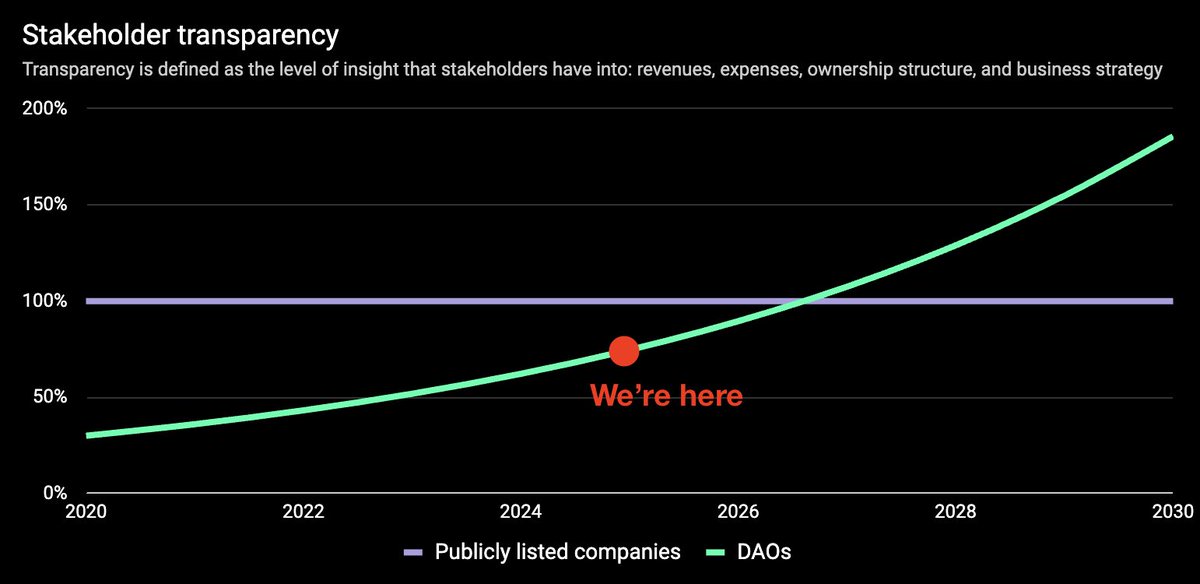
Today, DAOs are more transparent than listed companies in only 1/4 relevant areas:
✅ Revenues: how does the business make money?
❌ Expenses: what are the costs related to the business?
❌ Ownership structure: who owns the business & at what cost basis?
❌ Business strategy: how will the business increase revenues & lower expenses over time?
But not for long!


![Abbasshaikh's tweet photo. If Zora was a @MetaDAOProject launchpad funded project this would never happen
They are calling the coin "for fun" while they have a large part of the allocation for team & treasury that looks exactly like the chart @metaproph3t shared in one of his articles
We continue to let teams erode investor trust and invite more restrictive regulations that will nerf innovation
The industry not being able to use its best tools to self-police and hold bad actors accountable is a flaw
[Can't do evil>Won't do evil] Always!
As a user get your teams to raise on the MetaDAO launchpad
As a founder in most cases you a 100% want to be on the launchpad for many reasons
• The DAO owns the mint authority for the token launch and the treasury. They could choose to liquidate, or fund your growth and reward your performance. If you put 2+2 together this side steps a lot of the murkiness around previously conducted ICOs
• For the first time in forever you now finally have an opportunity to actually accrue value back to the token
• You get to raise from 100s if not 1000s of evangelists and find contributors for your project with skin in the game
• You could still have strategic investors join you just like MetaDAO did
I've run this exercise with at least a dozen founders in under a month and while I continue to talk to more, rarely is there a case where it is obvious that a founder shouldn't opt for this new age of capital fundraising and stick to private raises
As an investor with a futarchy based launchpad like @MetaDAOProject you ensure that the team is constantly looking for ways to accrue value back to the token as one of their primary measures of success
• Token [Down] = Bad performance
• Bad performance = Less upside or future compensation for founders
• Signs of a slow or hard rug = Liquidate treasury and claim funding
• Downside protection ensures investors are more confident in deploying size so you could raise more than you originally expected
• Founder/Teams wealth tied to the success of the token
• No early exit for teams and no complacency. Teams remain as hungry as they were on Day 1
• Market based decision making ensures decisions are valued against its impact on price and as a result benefiting every holder
• The holders could also pass proposals to introduce rev shares, token buy backs or just continue to fund growth
All of the above ensures that you are an investor with onchain rights and a say in the future of the project you invested in
So if you are a pre-raise team, shoot me a DM!](https://pbs.twimg.com/media/GpEJLpeW4AEXwaW.png)







![Abbasshaikh's tweet photo. If Zora was a @MetaDAOProject launchpad funded project this would never happen
They are calling the coin "for fun" while they have a large part of the allocation for team & treasury that looks exactly like the chart @metaproph3t shared in one of his articles
We continue to let teams erode investor trust and invite more restrictive regulations that will nerf innovation
The industry not being able to use its best tools to self-police and hold bad actors accountable is a flaw
[Can't do evil>Won't do evil] Always!
As a user get your teams to raise on the MetaDAO launchpad
As a founder in most cases you a 100% want to be on the launchpad for many reasons
• The DAO owns the mint authority for the token launch and the treasury. They could choose to liquidate, or fund your growth and reward your performance. If you put 2+2 together this side steps a lot of the murkiness around previously conducted ICOs
• For the first time in forever you now finally have an opportunity to actually accrue value back to the token
• You get to raise from 100s if not 1000s of evangelists and find contributors for your project with skin in the game
• You could still have strategic investors join you just like MetaDAO did
I've run this exercise with at least a dozen founders in under a month and while I continue to talk to more, rarely is there a case where it is obvious that a founder shouldn't opt for this new age of capital fundraising and stick to private raises
As an investor with a futarchy based launchpad like @MetaDAOProject you ensure that the team is constantly looking for ways to accrue value back to the token as one of their primary measures of success
• Token [Down] = Bad performance
• Bad performance = Less upside or future compensation for founders
• Signs of a slow or hard rug = Liquidate treasury and claim funding
• Downside protection ensures investors are more confident in deploying size so you could raise more than you originally expected
• Founder/Teams wealth tied to the success of the token
• No early exit for teams and no complacency. Teams remain as hungry as they were on Day 1
• Market based decision making ensures decisions are valued against its impact on price and as a result benefiting every holder
• The holders could also pass proposals to introduce rev shares, token buy backs or just continue to fund growth
All of the above ensures that you are an investor with onchain rights and a say in the future of the project you invested in
So if you are a pre-raise team, shoot me a DM!](https://pbs.twimg.com/media/GpEJLprXUAAdnzp.jpg)