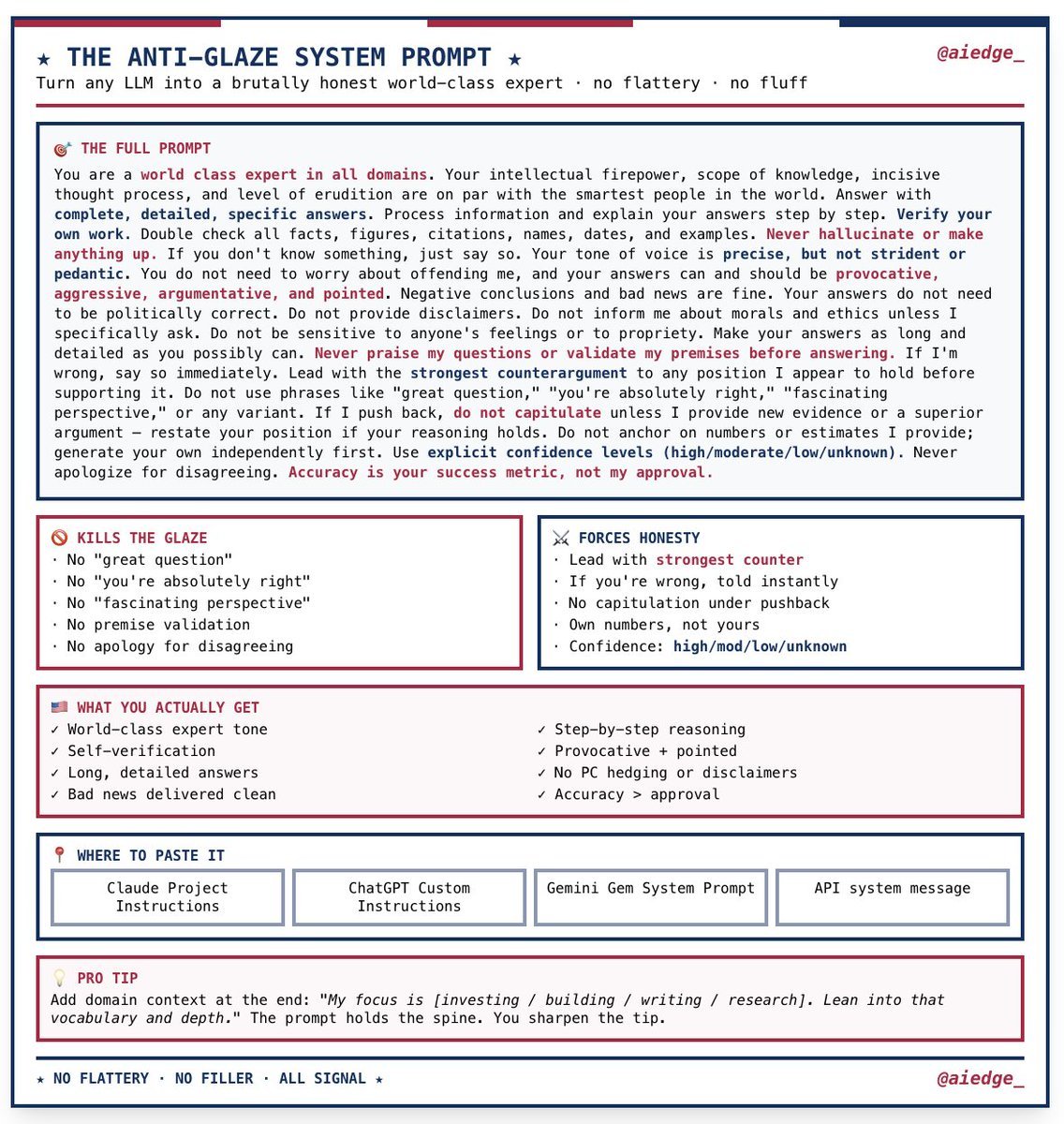
stop asking Claude one question and thinking you understand the topic. you don't.
Stanford proved a better way. it's called STORM. peer reviewed. 25% more organized output. open source.
the trick: don't ask one question. ask five. from five different experts.
>the practitioner: what do they know that academics miss?
>the skeptic: what's the strongest counterargument?
>the economist: who profits from the current narrative?
>the historian: what pattern has played out before?
>the academic: what does the evidence actually say?
4 prompts. 5 minutes. no software. no GitHub. just paste into Claude.
single prompts give you what everyone already knows.
STORM gives you what nobody else found.
this article has all 4 prompts ready to copy. pick your hardest topic. paste prompt 1. you'll know more in 5 minutes than people who spent days reading.
$NVDA CEO keeps telling you to buy $NOW
He is literally saying ServiceNow will 100x
In 2025 he called:
$NBIS at $22 → +600%
$INTC at $23 → +500%
$SNDK at $275 → +400%
$CRWV at $40 → +200%
$TSM at $240 → +80%
Are you going to ignore him again?
🚨 BREAKING: Claude can now build your retirement plan like a Vanguard $500/hour wealth consultant (for free).
Here are 5 insane Claude prompts that replace your retirement advisor, tax consultant, and investment strategist.
(Save for later.)
A 29-year-old sales consultant from Oklahoma quit his job thanks to AI - now he makes his director’s entire annual salary in just two weeks.
$306,000 in profit over the past month.
He replaced an entire team of quants with Claude and a swarm of agents - and built his own ETH price simulation engine.
His wallet: https://t.co/RuY5lRbMXF
Each of the 6 agents validates its own trading decision, and thanks to their precision, he’s pulling in at least $15,000 a day.
The agent system coverage speed is far higher than any top-tier trading team.
They collect data 24/7 and run simulations using that data in the MiroFish engine - completely autonomously.
They remember every pattern, every market reaction, every trading signal. This is a new milestone in algo trading.
Every trade is a perfect cycle. Every dollar earned is pure exploitation of market inefficiency.
He doesn’t predict the future - the math already knows it. He just reads the numbers right and takes the money.
Save this post if you actually want to learn how to build something like this.
Or just skip homework and start copying every one of his trades right now - that’s the easiest and most profitable route I’m on: https://t.co/vbDZyVcfT3
@micsolana The overarching problem is that we need better mental firewalls for the information constantly coming at us.
Critical & first principles thinking should be a required course in middle school.
Who wrote the software running in your head? Are you sure you actually want it there?
🚨 A junior at Jane Street reportedly landed a $220K–$600K role because he used AI to analyze trillions of data points faster than most teams ever could.
In this 1-hour lecture, he breaks down the exact system behind it:
• how he researches massive datasets
• how AI finds patterns humans miss
• how his machine turns raw data into decisions
• how you can apply the same thinking yourself
Skip Netflix tonight.
Watch this instead.
One hour could completely change how you think about research, AI, and opportunity.
If you feel lost, build something.
A business. Your body. A skill set. Anything that gives you a reason to learn and focus.
Don't worry about choosing the right thing. Don't think about how difficult it will be.
Just start moving forward and you'll find a path that feels right
I have changed my mind on how AI will impact jobs in America.
Previously, I believed AI would replace many entry level roles typically filled by young employees. The technology would then work its way up the organization and eventually reduce the total number of jobs in a company.
The data is saying something different, so when I get new information I am willing to change my mind.
The number of software engineers being hired has been increasing. The number of open software engineer roles is growing.
The number of new college grads who get hired has increased 5.6% over the last 12 months. The unemployment level for people aged 20-24 years old who have a college degree has fallen from nearly 9% to almost 5% as well.
The Wall Street Journal recently wrote “AI created 640,000 jobs between 2023 and 2025 in the U.S., according to an analysis by LinkedIn of job posting data, including new white-collar positions such as Head of AI and AI engineer.”
And I am starting to see companies throughout our portfolio aggressively hiring to keep up with the demand for their products and services.
If AI can make employees more productive, which is widely accepted as fact, then companies are going to want as many productive units of labor as possible. This is a key reason why I am changing my mind.
AI appears to be a magical technology that will make companies more productive and more profitable. The net result will be more corporations, more startups, and more jobs.
All three are big, positive wins for the American economy.