La cadena británica ITN publica cuatro horas de material filmado durante la masacra en la plaza de Tiananmen. El contenido estuvo archivado durante 35 años. Incluye imagenes de la represión de las protestas y del día después en las calles de Pekín
🌦️ POSIBLES CAMBIOS DE TENDENCIA METEOROLÓGICA A PARTIR DEL 15 DE OCTUBRE
📉 Los principales escenarios meteorológicos apuntan a un posible cambio de patrón a partir del 15-16 de octubre, con el descuelgue de una vaguada y la posible formación de una DANA al oeste de la Península Ibérica.
🌧️ ¿Podrían regresar las lluvias a Ávila?
De confirmarse esta evolución, podrían volver las ansiadas y necesarias precipitaciones a nuestra provincia, acompañadas de un descenso térmico que permitiría normalizar las temperaturas tras varios días con valores muy elevados para la época.
⚠️ No obstante, todavía existe incertidumbre sobre la evolución, la ubicación y el alcance de este posible episodio. Será necesario seguir de cerca las próximas actualizaciones de los modelos meteorológicos.
🔎 Desde MeteoÁvila seguiremos atentos a la evolución para informaros de cualquier novedad.
#MeteoÁvila #Ávila #Meteorología #PrevisiónMeteorológica #Lluvias #DANA #CambioDeTiempo
In 2006 the commanding general of the US Marines in Iraq banned his men from wearing the most popular sports shirts in America, because of what the burns surgeons were finding.
It was 50 degrees in Anbar province. The issued cotton T-shirt was soaked through in minutes, so Marines had been buying their own. Tight, light, sweat-wicking tops in polyester, the kind every gym in the country is full of. They were cooler and they dried fast. Nearly everybody had them on under the body armour.
Then the roadside bombs started. A bomb under a vehicle produces a flash of fire lasting a second or two. Cotton scorches in that time. Polyester melts.
The Navy doctors at the field hospitals described the result. The shirt turned to liquid and set again on the man's chest and back. A burn that should have been survivable became a far worse one, because there was now a layer of plastic fused across it that had to be cut away.
In April 2006 the order went out from Camp Fallujah. No synthetic athletic clothing outside the wire. It named the brands.
The Marines then went looking for something that wicked sweat, dried fast, did not stink after a week and would not melt. What they found had been grazing in New Zealand the whole time. Fine merino wool is now standard issue next to the skin for troops who expect fire.
That is twice in 25 years, in two different services, that plastic clothing has been tested on young men by an explosion. Both times the answer came off a sheep.
🔴 Se confirma el cambio de patrón: el chorro polar 🌬️ se desplazará hacia el norte y condicionará el tiempo de #España en los próximos días.
https://t.co/30ZpDKHQoD
Hipótesis: Si los hoteles no hubiesen disparado precios desorbitadamente, no había tanta demanda de pisos turísticos; con menos demanda ya no sería un negocio tan lucrativo.
Si tanto distorsionan el mercado los pisos turísticos, tal vez no faltan tantas viviendas por construir.
Advertencia, defender la actual fórmula de cálculo de la pensión no es ni progresista ni de izquierdas. Es populista porque solo busca la rentabilidad electoral a corto plazo favoreciendo a un colectivo cada vez más numeroso
Explicación detallada
👇👇👇👇👇
"L’olla de cardets. Un plat tradicional de la Plana a l'Alt Palància que aprofita els brots tendres d’una planta silvestre per a donar un sabor singular a una olla ben substanciosa". Ens l'explica Vicent Marqués👇 https://t.co/amfzzYIegC
The woman who ran faster than death itself.
They buried her alive at 19. Eight years later, she stood on a podium and proved death wrong.
Chicago, 1928.
A high school teacher watches a teenage girl sprint for a departing train. She's so fast, he literally times her the next day with a stopwatch.
"Betty," he says, "you need to compete."
She'd never raced. Didn't even know girls could run track.
Four months later, Betty Robinson became the youngest woman to ever win Olympic gold in the 100 meters. She was 16 years old.
Chicago threw her a parade. 20,000 people lined the streets. Diamond rings. Newspaper headlines. America's golden girl.
Then came the plane crash.
June 28, 1931. The engine died mid-flight. Betty's plane dropped into a marshy field outside Chicago. When rescuers found her, she wasn't breathing.
Broken leg in three places. Shattered arm. Eight-inch gash across her skull.
They put her in a car trunk and drove to the funeral home.
The undertaker noticed something. A breath. Barely there, but enough.
Betty woke up seven weeks later to devastating news: You'll never run again.
Metal pins. Uneven legs. Wheelchair. Two years just to walk.
She watched the 1932 Olympics from home, knowing she should've been there defending her title.
Most athletes would've quit.
Betty Robinson started crawling. Then walking. Then jogging.
There was one problem: her knee couldn't bend enough for a sprinter's crouch. But relay runners start standing up.
By 1936, against every medical prediction, she made the U.S. Olympic team for Berlin.
Getting there nearly bankrupted her family. The Depression had taken everything. Medical bills piled up. The women's team wasn't funded.
She sold her medals, her ribbons, everything—except the gold from 1928. She worked as a secretary, saved every cent, and barely scraped together enough.
In Berlin, in the 4x100 relay final, Germany was dominating. World record pace.
Then, in one heartbeat, Germany's anchor dropped the baton.
It bounced on the track.
America's Helen Stephens blazed past.
Gold medal.
Betty Robinson—declared dead five years earlier—stood on an Olympic podium for the second time.
Her daughter said it best: "The first medal was easier. The second one, she had to work her tail off for."
Betty retired at 24. She kept both medals in a candy box in her closet. Never displayed them. Rarely talked about it.
In 1996, at 84 years old, she carried the Olympic torch for Atlanta. Frail but fierce. Refused help from anyone.
She died in 1999, having done what almost no one in history has done.
Betty Robinson didn't just survive.
She didn't just recover.
She came back from death itself—and won.
That's not a comeback.
That's a resurrection.

⚠️Fijáos en esta pasada del modelo europeo a 192 hrs que no quiere decir que se cumpla tal cual porque es la salida determinista.
Pero hay varias cosas que señalar:
1.- Masa fría a 500hpa en el entorno peninsular a -18° (5500msnm)
2.-Gradiente barométrico acusado entre la potente dorsal y la depresión retrógrada.
3.-potente anticiclón con centro de 1035mb
4.- Vientos de largo recorrido marítimo, vienen desde Turquía...
Añado un Mediterráneo bastante cálido todavía.
Es una situación bomba de relojería que hay que seguir con atención los próximos días
In 1940, British fighter pilots began noticing something deeply frightening about their aircraft.
Push a Spitfire or Hurricane into a sharp dive, and the engine could suddenly splutter, lose its strength, or stop altogether.
German pilots already understood the advantage. Their fuel-injected Messerschmitt Bf 109s could dive aggressively without suffering the same problem. British Merlin engines relied on carburetors, and when the aircraft experienced negative G forces, fuel rushed through the carburetor in the wrong way, leaving the engine without the mixture it needed.
In a fight for your life, even a few seconds could mean everything.
Then Beatrice Shilling stepped in.
Shilling was an aeronautical engineer at the Royal Aircraft Establishment, but she was far from the quiet, conventional engineer people might have expected. Before the war, she raced motorcycles at Brooklands, one of Britain’s most dangerous racing circuits. She became one of the few women to earn its prestigious Gold Star after completing a lap at more than 100 mph.
She knew machines.
Rather than attempting to rebuild the entire carburetor, Shilling found a remarkably simple answer: a tiny metal restrictor placed in the fuel system to control the sudden rush of fuel during negative-G maneuvers.
From 1941 onward, Shilling and a small team traveled from RAF station to RAF station, fitting the modification directly onto fighter aircraft.
The pilots soon gave the little device a nickname that would follow it into history.
“Miss Shilling’s orifice.”
It was not a perfect solution. Later carburetor technology eventually dealt with the problem more completely.
But that little piece of metal gave RAF pilots something precious when they needed it most: an engine that was far less likely to betray them during combat, without having to wait for an entirely new engine design.
And perhaps the best part of the story is the woman behind it.
Before Beatrice Shilling helped keep British fighters alive in the sky, she had already been spending her weekends pushing motorcycle engines beyond 100 miles per hour on a dangerous racing circuit.
When war placed a dangerous engine problem in front of her, she did what she knew best.
She understood the machine.
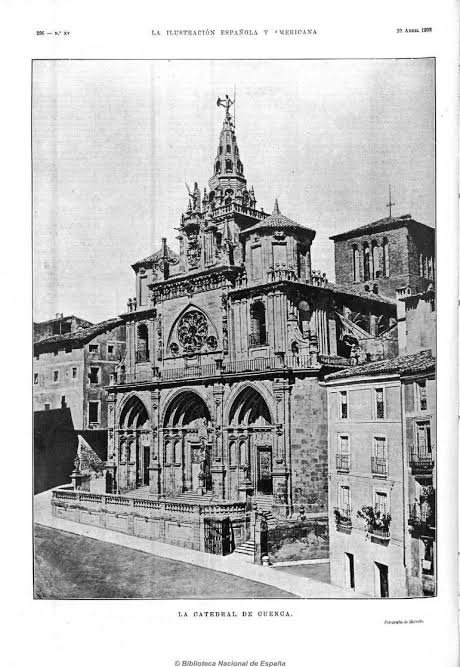
Si has estado alguna vez en la Plaza Mayor de Cuenca, quizá te hayan llamado la atención los dos pináculos que hay a los lados de la fachada de la catedral, cortados a media altura. Nunca llegaron a terminarse. Toda esa fachada es de principios del siglo XX, y está ahí porque la anterior se vino abajo.
Ocurrió el 13 de abril de 1902. La torre de las campanas, la del Giraldo, se desplomó delante de los vecinos y arrastró con ella parte de la fachada y varias vidas. Llevaba tocada desde 1837, cuando un rayo incendió sus pisos altos, y el obispado llevaba años avisando de que estaba en mal estado. Cuatro meses después del derrumbe, el Estado declaró la catedral Monumento Nacional.
La nueva fachada se empezó en 1910 con un proyecto de Vicente Lampérez, que tomó como modelo la catedral de Reims. Estaba pensada con dos agujas muy altas que nunca se construyeron, y por eso los pináculos se quedan como se quedan. No es casualidad que mirara a Francia. Cuenca fue, junto con Ávila, una de las dos primeras catedrales góticas de Castilla, y se empezó tras la conquista de la ciudad por Alfonso VIII en 1177, con la influencia de su esposa, Leonor de Inglaterra, que llegó a Castilla con gente del norte de Francia y de Normandía.
Desde que lo sé, no puedo mirar esa fachada sin fijarme en lo que le falta. Merece la pena plantarse un rato en la plaza y buscar la única escultura que tiene, la de san Julián, el segundo obispo de la ciudad, en el centro de la galería de arriba. Y después entrar, porque dentro sigue estando la catedral del siglo XII, con ese aire normando que la hace tan distinta a las demás.
La raíz de la lengua, el Derecho, el aceite de oliva, los monumentos... La imborrable huella de Roma en España 2.000 años después https://t.co/7mGxutFZzo
El INSS se niega a conceder el 100% de la pensión de incapacidad a una autónoma de 55 años sin vejiga porque consideran que puede continuar trabajando utilizando pañales https://t.co/kFOX86vOrN
🔴 #ÚLTIMAHORA || Melilla casi triplica la entrada de inmigrantes ilegales tras la invasión de Ceuta: el 86% de los llegados son marroquíes y el 97% varones con edad media de 24 años.
⚠️ Chafarinas se sitúa como punto de escalada para llegar a la ciudad.
https://t.co/JXaOwbeuzu