Introducing GlucoFM, a lightweight, self-supervised continuous glucose monitoring foundation model that separates metabolic baselines from transient spikes, producing transferable representations and setting new performance standards across diverse metabolic prediction tasks, such as diabetes risk assessment, insulin resistance, and post-prandial glycemic response.
Learn more →https://t.co/PA7wpFz2xo
The most comprehensive RL overview I've ever seen.
Kevin Murphy from Google DeepMind, who has over 128k citations, wrote this.
What makes this different from other RL resources:
→ It bridges classical RL with the modern LLM era:
There's an entire chapter dedicated to "LLMs and RL" covering:
- RLHF, RLAIF, and reward modeling
- PPO, GRPO, DPO, RLOO, REINFORCE++
- Training reasoning models
- Multi-turn RL for agents
- Test-time compute scaling
→ The fundamentals are crystal clear
Every major algorithm, like value-based methods, policy gradients, and actor-critic are explained with mathematical rigor.
→ Model-based RL and world models get proper coverage
Covers Dreamer, MuZero, MCTS, and beyond, which is exactly where the field is heading.
→ Multi-agent RL section
Game theory, Nash equilibrium, and MARL for LLM agents.
I have shared the arXiv paper in the replies!
@ethan_leee9113 Yea but who's making the agents? Malware vs. antivirus is just the lite version. The real shift comes when autonomous agents create and evolve malware purely to stress-test systems, no humans in the loop 🗿
What if the future of software dev is just AI gladiator matches
One agent attacks your app
Another defends it and tries to patch up bugs
Winner evolves
Loser gets deleted
Natural selection, but for code
I am an evangelist for simple ideas.
No matter the field, you can always find a small set of mind-numbingly simple ideas making the entire thing work.
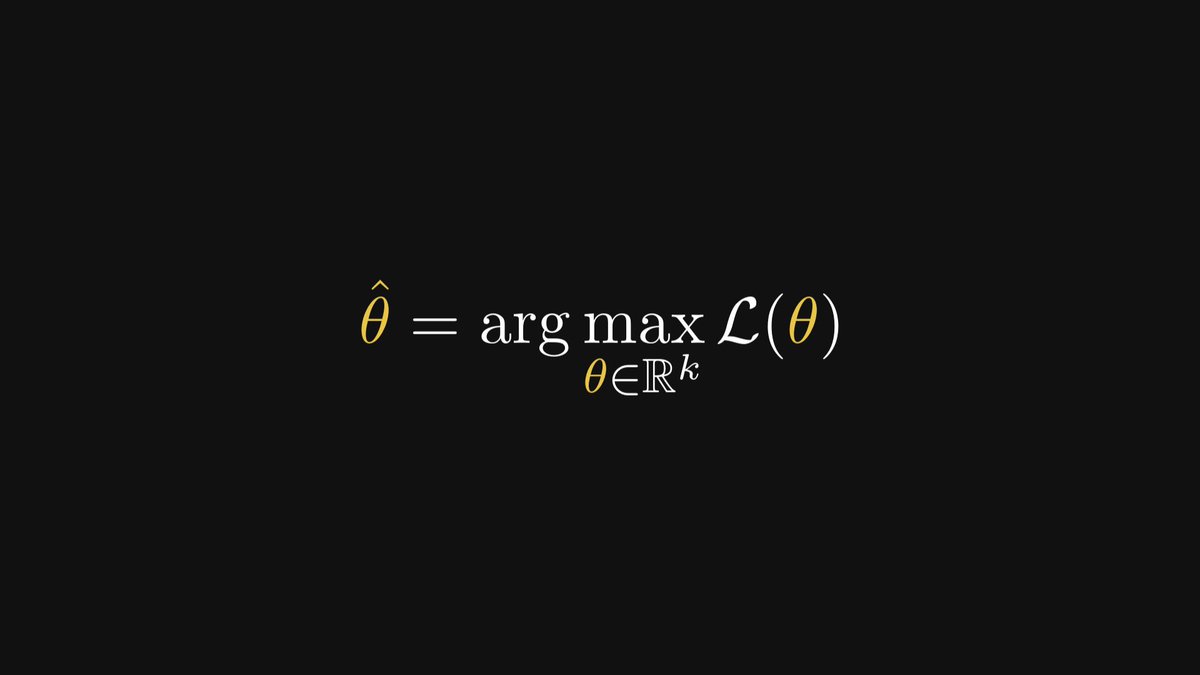
In machine learning, the maximum likelihood estimation is one of those.
Read on to find out why: