@jarredsumner would love the blog post to include: tooling speed and ergonomics for zig vs rust. how does rust compare to zig for compilation time? any change in ease of building for different targets? what rust features (traits etc?) are you leaning into and how do they help?
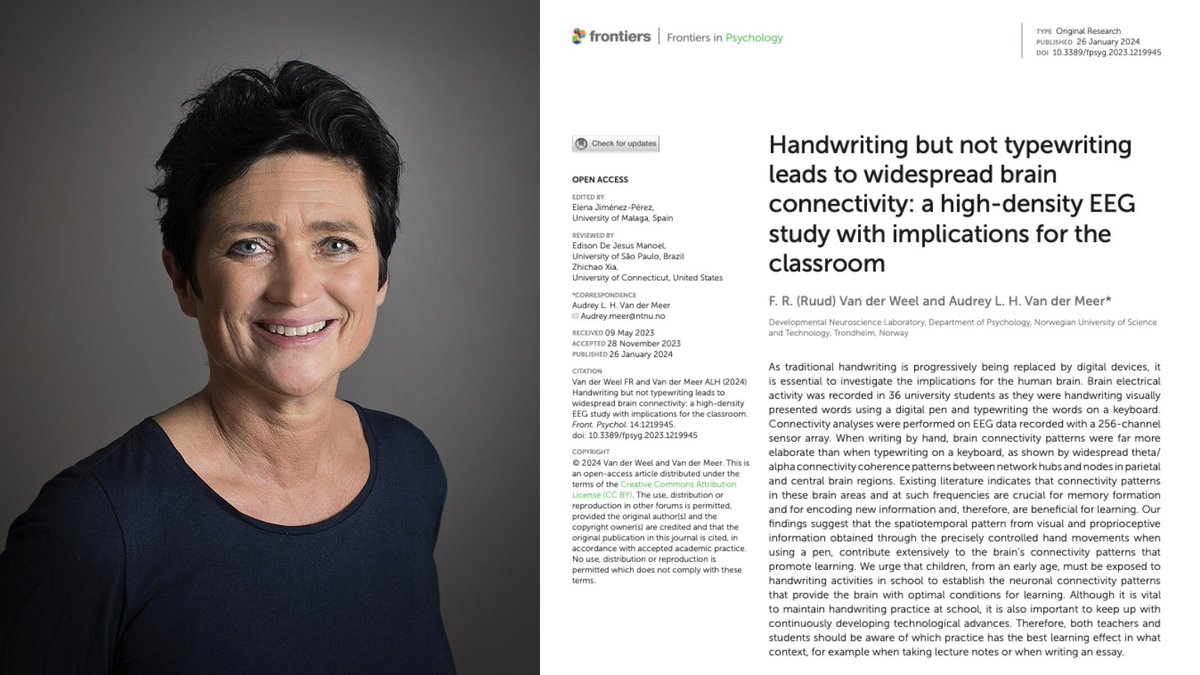
A Norwegian neuroscientist spent 20 years proving that the act of writing by hand changes the human brain in ways typing physically cannot, and almost nobody outside her field has read the paper.
Her name is Audrey van der Meer.
She runs a brain research lab in Trondheim, and the paper that closed the argument was published in 2024 in a journal called Frontiers in Psychology. The finding is brutal enough that it should have changed every classroom on Earth.
The experiment was simple. She recruited 36 university students and put each one in a cap with 256 sensors pressed against their scalp to record brain activity. Words flashed on a screen one at a time.
Sometimes the students wrote the word by hand on a touchscreen using a digital pen, and sometimes they typed the same word on a keyboard. Every neural response was recorded for the full five seconds the word stayed on screen.
Then her team looked at the part of the data most researchers had ignored for years, which is how different parts of the brain were communicating with each other during the task.
When the students wrote by hand, the brain lit up everywhere at once.
The regions responsible for memory, sensory integration, and the encoding of new information were all firing together in a coordinated pattern that spread across the entire cortex. The whole network was awake and connected.
When the same students typed the same word, that pattern collapsed almost completely.
Most of the brain went quiet, and the connections between regions that had been alive seconds earlier were nowhere to be found on the EEG.
Same word, same brain, same person, and two completely different neurological events.
The reason turned out to be something nobody had really paid attention to before her work. Writing by hand is not one motion but a sequence of thousands of tiny micro-movements coordinated with your eyes in real time, where each letter is a different shape that requires the brain to solve a slightly different spatial problem.
Your fingers, wrist, vision, and the parts of your brain that track position in space are all working together to produce one letter, then the next, then the next.
Typing throws all of that away. Every key on a keyboard requires the exact same finger motion regardless of which letter you are pressing, which means the brain has almost nothing to integrate and almost no problem to solve.
Van der Meer said it plainly in her interviews.
Pressing the same key with the same finger over and over does not stimulate the brain in any meaningful way, and she pointed out something that should scare every parent who handed their kid an iPad.
Children who learn to read and write on tablets often cannot tell letters like b and d apart, because they have never physically felt with their bodies what it takes to actually produce those letters on a page.
A decade before her, two researchers at Princeton ran the same fight using a completely different method and ended up at the same answer. Pam Mueller and Daniel Oppenheimer tested 327 students across three experiments, where half took notes on laptops with the internet disabled and half took notes by hand, before testing everyone on what they actually understood from the lectures they had watched.
The handwriting group won by a wide margin on every question that required real understanding rather than surface recall.
The reason was hiding in the transcripts of what the two groups had actually written down.
The laptop students typed almost word for word, capturing more total content but processing almost none of it as they went, while the handwriting students physically could not write fast enough to transcribe a lecture in real time, which forced them to listen carefully, decide what actually mattered, and put it in their own words on the page.
That single act of choosing what to keep was the learning itself, and the keyboard had quietly skipped the choosing and skipped the learning along with it.
Two studies. Two countries. Same answer.
Handwriting makes the brain work. Typing lets it coast.
Every note you have ever typed instead of written went into your brain through a thinner pipe. Every meeting, every book highlight, every idea you captured on your phone instead of on paper was processed at half depth.
You did not forget those things because your memory is bad. You forgot them because typing never woke the part of the brain that would have made them stick.
The fix is the thing your grandmother already knew.
Pick up a pen. Write the thing down. The slower road is the faster one.
@lemire@ladybirdbrowser@mitchellh Naive question: for a high performance library like this, do I need to recompile a program for my cpu to get the benefits, or is there some sort of "runtime" or "load time detection" to pick one of several compiled versions that will work best for my cpu?
Software horror: litellm PyPI supply chain attack.
Simple `pip install litellm` was enough to exfiltrate SSH keys, AWS/GCP/Azure creds, Kubernetes configs, git credentials, env vars (all your API keys), shell history, crypto wallets, SSL private keys, CI/CD secrets, database passwords.
LiteLLM itself has 97 million downloads per month which is already terrible, but much worse, the contagion spreads to any project that depends on litellm. For example, if you did `pip install dspy` (which depended on litellm>=1.64.0), you'd also be pwnd. Same for any other large project that depended on litellm.
Afaict the poisoned version was up for only less than ~1 hour. The attack had a bug which led to its discovery - Callum McMahon was using an MCP plugin inside Cursor that pulled in litellm as a transitive dependency. When litellm 1.82.8 installed, their machine ran out of RAM and crashed. So if the attacker didn't vibe code this attack it could have been undetected for many days or weeks.
Supply chain attacks like this are basically the scariest thing imaginable in modern software. Every time you install any depedency you could be pulling in a poisoned package anywhere deep inside its entire depedency tree. This is especially risky with large projects that might have lots and lots of dependencies. The credentials that do get stolen in each attack can then be used to take over more accounts and compromise more packages.
Classical software engineering would have you believe that dependencies are good (we're building pyramids from bricks), but imo this has to be re-evaluated, and it's why I've been so growingly averse to them, preferring to use LLMs to "yoink" functionality when it's simple enough and possible.
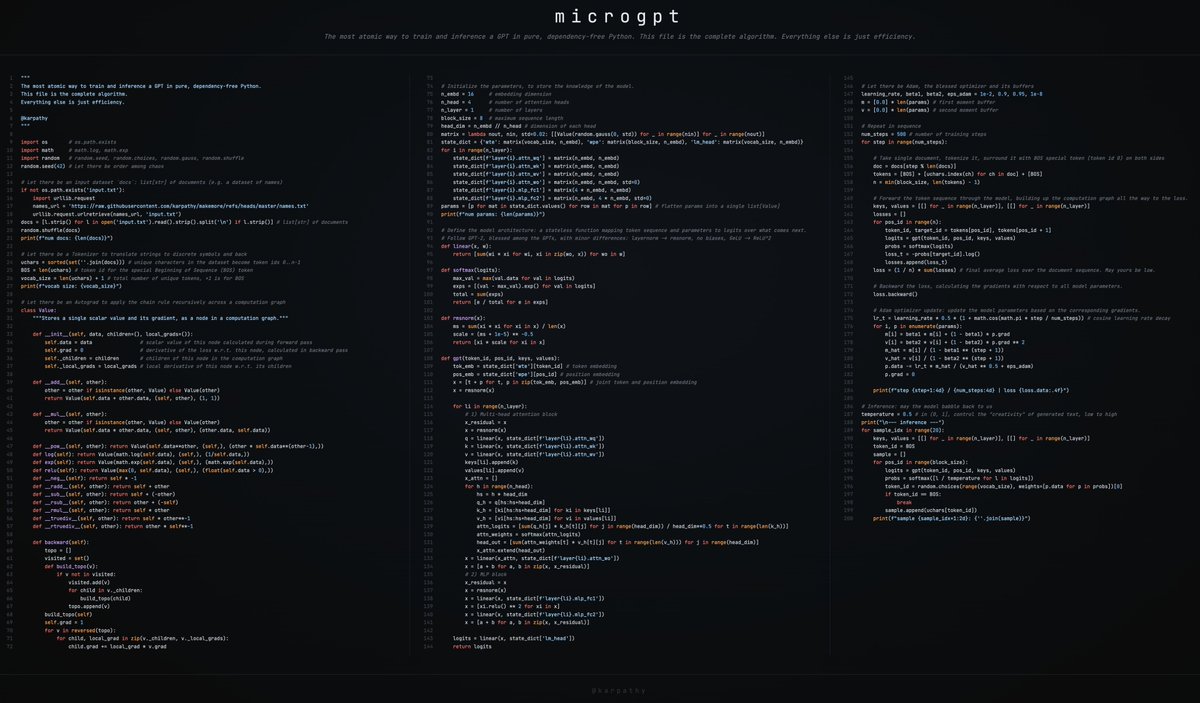
I spent more test time compute and realized that my micrograd can be dramatically simplified even further. You just return local gradients for each op and get backward() to do the multiply (chaining) with global gradient from loss. So each op just expresses the bare fundamentals of what it needs to: the forward computation and the backward gradients for it.
Huge savings from 243 lines of code to just 200 (~18%).
Also, the code now fits even more beautifully to 3 columns and happens to break just right:
Column 1: Dataset, Tokenizer, Autograd
Column 2: GPT model
Column 3: Training, Inference
Ok now surely we are done.
I had the following horrific experience today during a faculty meeting. I'd had a zoom call a few days ago with someone who was using an AI secretary - it recorded the call and emailed both of us a summary, complete with action items, etc. Oh that could be useful, I thought.
So I clicked the link in the email to see the summary. It asked me to login with my google account. I thought, what's the harm. (Famous last words!) I glanced at the summary, deleted the email and forgot all about it.
Today we had a department meeting about sensitive topics. Then the AI secretary joined the call and announced to everyone via chat that it's there to help *me*, that it will be recording, transcribing, and analyzing the conversation. I panicked and logged off the zoom call, joining the meeting from a colleague's computer. But that didn't kick the AI off, it was still in the meeting! I don't know how it got in the meeting in the first place (perhaps it read the zoom link in my google calendar? I didn't think I gave it access!...). The chair had to manually boot it out of zoom, and even then I wasn't sure that it wasn't still recording us. How mortifying! (After the meeting, I googled how to get rid of it.)
Having lived through a similar, nationwide version of this in Trump's model, Putin's Russia, it’s not easy to fight against. And Trump and many of his gang have passed the point at which they feel they can afford to lose power, even in Congress. It’s a perilous moment.
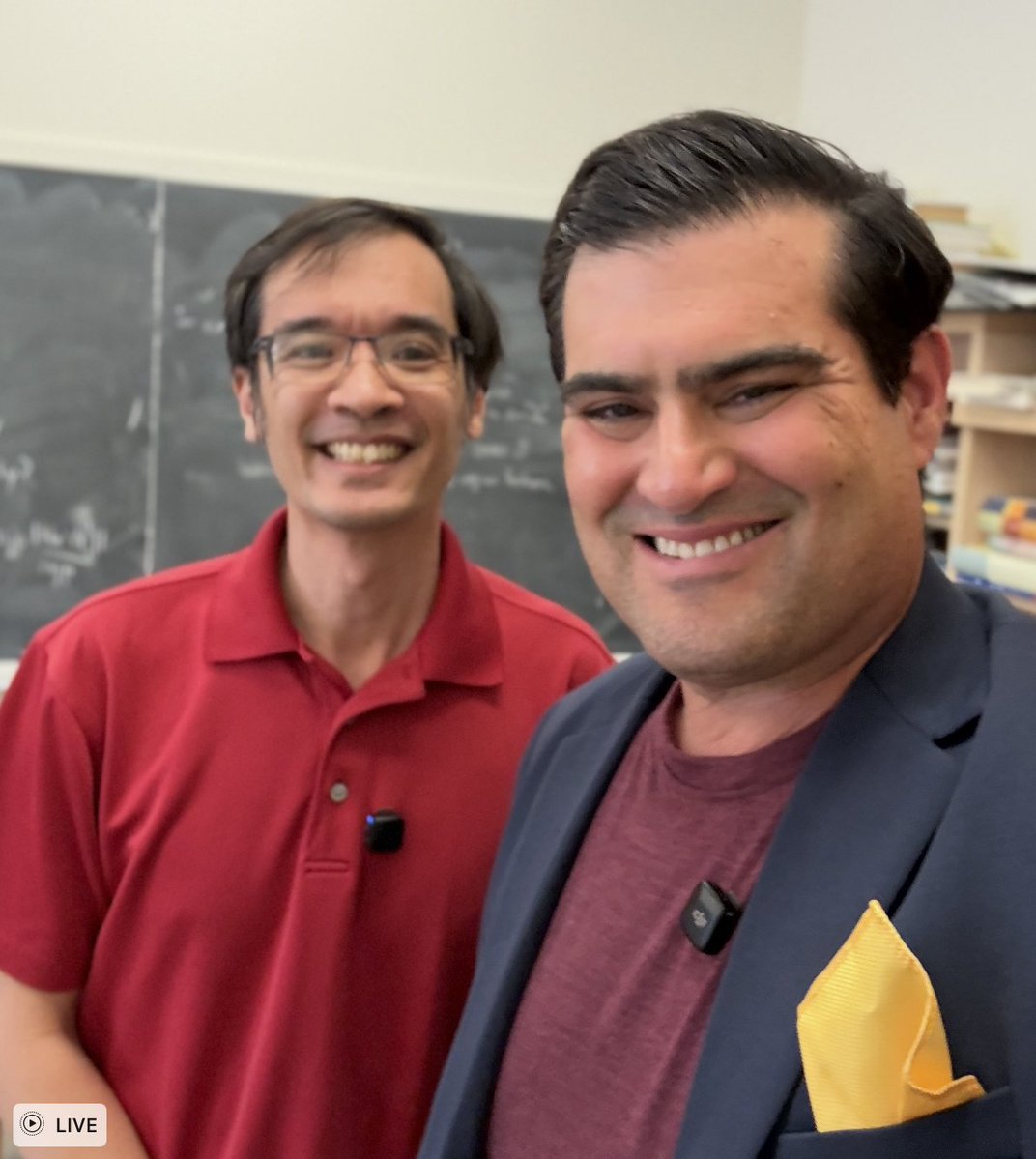
Terry Tao told me something wild:
America’s greatest living mathematician had his approved federal research funding erased overnight—no warning, no explanation, no scientific reason. If this can happen to Terence Tao, what does it mean for every young scientist trying to build a career?
In this conversation, Tao explains:
• how “trigger words” like inequality now get grants auto-flagged
• why arbitrary rule changes are destabilizing U.S. research
• the hidden math powering nearly every modern technology
• what happens when political turbulence hits pure science
Bonus: we almost get hit by an autonomous vehicle!
If you care about science, this one matters. Link in reply