AI/ML engineer, MSc Math & AI. I love building agents and the tooling around them, still figuring it out as I go. Open source, local models & agent safety.
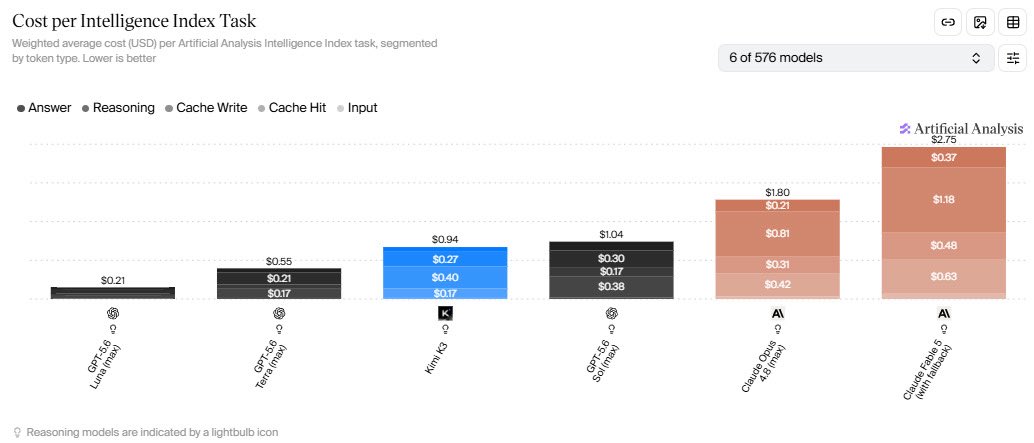
Kimi K3 may be an important inflection point for AI. Potentially negative for Anthropic and OpenAI while being net positive for essentially every other company in the world. I mean that very literally. Although the real “Sputnik moment” would be an open-source frontier model that was also token efficient unlike Kimi K3 which is 50-70% more expensive to run than GPT 5.6 per Artificial Analysis.
Rationale:
A world where there are only 2-3 dominant frontier labs with 90% inference margins is net negative for every other layer while being awesome for those 2-3 labs. Those labs would become monopsonies for power, data centers, semiconductors and hyperscalers and would obviously vertically integrate over time into all those layers while also completely subsuming the application/software layers.
Anything that lowers margins and increases competition at the model layer is good for every other AI layer: power, semiconductors, hyperscalers, neoclouds and yes even software.
This is why Jensen is so supportive of open-source. An open-source model requires the *exact* same amount of compute to run as a closed frontier model of similar size and architecture. Kimi K3 is roughly the same price as GPT 5.6 Terra on a per token basis, which actually suggests that it is less computationally efficient as I am sure that GPT 5.6 is priced to a higher margin than K3. And given that K3 is a token wastrel, i.e. token inefficient, it is significantly more expensive per task than GPT 5.6 and Grok 4.5, which are much more token efficient. Cost per token and token efficiency (i.e. intelligence density per token) are the drivers of intelligence per unit of cost. The winning AI companies will be those that offer the most intelligence per $ over time.
Lower margin % at the model layer = more margin $ at every part of the infrastructure layer and is a godsend for software. This can happen either through open-source models like K3 at the frontier *or* having a vertically integrated model company like Meta, SpaceX or Google at the frontier. Both outcomes result in a lower margin % at the model layer as vertically integrated model companies don’t really care where the margin $ come from. This is why it was so painful for OpenAI and Anthropic when Google was right there with them from a model competitiveness perspective and why Grok 4.5 and Muse 1.1 were just as important as Kimi K3.
The reason Kimi K3 is only *potentially* negative for Anthropic and OpenAI is 1) the @ericvishria point that the Claude and ChatGPT products and harnesses may be more important than their models today and 2) the hypothesis that they have much more advanced model checkpoints internally that are already being used for RSI. In the latter scenario, reaching RSI even a few months ahead of other labs might be enough to cement a permanent lead.
Time will tell on both points. And likely fairly quickly.
Caveat would be that since Kimi K3 is not token efficient and thereby actually more expensive than ChatGPT 5.6, we may need to see a more token efficient open-source model at the frontier or see Grok 5/Composer 4/Muse 2 at multiple points on the Pareto frontier for this potential risk to Anthropic and OpenAI to play out. And I am sure they will both vertically integrate as quickly as possible while continuing the product/harness strength they have shown over the last 8 months.
A model story to follow
Kimi K3 in the next few hours. Deepseek V4 GA later in the week. New Liquid models. New Mistral models sometime this month. And some rumours suggest GLM 5.5 is coming in August. Openweight AI is eating good.
#DeepSeek#AI
https://t.co/kTgP11aJji
@morganlinton@VulcanBench The main question is why I use Kimi 3 with the same or nearly the same price usage as Claude? Iam talking about actual usage not the price per 1m token .
Nuqasm/Qcap: Open, offline, tamper-evident provenance for AI models, agents, and quantum workloads , prove what ran, on what hardware, under whose authorization.
#AI#GitHub
https://t.co/yCAcelJRyk
TypeScript teams should standardize on satisfies over type annotations for any object literal that needs both a structural check and preserved literal types.
#TypeScript
kimi k3 this morning, gpt 5.6 sol by lunch, claude fable 5 while i typed this tweet. at this rate a new model drops mid-sentence. i'm one guy with a normal bank account, not a research lab. i cannot afford to date all of you.
TypeScript teams should adopt discriminated unions as the canonical shape for any value that crosses a module boundary, especially error and result types.
The UN digital technology agency's initiative to improve trust in AI agents, covered by Reuters this week, is the first international-policy signal of the year that targets the agent layer specifically rather than AI in general. The framing matters. Existing AI policy work...