Here's my take on what a software factory really is
This is my talk from @aiDotEngineer NYC, and I decided to record a version for everyone to watch on X.
tl;dr - software engineering is becoming factory engineering, and there's new work (especially factory benchmarking) that engineers should start focusing on.
Claude writes about 90% of Claude Code's code.
From June to September, merged PRs more than doubled while the share reverted fell by more than 40%.
We wrote about how we changed code review to get there, and how to adopt it:
https://t.co/9sZe64g3mb
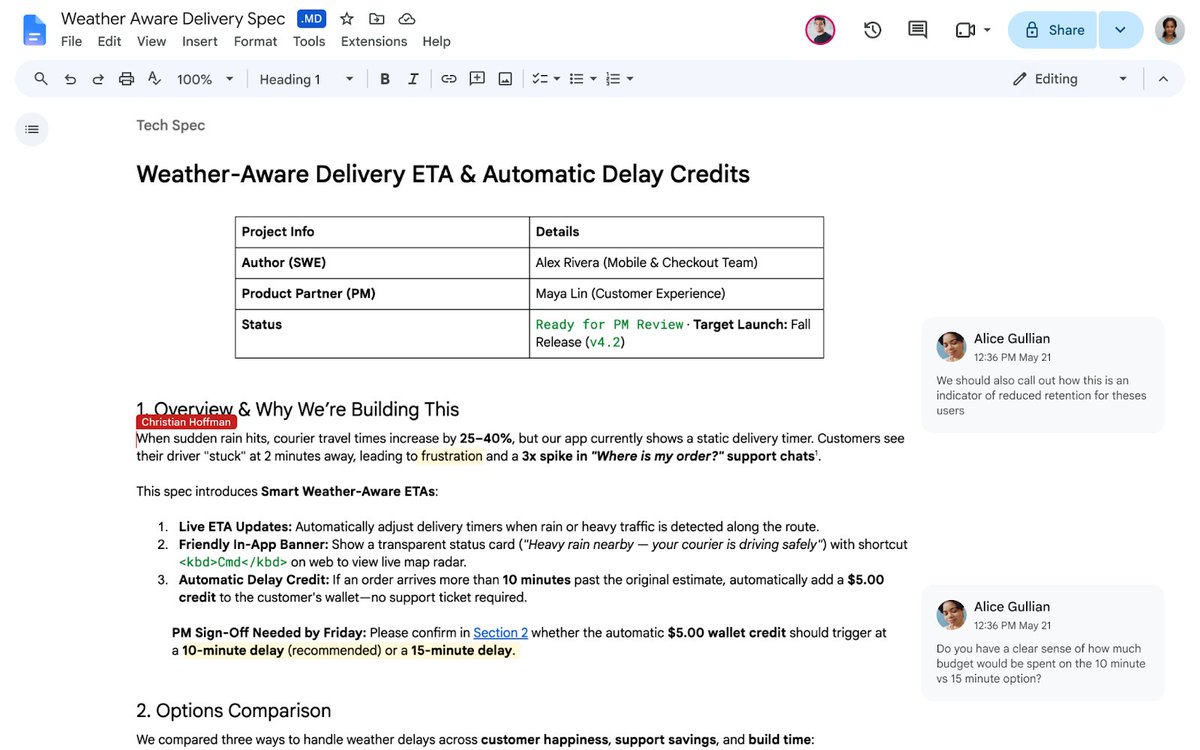
We are making Markdown files work natively across Google Drive and Docs.
You can now preview .md files in Drive, open them in Docs, edit them, comment on them, and collaborate without converting the file into a Google Doc!
👀 Introduce https://t.co/BlxTwFWVTn
Categorize changes in Pull Requests into logical groups, with a summary. Helps you do reviews more efficiently by focusing on what matters.
With opt-in GitHub userscript, GitHub Actions, or CLI for local git changes!
Watching an ex-YouTube engineer rebuild YouTube in 45 mins is quite fun.
Mikhail (@AstraliteHeart ) spent 8 years at YouTube. When we first met, I asked him how much of it he could rebuild in an hour. He said let's find out.
Here's the result. Let's see how much he actually gets done.
This is an extremely good watch.
The things that felt novel/interesting to me:
1. Lock down your agents
Humans tend to like 'sharp knife' abstractions - that are powerful, but you can cut yourself if your use them wrong. Lauren says agents perform much better in extremely locked-down environments. Abstractions are designed so they can't screw up, and lint rules enforce it.
They built a whole internal framework (Dune) to keep the agent on track.
That helps optimise agents that don't have a large context window to work productively in your codebase.
2. Create verification infrastructure
To trust the results of any agent, you either need to sit and watch it OR have it provide evidence of its improvement. This has always made sense to me, but Lauren really pushes it hard here:
- Invest in custom CLI's that let the agent drive the app and measure its performance
- Make the app "factory ready" from the get-go - i.e. deployable to an environment where the agent can mess about with it
3. Feature Maps
Lauren's software factory (what she calls an 'outer loop') often requires the agent to break down vague bug reports from users and to turn those into potential fixes.
To aid that, they built a 'feature map' of all the main features in their application, which describe exactly how the app is supposed to function.
This has become essential for helping the agent navigate the codebase, and figure out quickly how things are supposed to work. It's maintained along with the codebase, and kept in sync via automations.
This is the kind of documentation I usually warn against. It goes stale quickly and can confuse agents if it's not kept up to date.
But Lauren's team are using it as critical navigation infrastructure, and it makes it possible for agents to explore faster and better - even on a large codebase. So it sounds like navigation docs like this are worth it if they enable new behavior.
Banger talk - watch the whole thing on 2x.
Try these in your first Opus 5.5 session:
→ Hand over a whole task. Define "done" and when to check in.
→ Drop "think carefully". It always thinks first.
→ After a long run, check what it needs to go further.
Our playbook: https://t.co/h4Vz9BIl0z
After co-inventing ChatGPT, I kept asking myself: why have superhuman chat models not led to AGI?
I’ve spent the last 2 years in stealth building a new way to train models (RLCD), and a new type of frontier AI model that we are releasing today: Jev
• 20-200x faster
• 40-400x cheaper (w/ output tokens free)
• Frontier composable intelligence optimized for decisions
AFAICT the shortest path to AI-based economic revolution
Sometimes it's easier to show than tell. We're sure this update will help with that. 👀
GitHub CLI now has a repeatable --attach flag that uploads a local image or video. Reference it inline in an issue, pull request, or comment body.
Available now to all users on GitHub across all plans. 🎉
https://t.co/2oRtlSHdPT
Lookin for an AI-native SDLC playbook?
@AnthropicAI just published a detailed one.
It keeps the standard SDLC stages (plan/design/build/test/deploy/maintain) but reframes the process from a linear flow to artifact-driven loop. Interesting read!
https://t.co/n23whO4oIq
a skill people at Anthropic have been using a lot recently: ELI5
/eli5 <what you want explained>
"explain like I'm someone who knows nothing about this topic, using a HTML artifact with big pictures and few words"
Sweep — disk hygiene for developers.
Finds the gigabytes your toolchain is sitting on, and tells you what each one costs to delete before you delete it.
macOS, free, open source.
brew tap moelzanaty3/tap
brew install --cask sweep
Meet Sweep — a modern macOS cleanup app, built developer-first.
Your Mac sits on gigabytes of npm, pip, Cargo, Docker and Xcode cache.
SAFE regenerates. REBUILD costs a build. PROTECTED is never picked for you.
Free, open source: https://t.co/unt5H5hvgJ
I got tired of guessing which cache was safe to rm -rf.
So I built Sweep: a macOS app that finds every package manager and toolchain cache, then labels each one by what deleting it actually costs you.
Trash by default. No telemetry. MIT.
https://t.co/unt5H5hvgJ
A Chinese developer just explained the shift from Loop Engineering to Graph Engineering better than anyone.
most people are still building agents the way that's about to be obsolete.
> why single-agent loops break and go "goal blind"
> the 4 parts of a graph: nodes, edges, state, policy
> 3 topologies that run everything: diamond, supervisor, pipeline
> Anthropic's 5 official workflow patterns
the punchline: it's not how many agents you run. it's the determinism you build with verifiers, code fallbacks, and reality anchors.
I broke the same architecture down with Kimi K3. Full A-Z guide below.
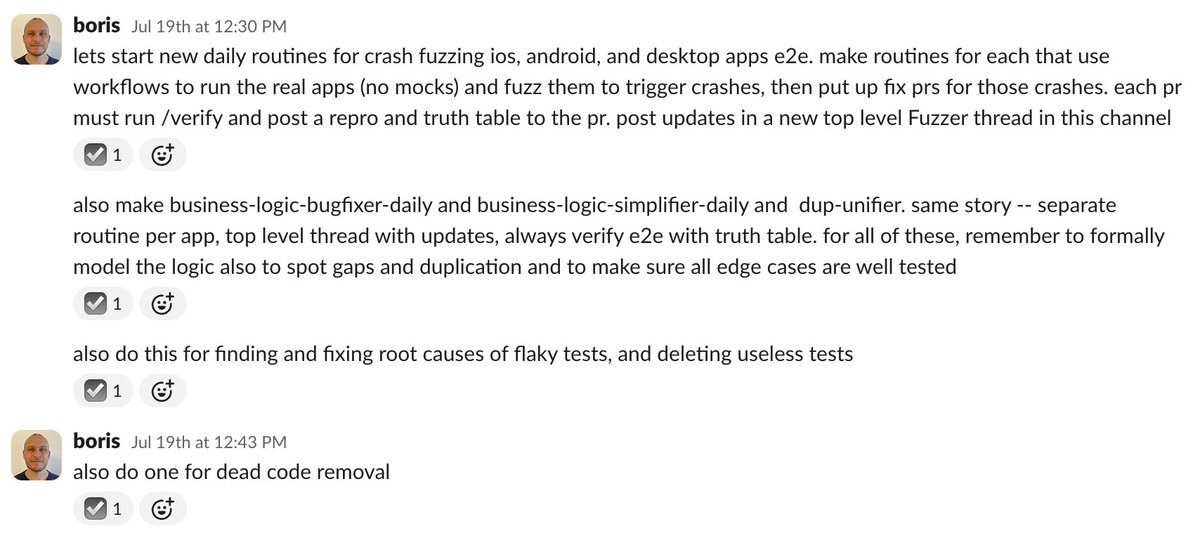
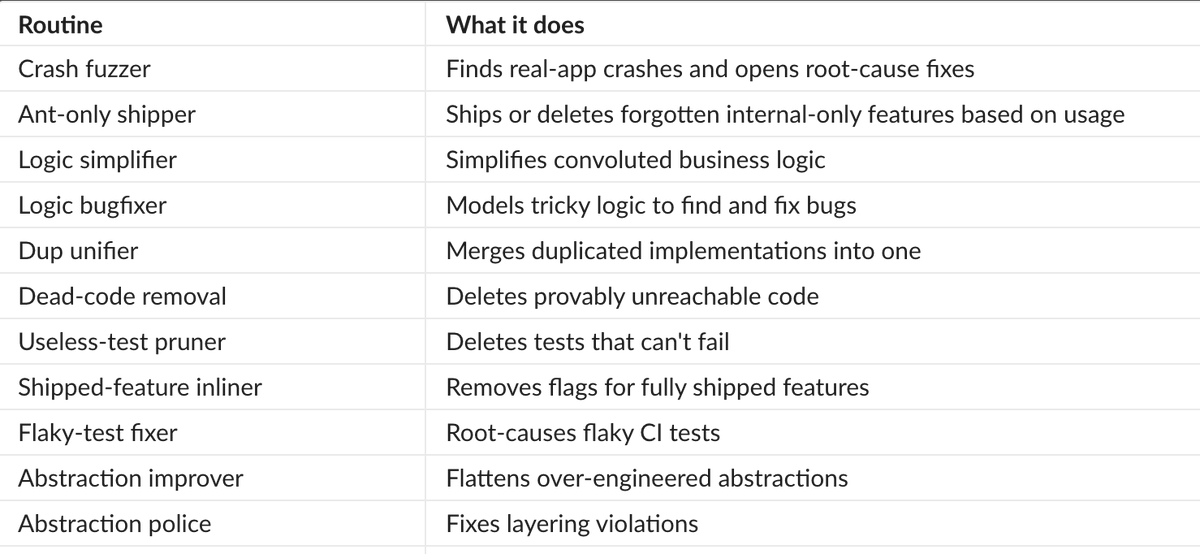
A weird experiment I've been trying the last few weeks is having Claude take over day-to-day maintenance of our apps. Seeing early signs of life that this might be possible.
The setup is straightforward: we have a Slack channel called proj-claude-maintains-apps. In it, Claude Tag runs a bunch of daily routines across iOS, Android, Desktop, web, CLI, and Agent SDK:
- Crash fuzzer: open the app in a simulator and tap around to find ways to crash it, then root cause and fix the crashes
- Dup unifier: scans the codebase for similar-yet-slightly-divergent abstractions, and puts up PRs to unify them
- Dead-code remover: removes statically unreachable code, and adds logging to suspected dead code to check if it's really dead and if so, remove it the next day
- Abstraction police: fixes leaky abstractions
- a bunch more..
Results have been surprisingly positive. Over the last few weeks, these routines have opened 388 PRs across our repos, 180 of which we merged after Claude Code Review + human review. We're now thinking about how to streamline this to make merging these kinds of mechanical changes easier.
Claude generally gets these PRs right on the first shot, and if it doesn't, we ask Claude to tune its routines so it's better the next day. Sometimes it takes a few days of tuning.
To try a similar workflow, ask Claude Code or Tag, or create some routines directly at https://t.co/Z70hStEBH6. A few of the actual prompts I used below.
Has anyone experimented with similar workflows?