Catching skin cancer early is a home robotics problem.
Melanoma is highly treatable when detected early, yet today’s screening process depends heavily on patients noticing tiny changes across their entire skin surface. This requires patients to solve a near-impossible visual-memory and registration problem.
I built OpenDerm, an open-source 4-DOF robot that captures high-resolution images of the skin and uses them to reconstruct and track the skin surface in 3D over time.
The best way to make skin screening truly routine is to bring it into the home. OpenDerm shows that inexpensive robotic skin imaging is possible, but the path to scale is not a dedicated screening robot in every household—it is to make skin screening one of the many useful things a general-purpose home robot can do.
Read more about why I built OpenDerm and how it works here:
Blog: https://t.co/KYlNIkF3TV
Project: https://t.co/c9d4KuwXUP
Extremely mathematically and verbally precocious kids show three physiological characteristics well above general population rates:
left-handedness or ambidexterity (19 to 21% versus 10%), symptomatic allergies (54 to 57% versus about 10%), and myopia (53 to 76% versus about 15%).
There is a graded pattern, with lower-scoring (but still precocious) kids and their parents and siblings having all three rates elevated as well, though less dramatically (Benbow & Benbow, 1984).
These findings come from the Study of Mathematically Precocious Youth (SMPY), which doesn't rely on self-selected samples the way studies of Mensa members do, since youth were identified through statewide testing.
Our world is guided to some degree by people who aren’t principled in this way. Unless the unprincipled are barred from creative influence and especially from power, your principled action won’t spread outwards (except in the cases where your show of faith infects!)
The magic of older texts is the grammar, which holds together thoughts in foreign ways. By reading the ancients, what we know becomes newer, refreshed by the displacement of seeing how far we have come. It is like how a reflection in a mirror appears at double the distance.
@jumdude Ah I felt that too with map miscalcs leading to huge score loss. Easier to maintain points with timeline.
But I think your strat around decomposition/late-production is just accurate - civilization had several setbacks in the americas and all.
In summary, to ensure healthy cholinesterase levels, optimal brain and muscle function +tissue protection
Don’t:
— be isolated
— get traumatized
— eat/breathe pesticides
— be high estrogen
— be hypothyroid
— be high cortisol
— be hypoglycemic
— live in darkness
— be low altitude
@janhkirchner I'm a big fan of this line of thinking that prioritizes 'feature engineering' (although I've only just opened the article, I'll see if that's actually the case!)
The mistake is assuming that there is psychological complexity or meaning to this sort of loserslop.
There isn’t.
Well you have to have your philosophy and assumptions worked out and airtight, choose your God so to speak, but beyond that you just need to get your metabolism up.
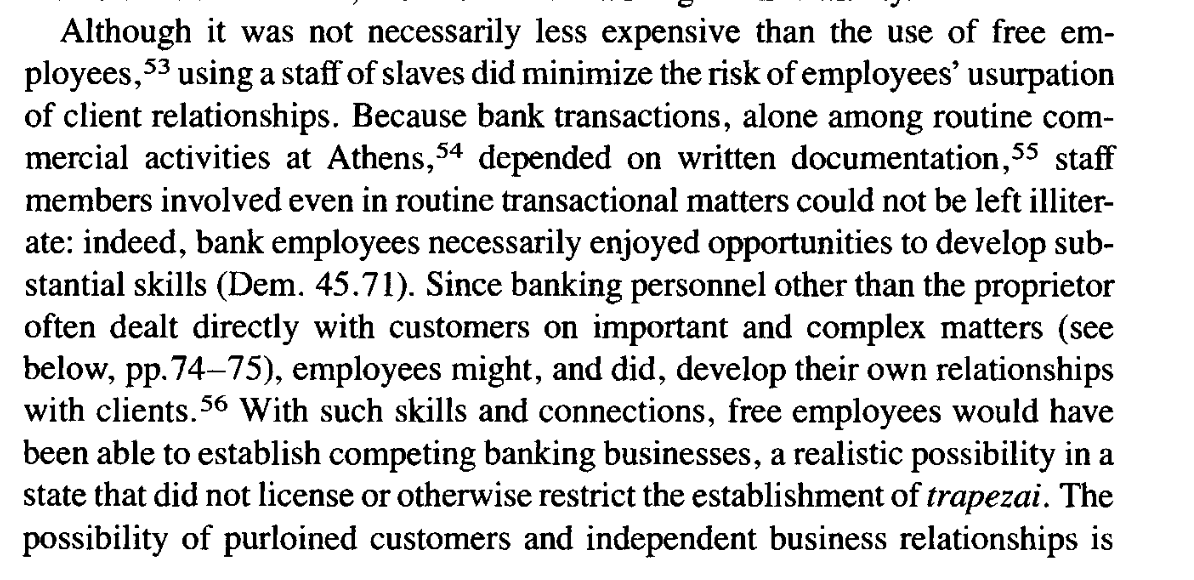
Bankers preferred using slaves despite being equivalent in expense with free labor, because slaves could not take their expertise and relationships and establish competing banks.
This meant banking provided opportunities for slaves to advance significantly.
Have no interest in treating organisms as a semantic turf war. The functional relations within life's emergence embody a complex multiscale network that have different topological characteristics depending on how you view them. One functionally meaningful lens is hierarchy as the processual precipitate of organizational centrality.
Those who have issues w/ authority, often because they've been disproportionately exposed to corrupt authority, but also because our lineage to some extent conserves this temperament, bristle at the notion that hierarchical centralization plays an essential functional role. Nonetheless, it's an undeniable aspect of life's emergent coherence.