Quick renders after building my own AI model for interiors (here kitchen, but also works for bedroom and living room in 🧵). No image adjustments, no scaling, straits from GPU 😂. Not perfect yet, but way better lighting and lines, room style that doesn't exist by default, etc.
Sometimes I try to be gentle when it comes to disagreements about technology choices, but I think it is time to start speaking more plainly.
#Elixir, #AshFramework and @elixirphoenix are by a wide margin the best choices to build your business and core technology on top of. If you are building with other things, you're just making a bad decision, plain and simple.
No, that does not mean you are creating a barrier you cannot surmount. We power through bad decisions every day. Yes, there are specific things I wouldn't choose Elixir for. Mobile apps, hard real time number crunching etc. We have some answers for those that I might use if the use case is bounded and I can see that they fit well (NX etc.), but my unqualified "Elixir is better" is less strong in certain domains.
If you are writing a web server, APIs, ETL, etc. there is just flat out no other better option. Fight me bro.
I often say things like "well, I'm biased but ..." when qualifying that one should use Elixir, as I'm the author of #AshFramework, but that framing is getting old. I'm not biased. It's just better technology. I'm happy to debate it, and I don't think that anyone who disagrees with me is stupid, but I do think that they are wrong.
I don't believe in the "different strokes for different folks" thing anymore.
Hey Elixir friends, the screenshot below is all the realtime code you have to write for a chat room in Hologram (new in v0.9). 17 lines of code.
I'd love to take credit for all that simplicity :) But honestly it's an iceberg situation - what you see is the tip, and most of what makes it work sits below the waterline. Clustering, message routing between nodes, process supervision - none of that is Hologram code. It ships with the BEAM, the Erlang VM that's been running telecom switches for decades and powers WhatsApp today.
The cluster can grow or shrink and broadcasts keep finding every client connected to it - I didn't write a single line of that routing.
What I did build is the layer in between, the part that turns all that raw capability into a declarative API. It sounds like a thin wrapper but it really isn't - there are tombstones, client-side receipts, and a bunch of other machinery underneath whose whole job is keeping those one-liners correct without the developer ever noticing.
That's the quiet superpower of building a web framework on Elixir - the BEAM takes care of the distributed systems part, so all my time went into the layer developers actually touch.
What's the biggest thing the BEAM has saved you from building?
Elixir v1.20 released! Now officially a gradually typed language: Elixir type checks every single line of code, finding bugs and dead code, without developer overhead (no typing signatures) and extremely low false positives rate. Plus a faster compiler! Links and reports below.
@hunvreus As Luis Enrique said : ”C'est catastrophique !”. On a les talents, les idées, les moyens, mais ces carcans (idéologiques, politiques, etc) nous empêchent d'avancer.
I just got lost into the French 🇫🇷 « indie hacker » bubble, and wow
- Everyone’s telling everyone what to do, convinced they know better
- Super agressive and/or sarcastic, bitter tone everywhere
- Linkedin-like bullshit content full of big words by people with no experience
- Almost no products, no links, no websites, no proof, never heard or saw most people
- Everyone criticizing everything
I scrolled for half an hour…
What’s going on with my fellow French people? Couldn't we be a little nicer and more humble?
What if we could run Postgres as a single file, and take advantage of the best SQLite has to offer?
Today I am announcing pg-micro, a crazy experiment I've been undertaking to make this happen.
pg-micro is different than other approaches because it is fully local, and expected to be fast: there is no concurrency limitation and no statement translation.
Here's how it works: we use the actual postgres parser to parse the statement, but compile that to the Turso AST. The Turso AST is then compiled do bytecode, and from there everything executes natively, as it'd do in SQLite. This makes it a perfect target to run in any environment.
There is traditionally a mismatch between Postgres and SQLite in terms of functionality. But @tursodatabase has been hard at work to close this gap: things like MVCC and a rich, strict type system are present in Turso. There are PRs for things like lateral joins, etc. This means that the gap can be closed until it theoretically reaches zero.
What you could do with it? Just imagine for example a primitive like Durable Objects by @Cloudflare, but with a postgres interface? Or imagine you could use the same pattern of local databases for agents that SQLite gives you, totally ephemeral and free, but with a Postgres interface? Or even that you could execute remote postgres in platforms like @vercel but with the unmatched density of the Turso Cloud?
Expect lots not to work at this point. But as usual, this is done in the full spirit of OSS, so PRs welcome!
To get started: npx pg-micro
Si vous ne regardez qu'une seule vidéo aujourd'hui, regardez celle-ci. 2 minutes 28. Antenne 2, 1984. Elle est anthologique.
Sur le sujet de l'échec et du rapport culturel à l'entrepreneuriat, regardez cette vidéo. C'est Steve Jobs. Sur Antenne 2. En 1984. Le mec qui a inventé l'objet qui vous permet de partager vos idées marxistes depuis votre iPhone.
Et qu'est-ce qu'il dit sur la France ? Deux choses.
Premièrement, l'échec. Il dit que le problème fondamental de l'Europe c'est le rapport culturel à l'échec. En Amérique, à Silicon Valley, "on passe son temps à échouer, quand on se casse la figure, on se relève et on recommence". En France, si tu loupes ton coup en sortant de l'université, "cela vous suit toute votre vie". En 1984 il posait le diagnostic. 42 ans plus tard, rien n'a changé.
Deuxièmement, et c'est là que ça devient magnifique, il dit texto : "Il faut des centaines de mini entreprises de logiciels" et surtout "les capitaux à risque sont plus efficaces entre les mains du secteur privé" et "le gouvernement ne doit pas tenter de mettre la main dessus, elles doivent appartenir à ceux qui prennent des risques".
Steve Jobs, 29 ans, sur la télévision française, est littéralement en train d'expliquer aux Français que le capital privé alloué par des gens qui prennent des risques produit plus de valeur que le capital public alloué par des bureaucrates. En 1984. Sur Antenne 2. Devant Mitterrand.
Le mec qui a construit la boîte la plus valorisée de l'histoire de l'humanité vous disait il y a 42 ans exactement ce qu'on vous dit aujourd'hui. Et on est toujours en train d'avoir le même débat.
My dear front-end developers (and anyone who’s interested in the future of interfaces):
I have crawled through depths of hell to bring you, for the foreseeable years, one of the more important foundational pieces of UI engineering (if not in implementation then certainly at least in concept):
Fast, accurate and comprehensive userland text measurement algorithm in pure TypeScript, usable for laying out entire web pages without CSS, bypassing DOM measurements and reflow
Most online tools only optimize file size, but they're still reinflated in memory.
This tool will optimize your GLTF/GLB assets and export to GPU-compressed KTX2, entirely client-side.
Try it here: https://t.co/FydO3NEXjB
#threejs#gamedev
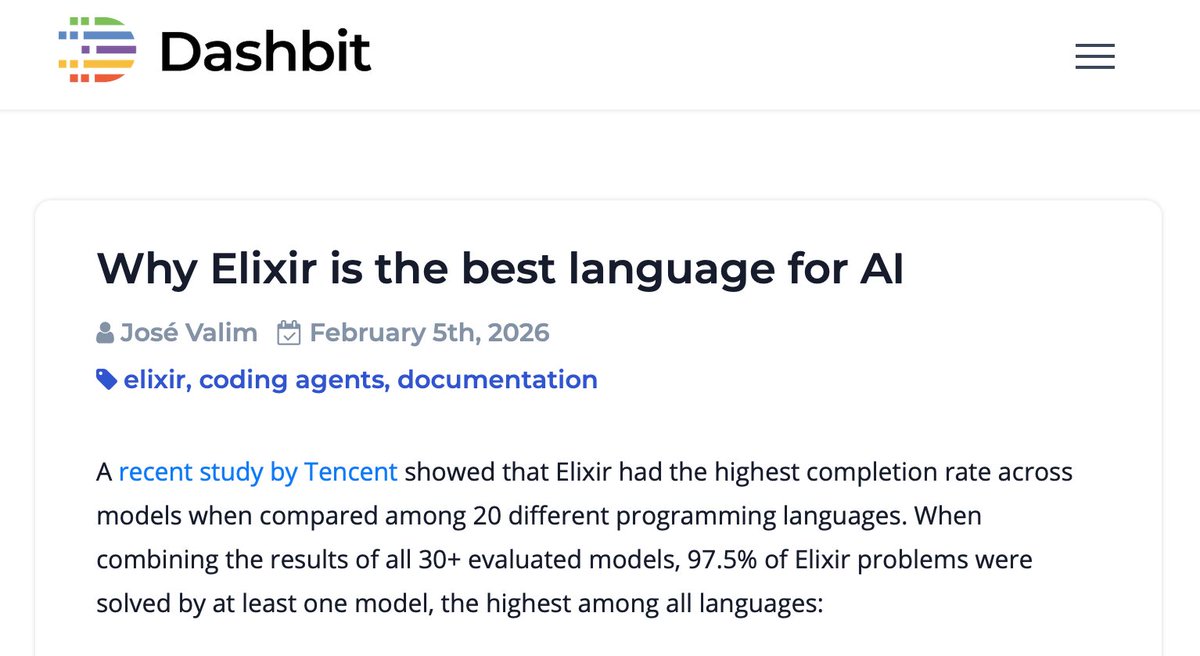
Here is my take on why Elixir is the best language for AI: immutability, documentation, stability, and tooling for coding agents.
It builds on the recent study in which Elixir had the highest completion rate across models among 20 different languages.
Link in the thread below.