Mojo in Jupyter is here 🙌
@jeremyphoward released a new Jupyter kernel that lets you run Mojo directly in notebooks.
It works great on macOS, supports recent Linux versions, and is easy to install via pip or uv.
Give it a try and let us know what you build!
https://t.co/3AN1UooKCd
#MojoLang #OpenSource #DeveloperTools
Tired to go back to the original papers again and again? Our monograph: a systematic and fundamental recipe you can rely on!
📘 We’re excited to release 《The Principles of Diffusion Models》— with @DrYangSong, @gimdong58085414, @mittu1204, and @StefanoErmon.
It traces the core ideas that shaped diffusion modeling and explains how today’s models work, why they work, and where they’re heading.
🧵You’ll find the link and a few highlights in the thread.
We’d love to hear your thoughts and join some discussions!
⚡ Stay tuned for our markdown version, where you can drop your comments!
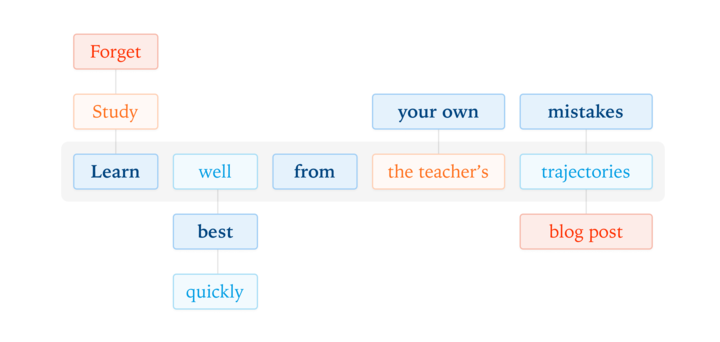
Our latest post explores on-policy distillation, a training approach that unites the error-correcting relevance of RL with the reward density of SFT. When training it for math reasoning and as an internal chat assistant, we find that on-policy distillation can outperform other approaches for a fraction of the cost.
https://t.co/JhpyWQOpBe
In diffusion LMs, discrete methods have all but displaced continuous ones (🥲).
Interesting new trend: why not both? Use continuous methods to make discrete diffusion better.
Diffusion duality: https://t.co/KPO56vDygp
CADD: https://t.co/CNOIWcUIMo
CCDD: https://t.co/2jOBIcZvQZ
@aryanvs_ Have you given Mojo a try for this? It has a bunch of infra and existing basic support for neon matmuls - I bet you could make it significantly faster!
Jeremy builds on his years of AI and teaching experience, embracing AI coding by using it the right way: increase productivity and understanding of code, rather than replace programmers with "vibe code".
solveit is an innovative platform to learn and build apps. Check it out! 👇
Makes sense. Mojo gives you the full power of the hardware, it doesn't "abstract" it like some other systems, so it is perfect for doing this sort of work.
It provides helper libraries that you can optionally use to make some things (incl tiling etc) more declarative, and provides full AI models that you can run to benchmark your code under real workloads. You can basic NEON and VNNI implementations here:
https://t.co/Ymg6TK4AxM
The folks on https://t.co/Fc822uz6qr or discord would be happy to provide pointers too if you're interested!