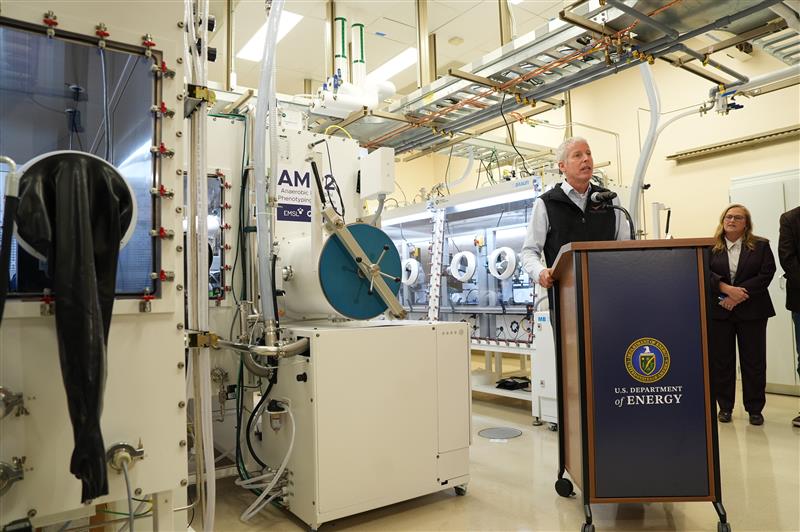
Yesterday, we were thrilled to join Secretary of Energy Chris Wright in dedicating the new Anaerobic Microbial Phenotyping Platform, known as AMP2, at the Environmental Molecular Sciences Laboratory (EMSL) situated on the campus of the Pacific Northwest National Laboratory (PNNL). The 1,800-square-foot facility will begin operations this month and will be available to scientists around the nation working with DOE to explore the characteristics of microbes that thrive in environments that lack oxygen. PNNL scientists believe that AMP2 is the world’s largest autonomous-capable science system for anaerobic microbial experimentation in the world.
This dedication marks a major step in redefining how biological science is done in the United States. AMP2 gives researchers the speed and scale needed to accelerate biotechnology discovery and strengthen the U.S. bioeconomy. Scientists will use AMP2 to explore questions about bacteria and fungi that play important roles in industrial processes to make chemicals, energy, fuels and biomaterials.
Ginkgo was honored to be chosen to build not just AMP2, but the larger facility for which it is a prototype: the Microbial Molecular Phenotyping Capability or M2PC. That facility will include 32,000 square feet filled with more than 100 high-tech instruments, all fully connected and automated. PNNL expects to break ground on M2PC next year.
Both facilities integrate three main components that are central to Ginkgo’s mission to make biology easier to engineer: AI-guided software, lab robotics capable of autonomy, and scientific expertise to power our economy and our planet.
Learn more here: https://t.co/lZb3ueoQwN
We’re proud to welcome @ENERGY@SecretaryWright to PNNL today!
Follow along for photo highlights of PNNL sharing its work in scientific discovery, energy resilience, and national security.
The Anaerobic Microbial Phenotyping Platform (AMP2) at @EMSLscience was commissioned today during @ENERGY@SecretaryWright’s visit to PNNL.
AMP2 will accelerate biotechnology discovery and strengthen the U.S. bioeconomy.
🦓 Hey, or do we mean neigh?
A #zebra has been spotted in western Washington! We think she's more interested in exploring EMSL's Tahoma than going to Tacoma.
Check out @EMSLscience's instrumentation for yourself: https://t.co/7qUryE43wA
#northbend
Tough loss but an exciting game and great visit to Mullett Arena - so great to see @ArizonaCoyotes in person! And we met our favorite hockey play-by-play announcer @mattycoyotestv!
Excited this to have this in mBio! Cochliobolus heterostrophus is one of nature's synthetic biology chassis and we can learn a lot about how microbes produce small molecules @jbei@jgi. Awesome to get to collaborate again with @Turgeon!
Proud to announce the publication of our latest manuscript “Conformational changes in the negative arm of the circadian clock correlate with dynamic interactomes involved in post-transcriptional regulation” in Cell Reports. 1/9 https://t.co/LOrXZAop8U
Conformational changes in the negative arm of the circadian clock correlate with dynamic interactomes involved in post-transcriptional regulation https://t.co/4hb8dfChaD
Could a zombie fungus be the last of us?
Hear what Scott Baker, who has spent his career studying fungi, has to say.
Read the article: https://t.co/IBnCi39SXE
Listen to the podcast: https://t.co/MsHe3jV4zl
@moldomics@TheLastofUsHBO#lastofus#fungi#fungus#cordyceps
Did @TheLastofUs leave you with a fear of fungi? Rest assured. It's fiction.
Listen to the latest Bonding Over Science podcast episode to hear fungal scientists talk about the underground world of fungi. https://t.co/azslfagGzc @doescience@jbei @NREL @moldomics@DSalvachua