🚀 Big news! I'm excited to announce that I'll be launching my independent research lab: Cell DAMAGE CONTROL at @SAHMRI in January 2027!
We'll investigate how cells detect and destroy damaged components, including harmful protein aggregates.
🔬 Detect. Destroy. Protect.
We've relied on doing a heart biopsy for decades to make important diagnoses. Now there may be a non-invasive blood test (liquid biopsy) that can do that! @CellCellPress today @SaumyaDas_Lab
https://t.co/9LfneFNE9G
Early-life stress may prime the brain for chronic pain and anxiety later in life, particularly in women, according to a new Science study in mice.
A neural pathway between two brain regions involved in pain and fear appears to drive this heightened sensitivity, the study’s authors report, and understanding this pathway could represent a therapeutic target for addressing chronic pain and anxiety in women with a history of childhood adversity.
Learn more: https://t.co/PF2NUN17oY
Extracellular vesicle budding is a vital cellular process that allows cells to communicate with each other and the microenvironment.
Release of vesicles to the extracellular space can occur through an internal pathway, whereby vesiclecontaining compartments fuse with the plasma membrane to release vesicles called exosomes, or by vesicle budding directly from the cell surface.
The latter occurs even at the surface of a primary cilium, a tiny antenna-like organelle that projects from the surface of most vertebrate cells. Although it makes up less than a thousandth of the plasma membrane, the cilium is a major signaling hub.
In a new Science study, researchers report that cilial budding does not rely on a complex machinery generally harnessed for extracellular vesicle formation but on the condensation of a single component of this machinery that drives the concentration of cargo and the release of vesicles from this structure.
Learn more in this #SciencePerspective: https://t.co/7X6JgTOEfi
Philosophers from the Stoics to Nietzsche and Daoists treated aging not as decline but as an opportunity to gain freedom, wisdom, and perspective.
https://t.co/21P3f1mkcU
Science moves forward when passionate minds come together. At the heart of India’s EV revolution, @InSEV brings our passionate research community together once again. Let’s continue our journey of collaboration and innovation. 𝐒𝐚𝐯𝐞 𝐭𝐡𝐞 𝐃𝐚𝐭𝐞 𝐟𝐨𝐫 𝐄𝐕𝐎𝐋𝐕𝐄 𝟮𝟬𝟮7
We made it! 🎉
@dfg_public has approved our new consortium at @UniKonstanz on how genes and environment "interplay" in toxic responses (GxE).
Grateful to our outstanding team of PIs for their commitment and to the reviewers for their trust!
📢 PhD positions coming soon!
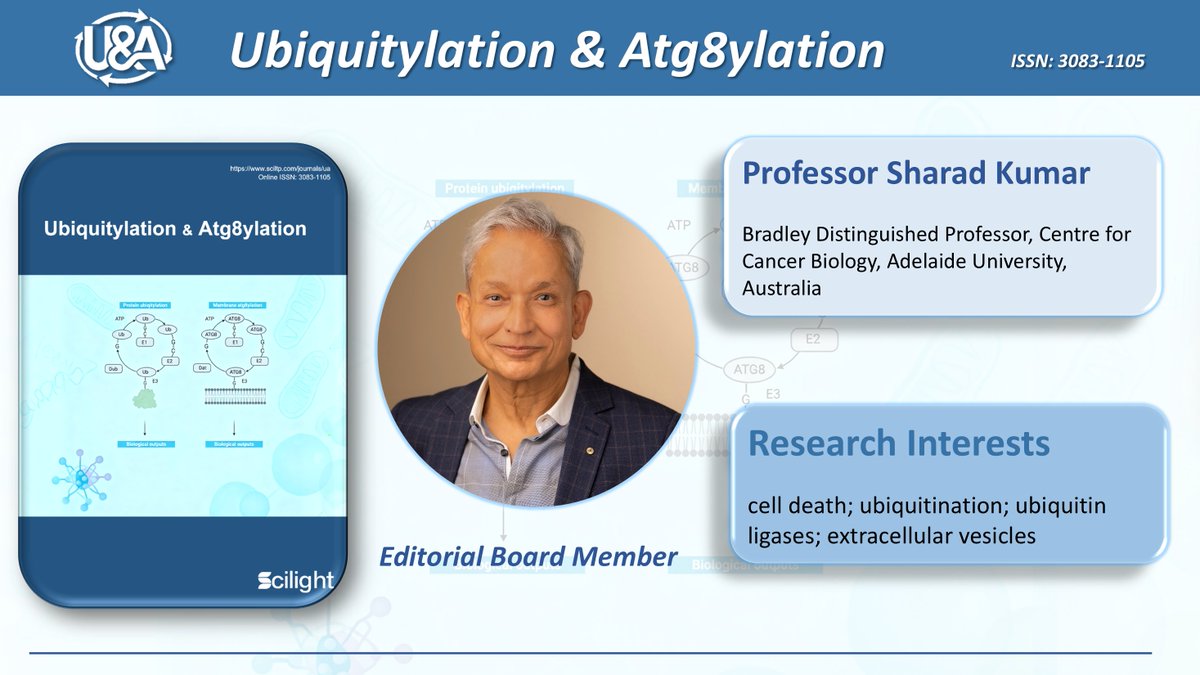
📢 Meet Our Editorial Board Member | Professor Sharad Kumar @molregulation
👏 👏 👏We greatly value his broad expertise in cell biology, ubiquitin signalling and disease mechanisms. Professor Kumar supports our journal a lot as we grow our community.
The #NobelPrize in Chemistry 2026 recognises discoveries that have enabled chemists to drive chemical reactions that lead to homochirality.
Life’s chemistry is what chemists call homochiral, after the Greek words for “same” and “hand”. Like hands, all amino acids exist as two mirrored variants, but only one of them is found in the proteins in your cells. The other is rarely found in nature.
For a long time, chemists wondered how homochirality can emerge. When they began to experiment with chemical reactions that can form two mirrored molecules, they always obtained equal proportions of both in their test tubes. However, chemists strived to produce only one of these mirror images, because in the development of molecules that will interact with living beings – such as in pharmaceuticals – only one mirror image will have the desired effect.
Thanks to laureates Henri Kagan and Kenso Soai, we now know how homochirality can emerge. Their discoveries have been decisive for chemists who design reactions for the manufacture of pharmaceuticals.
“In basic research, we want to learn more and more about how molecules behave and how they can interact – this year's prize fits into that.”
Immediately after the announcement, Peter Somfai, Member of the Nobel Committee for Chemistry, was interviewed by freelance journalist Sharon Jåma regarding the 2026 Nobel Prize in Chemistry.
Our latest paper has just been published in @Aging_Cell 🥳
https://t.co/f2HJFTh5To
Extracellular vesicles (EVs) from senescent cancer cells are not just passengers of the SASP. They are both necessary and sufficient to spread senescence to neighboring cells 🧵
Claude has discovered a previously unknown enzyme system hidden in the DNA of bacteriophages. Beside the enzyme’s gene sits a long array of repeating DNA—a structure that looks somewhat similar to CRISPR.
We don’t yet understand what this system does, but only a handful of known systems share its features, and all of them are able to cut, copy, and paste DNA. Historically, the discovery of such programmable systems has helped revolutionize medicine. CRISPR, for instance, is now the foundation of genetic medicines. But it will take much more work to learn what this system does, and whether it can be put to similar use.
Read more: https://t.co/RuEosScSMb