A heart surface is the zero set of one sextic, (x² + 9/4 y² + z² − 1)³ − x²z³ − 9/200 y²z³ = 0.
The first term alone is an ellipsoid squeezed to 2/3 along y. The x²z³ term lifts its sides into two lobes 1.237 high around a dimple at z = 1, and draws the lower half in to a point at z = −1. Every ray from the origin meets it once.
Taubin's original has 9/80 in the last term; 9/200 makes the upper half slightly slimmer front to back.
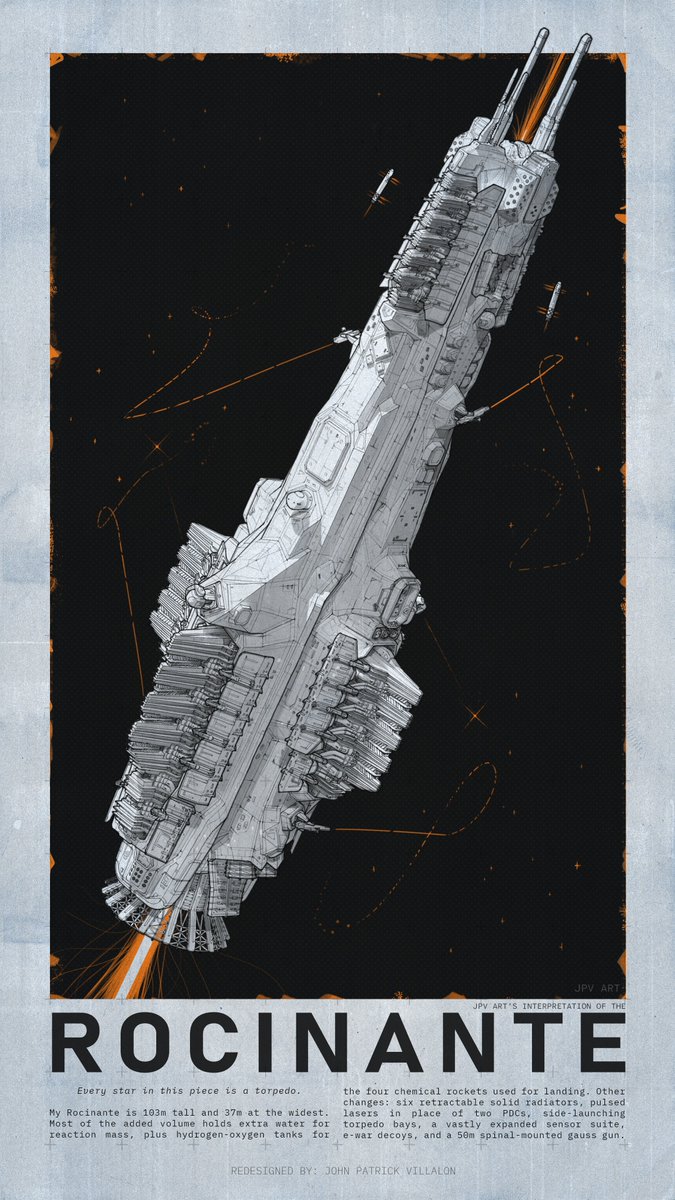
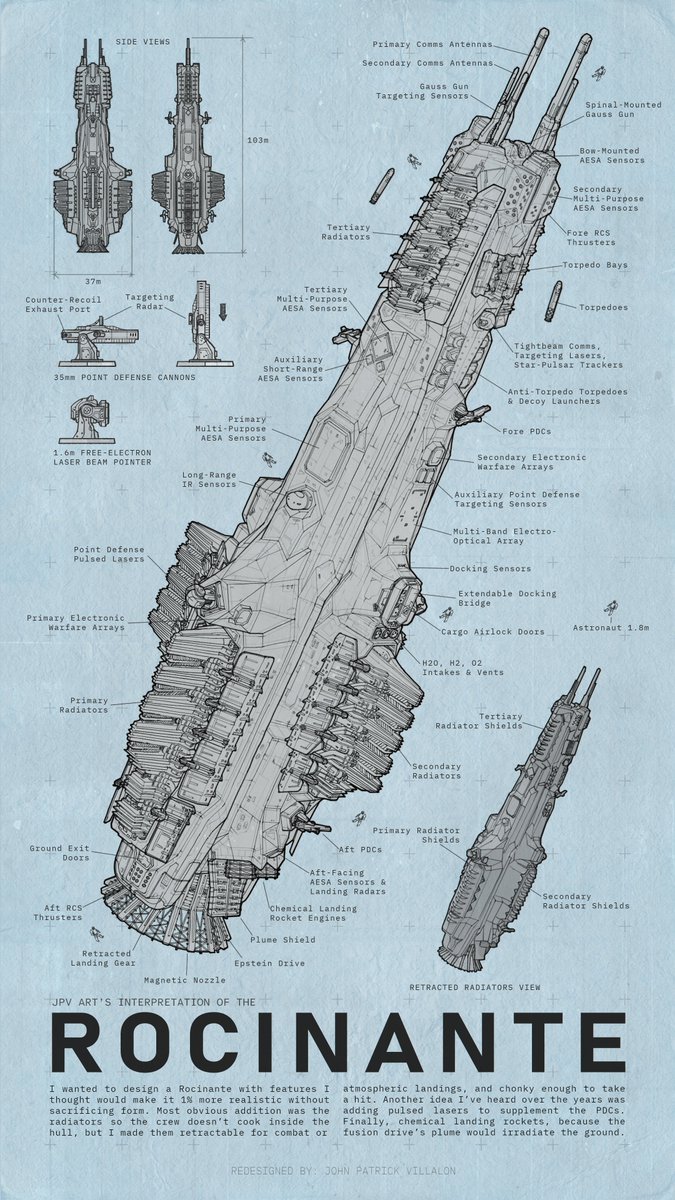
My redesign of The Expanse's Rocinante - 1% more realistic: bigger for more water (re-mass, RCS) and chemical rockets for landing. Shouldn't turn your landing pad into cancercrete! Also lasers? And radiators?
Someone please make a co-op Expanse ship-to-ship combat game. I beg u.
The outline of π, sampled at 2048 points, is a sum of circles: z(t) = ∑ cₖ eⁱᵏᵗ, the cₖ from its discrete Fourier transform.
Circle k has radius |cₖ| and turns k times per lap. With the N largest, the widest gap to the outline is 41.6 % of the letter's height at N = 1, 1.37 % at 64, 0.36 % at 256.
Finitely many circles make a smooth curve, and π has four sharp corners, so no chain is exact. The error stays below the sum of the radii left out.
Meet Morpho, a unique inspection drone developed by Elythor, an EPFL spinoff company.
It uses wind and adaptive wings to extend flight time and enable vertical and horizontal flight.
It can inspect power plants, power lines, turbines, pipelines, and offshore platforms.
How did engineers build the SR-71 Blackbird to fly at Mach 3+?
Titanium structure, specialized fuels, enormous J58 engines, and variable-geometry air inlets were all engineered around one goal: surviving extreme heat and aerodynamic forces at 80,000+ feet.
The crazy part? At Mach 3, the air itself becomes part of the propulsion problem.
A Galton board drops balls through 12 rows of pegs, and at each peg a ball goes left or right with probability ½.
Bin k collects the balls that went right exactly k times, and C(12, k) of the 2¹² equally likely paths do that, so P(k) = C(12, k)/2¹². The middle bin gets 924/4096 ≈ 22.6 %: here 227 of 1000 balls, against 225.6 expected.
With mean np = 6 and spread √(npq) = √3, the stacks close on the normal curve as rows are added.
🏁 That's a wrap! The @biohub Cell Tracking challenge on @kaggle has ended.
4,478 participants, 3,947 teams, 120 countries, 95,438 submissions, tracking every cell of developing zebrafish embryos in 3D over time. Thank you! 🧵🐟
https://t.co/Gwk2gk35kU
Twitter is best institute of research now. I never learned so many things so profoundly before. Unknown people without any prejudice creating basic concepts, learning physics once again.
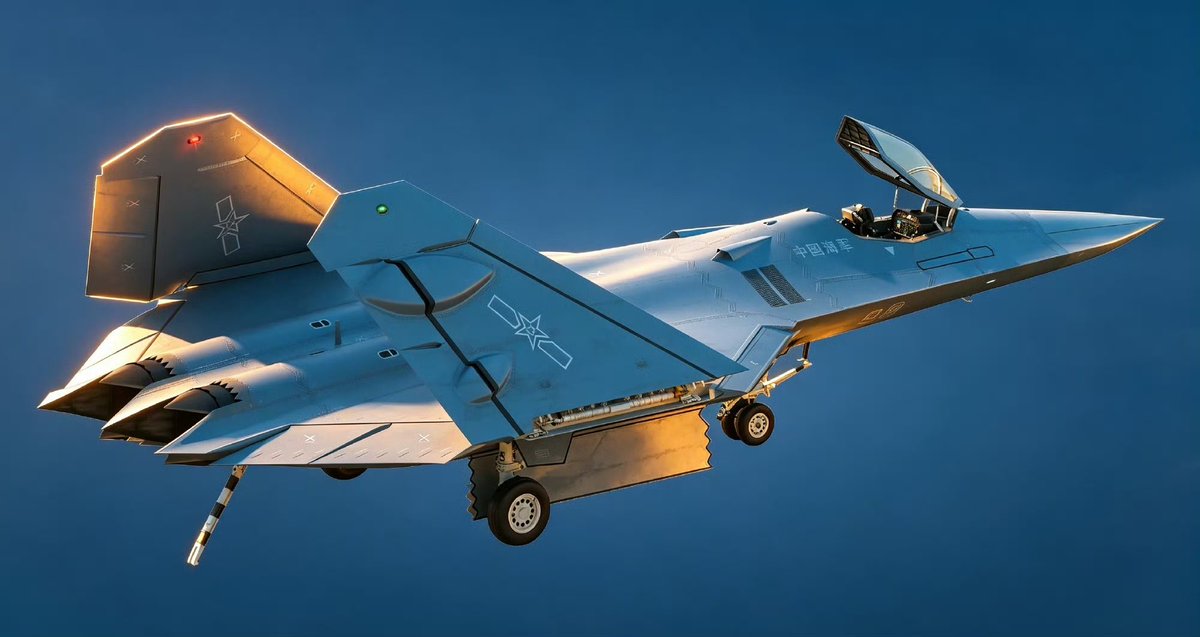
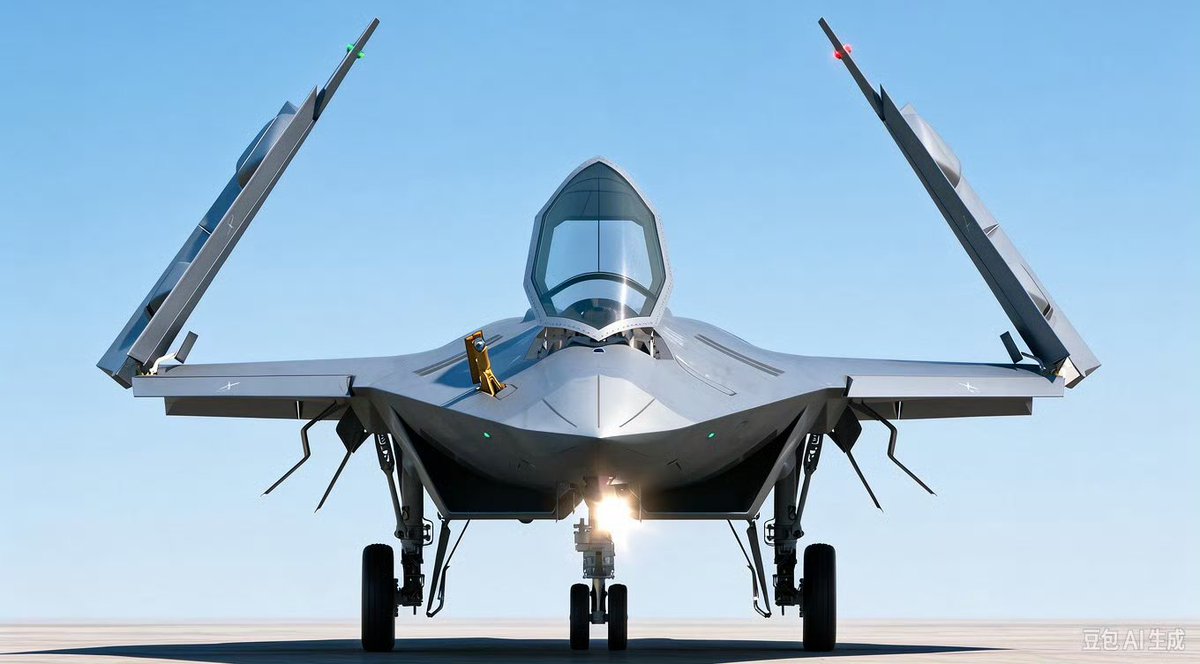
🇨🇳PLA Air Force's J-20 Mighty Dragon — the world's largest 5th-gen fighter.
WS-15-powered. Only the elite need apply.
Extreme range, heavy payload, insane agility.
The J-20S flies with stealth drone wingmen.
Air combat, rewritten.