And so many regular people are now entering their confidential medical information, including DNA and lab reports, into public AI tools and irrevocably hurting their future employability and insurability.
Use Monadic DNA Explorer instead.
We use Nillion's confidential LLMs and storage so nobody snoops on your data!
57% of enterprise employees admit to entering confidential company data into public AI tools.
That includes internal documents and business information.
AI is already being used in sensitive environments.
Following on from Kitchen table genomes/liquid biopsy. There are two forces at work, a centralization one and a decentralization one. Large companies are trying to trap everything in central data centers with proprietary data streams, giving them a moat and control, others are pushing to run AI and other things locally empowering individual users. Same is happening to bio/medical data including sequencing.
At-home sequencing is the future!
However, until it becomes cheap, easy and reliable, people will still turn to services which compromise their anonymity and privacy.
Our upcoming Batcher app provides an anonymous mixing service using reliable lab partners for your DNA exploration needs!
Human genome sequencing:
2003:
$3,000,000,000
global effort
years of research
2026:
your kitchen table
a few hundred $
Hard not to be excited for the future.
https://t.co/0U5bXsHwt6
https://t.co/0U5bXsHwt6
The Vercel breach put the problem in plain sight.
Too many systems still keep sensitive logic and data stored in one place.
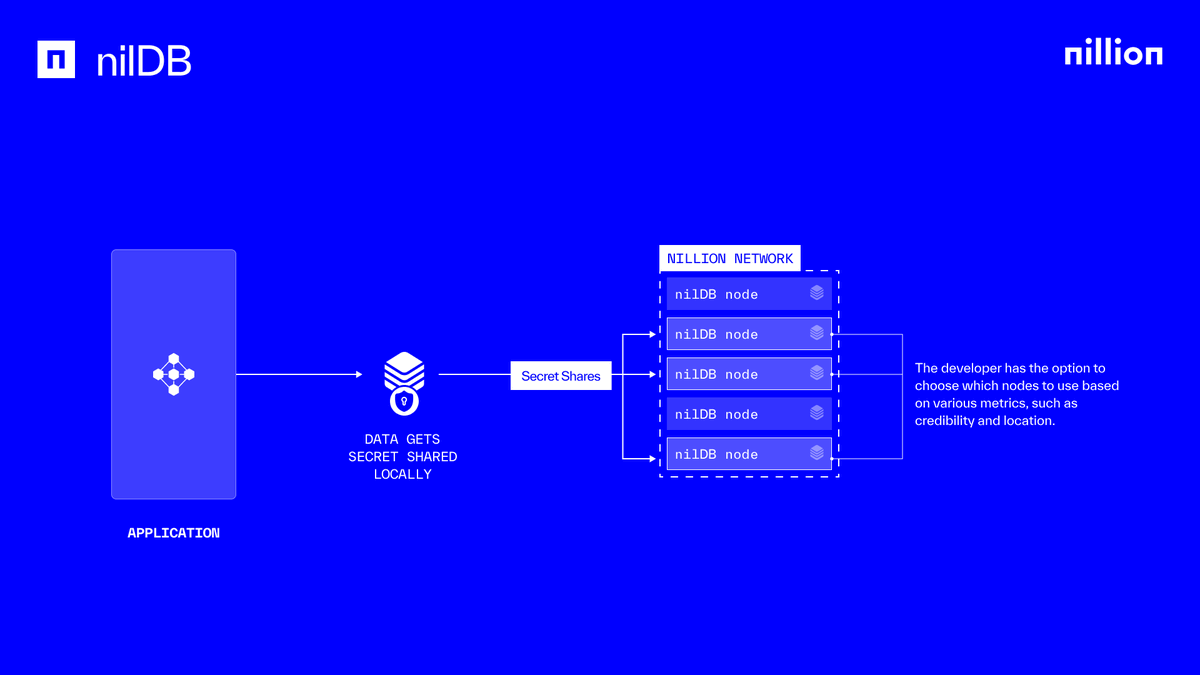
nilDB exists to break that pattern.
- Sensitive data is split before it is stored
- It is distributed across multiple nilDB nodes
- No single node holds the complete secret
- No single breach reveals the whole dataset
That’s why Nillion matters: it gives builders a privacy layer for sensitive data.
The Vercel breach put the problem in plain sight.
Too many systems still keep sensitive logic and data stored in one place.
nilDB exists to break that pattern.
- Sensitive data is split before it is stored
- It is distributed across multiple nilDB nodes
- No single node holds the complete secret
- No single breach reveals the whole dataset
That’s why Nillion matters: it gives builders a privacy layer for sensitive data.
one of the reasons i became a medical geneticist: the genome is the only medical test where we measure once, but our interpretation evolves indefinitely.
as our models and variant knowledge mature, the same data yields new truths, and eventually, actionabilities.
the genome (and its derivative products) are the ultimate substrates for AI in medicine.
Genome editing is getting safer, but there’s an obvious question almost no one is asking: what happens to your DNA data once it’s sequenced?
The new FDA guidance focuses on catching unintended edits, but it mostly skips over how this data is stored or who can access it, even though your genome is permanent and uniquely identifying.
We think your genetic data should stay encrypted the whole time, and that analysis should happen without exposing the raw data using cryptographic techniques like FHE, MPC, TEEs, and zero-knowledge proofs.
People should have clear control over what gets shared and when.
Better editing is real progress, but without strong data protection, it creates new dangers.
🚨NEW FDA Draft Guidance Safety Assessment of Genome Editing in Human Gene Therapy Products Using Next-Generation Sequencing #FDA#Regulatory#geneediting#genetherapy
Top 5 Takeaways -
1) NGS becomes the regulatory backbone for genome editing safety
2) FDA expects a layered, redundant approach to off-target assessment
3) Low-frequency events matter and must be detectable
4) Patient genetics is now explicitly part of risk assessment
5) Genome integrity (translocations) is no longer optional for DSB-based gene editing systems
https://t.co/28QKQPFtLb
Motion sickness is written into the body more than most people realize.
In a genome-wide study of 80,494 individuals, researchers identified 35 SNPs significantly associated with susceptibility. Individuals in the top 5% of genetic risk had over 6× higher odds of frequent motion sickness compared to the bottom 5%.
Some of the strongest signals:
• rs66800491 near PVRL3 (eye development)
• rs10514168 near TSHZ1 (inner ear development)
• rs2153535 near MUTED (balance)
• rs2551802 between HOXD3/HOXD4
• rs9906289 in HOXB3
These variants cluster around systems that maintain equilibrium. Inner ear structure, neural signaling, even glucose regulation all appear to shape how the brain processes motion.
The biology extends further. The same genetic architecture overlaps with migraines, vertigo, morning sickness, and postoperative nausea. Several variants show effects up to 3× stronger in women.
Motion sickness is not just situational. It reflects how sensory conflict is processed at a systems level, influenced by development, metabolism, and neural wiring.
If you have your genetic data, you can look up your own propensity in Explorer.
https://t.co/ctmoVDS9qc
Study: Genetic variants associated with motion sickness point to roles for inner ear development, neurological processes and glucose homeostasis
Authors: Hromatka, Tung , et al