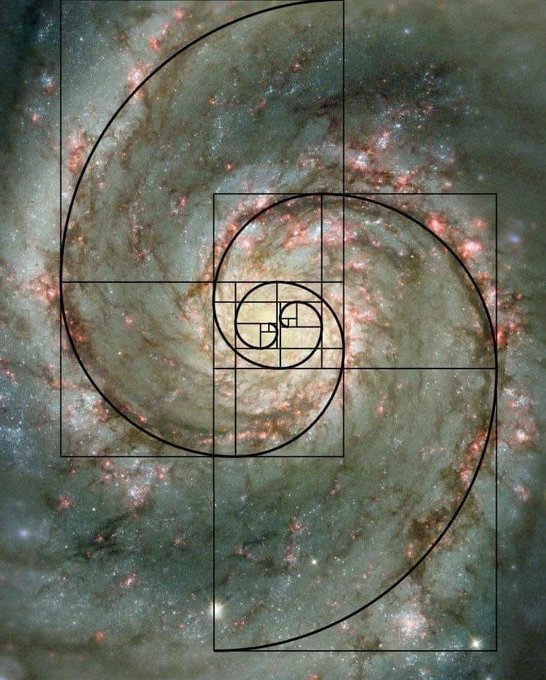
The Fibonacci sequence (0,1,1,2,3,5,8,13…) isn’t just math — it’s a universal pattern. As it grows, ratios of terms approach the Golden Ratio (Φ ≈1.618), a harmony found in spirals, plants, shells, galaxies & even DNA.
[🎞️ thevisualalchemy]
Today marks Fibonacci Day (11/23), a date that reflects the famous numerical sequence 1, 1, 2, 3.
This sequence appears in mathematics, nature, architecture, and many scientific phenomena, reminding us of the elegance and order underlying complex systems.
Quantum tunnelling — when a particle skips through a barrier that classical physics would forbid — happens faster when objects have less energy
https://t.co/7uIBx0AH8O
Congratulations to our members John Clarke, Michel H. Devoret, and John M. Martinis, winners of the 2025 @NobelPrize in Physics for their groundbreaking experiments revealing quantum tunneling in electrical circuits.
A fitting recognition during the International Year of Quantum Science and Technology, their work helped bring quantum mechanics from the microscopic to the macroscopic world.
We’re proud to have published their winning research in Physical Review Letters — and all three papers are now free to read. In addition, all three laureates have been APS members for more than 20 years and Clarke and Martinis are APS Fellows.
Supported in part by the U.S. Department of Energy, the U.S. National Science Foundation, IBM, and the Commissiariat à l'Energie Atomique in France, this achievement is a reminder that international collaboration and sustained investment are essential to scientific and technological innovation.
#NobelPrize @QuantumYear2025
WATCH LIVE: Join us for the 2025 Nobel Prize in Physics announcement.
Hear the breaking news first – see the live coverage from 11:45 CEST.
Where are you watching from?
#NobelPrize
https://t.co/rogqaeFtSu
This year’s physics laureates’ experiments on a chip revealed quantum physics in action.
A major question in physics is the maximum size of a system that can demonstrate quantum mechanical effects. The 2025 physics laureates conducted experiments with an electrical circuit in which they demonstrated both quantum mechanical tunnelling and quantised energy levels in a system big enough to be held in the hand.
The transistors in computer microchips are one example of the established quantum technology that surrounds us. The 2025 #NobelPrize in Physics has provided opportunities for developing the next generation of quantum technology, including quantum cryptography, quantum computers, and quantum sensors.
When you throw a ball at a wall, you can be sure it will bounce back at you.
You would be extremely surprised if the ball suddenly appeared on the other side of the wall. In quantum mechanics this type of phenomenon is called tunnelling and is exactly the type of phenomenon that has given it a reputation for being bizarre and unintuitive.
The 2025 #NobelPrize laureates in physics John Clarke, Michel H. Devoret and John M. Martinis, used a series of experiments to demonstrate that the bizarre properties of the quantum world can be made concrete in a system big enough to be held in the hand. Their superconducting electrical system could tunnel from one state to another, as if it were passing straight through a wall. They also showed that the system absorbed and emitted energy in doses of specific sizes, just as predicted by quantum mechanics.
The 2025 #NobelPrize in Physics recognises experiments that demonstrated how quantum tunnelling can be observed on a macroscopic scale, involving many particles.
John Clarke, Michel Devoret and John Martinis – awarded this year’s Nobel Prize in Physics – constructed an experiment using a superconducting electrical circuit.
The chip that held this circuit was about a centimetre in size. Previously, tunnelling and energy quantisation had been studied in systems that had just a few particles; here, these phenomena appeared in a quantum mechanical system with billions of Cooper pairs that filled the entire superconductor on the chip. In this way, the experiment took quantum mechanical effects from a microscopic scale to a macroscopic one.
Read more about the research that led to this year’s physics prize: https://t.co/NmNaTARwEA
Learn more about the 2025 #NobelPrize in Physics
Press release: https://t.co/Gh6DynVSUu
Popular information: https://t.co/ehKsc7qPCY
Advanced information: https://t.co/uaaAe3rwIq
BREAKING NEWS
The Royal Swedish Academy of Sciences has decided to award the 2025 #NobelPrize in Physics to John Clarke, Michel H. Devoret and John M. Martinis “for the discovery of macroscopic quantum mechanical tunnelling and energy quantisation in an electric circuit.”
"Sometimes we don't want to heal because the pain is the last link to what we've lost." - Ibn Sina
I wasn't ready for how hard this quote hit this morning when I read it.
I had my whole life flash before my eyes 🤣
I just put up a new video, which was a collaboration with Terence Tao about the cosmic distance ladder. You can find the full video on YouTube, and here's a bit of extra footage that didn't make it into the final.