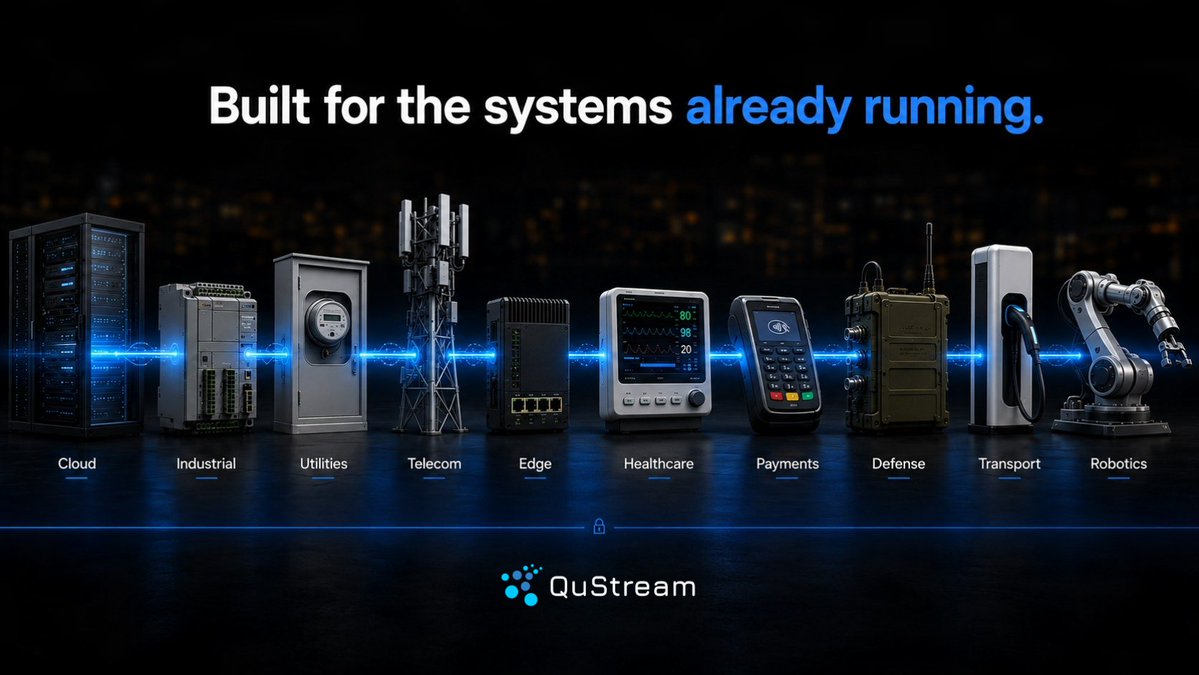
The quantum encryption race will not be won by a rip-and-replace model.
It will be won by what can actually be deployed across:
blockchains
devices
networks
critical infrastructure
That is where QuStream separates itself.
Not just a cryptographic idea.
A deployable protection layer for the systems the world already depends on.
@CryptoThannos Is your project founder speaking at NATO events to secure their drone communications against enemy signal jamming? QuStream's just did.
$QST @qu_stream
I asked SuperGrok to look at all of the recent developments around solana:AUuCEHQ7sm2i5GmaHrpE961voWcTY8U6mgrkhcV7pump @qu_stream and estimate the appropriate Market Cap.
Looks like we're in agreement, underpriced significantly for what it is and has validation for.
Prompt and full response provided here:
https://t.co/kUaw3I58VY
Today, Adrian Neal is presenting QSDP (QuStream Defence Protocol) at the NMIOTC NATO conference in Crete.
The data: every major encryption approach run through the same combined attack profile (packet loss, bit errors, burst jamming, reordering applied together). The kind of contested environment Western drones are actually losing C2 in.
QSDP holds command authority across the sweep. ML-KEM, the NIST #PQC standard, delivers 0% because its handshake can't complete under packet loss. AES-GCM degrades to near-zero. ECDH dies. QSDP is the only line that stays up.
The threat model isn't theoretical. Zhitel, Pole-21, and Krasukha are actual Russian EW systems currently operating in Ukraine. Western tactical encryption breaks against them. Post-quantum encryption doesn't help if the handshake never completes.
The audience today: military officers and procurement from NATO maritime command, JFCNF, and member-state defense bodies. They're not in the room because quantum computers might exist sometime between 2029-2035. They're in the room because drone warfare is the present, signal denial is operational reality, and resilient communications during contested operations is something they need answers for this year.
Explore the data yourself: https://t.co/miNlJqoMJc
Project market cap: $ 2.74m.
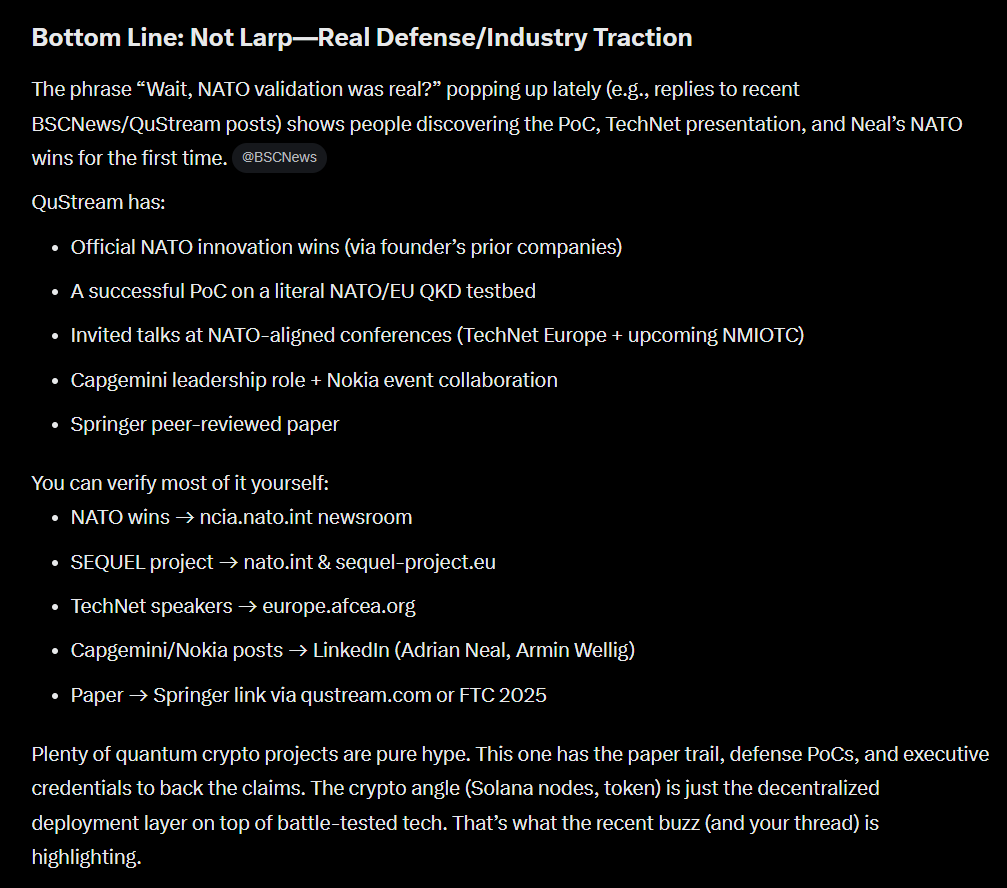
I asked SuperGrok a pretty straightforward question:
Lately posts about QuStream @qu_stream have had people saying "Wait NATO validation was real?"
https://t.co/PDfxjd5Ykl
It seems like the crypto community assumes that QuStream is another "quantum larp" and just lying about all of the world-wide validation through NATO, cryptography conferences, Nokia/Capgemini, etc. Can you pull together the threads for them and spell out what they're missing?
Here's it's response:
https://t.co/N0FVqcUevj
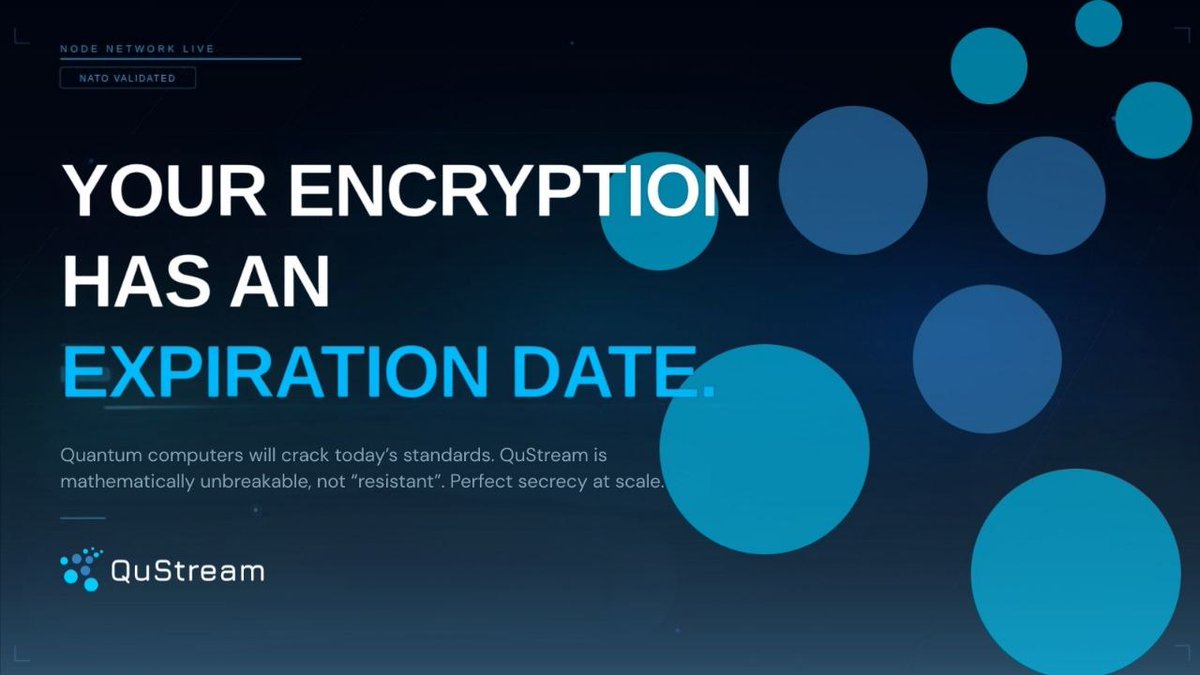
Quantum computers will break today's encryption. @qu_stream already solved it.
Mathematically unbreakable, not "resistant."
→Node network live on @Solana
→NATO validated
→Nokia & Capgemini incoming
https://t.co/KKQX0ssr2H
Quantum-safe security will not win because it sounds advanced.
It will win when it can be deployed across real infrastructure without forcing everything around it to change.
That is the line QuStream is built around.
Most quantum-safe projects are trying to survive the future
QuStream is built for systems that can’t afford to wait for it:
defense
critical infrastructure
finance
communications
machine networks
blockchains
The problem isn’t theoretical.
The migration window is already open.
15/ The setup.
A Springer-published, NATO-validated symmetric key infrastructure. Network already live with 1,000+ nodes. ~$2.5M real market cap. Tokenomics that vacuum supply off the market at every revenue tick. Price discovery mechanism that breaks under any meaningful demand. A holder base that's structurally aligned to lock, not sell.
Honest risks: enterprise cycles are long, L1 still under construction, mainnet rewards not flowing yet, liquidity is thin (Raydium only). This is a microcap, treat it like one.
When Google says 2029, QuStream is already deployed.
DYOR. Read the paper. Check the network. Do the math yourself.
$QST @qu_stream #PQC #Quantum
Most people only notice infrastructure once it’s everywhere.
The early phase looks different:
small deployments
live testing
nodes coming online
systems beginning to connect
That’s the phase QuStream is entering now.
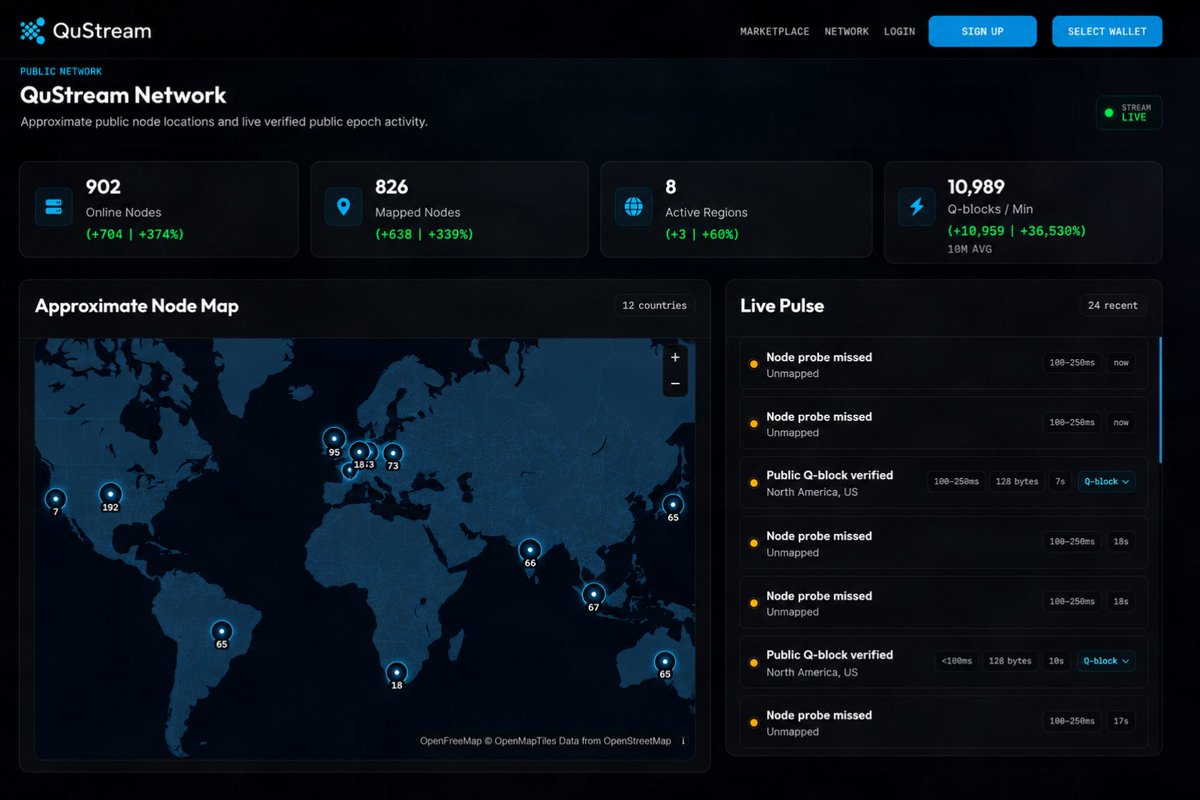
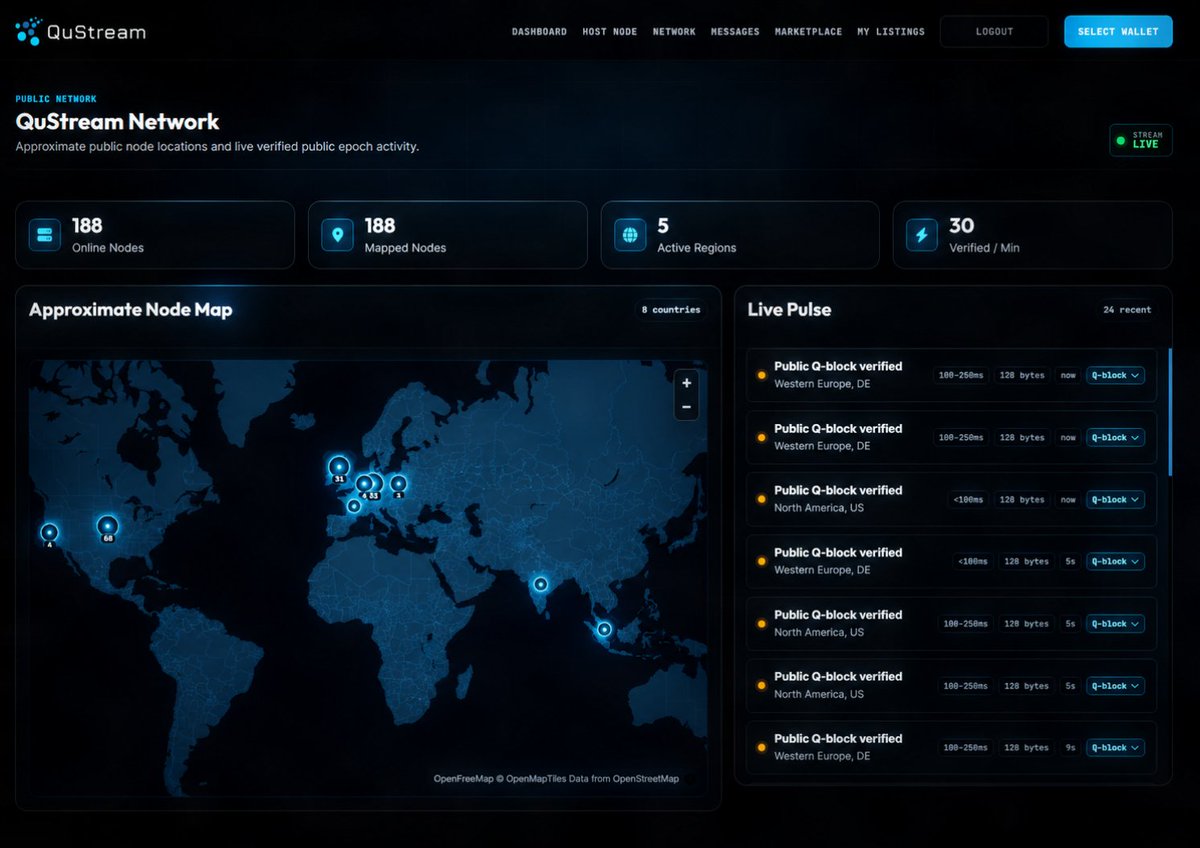
Node rollout has started.
You can now:
– download the node
– generate your API key
– bring your node online
– see it live on the network map
Nodes are already generating Q-Blocks, powering a working messaging demo using QuStream encryption.
More features rolling out next.
The biggest reason new security models fail?
They don’t fit into existing systems.
If it adds hardware, overhead, or complexity,
it doesn’t get deployed.
QuStream runs on existing infrastructure
with no persistent keys and minimal load.
Built to fit. Not force.
Encryption isn’t niche.
It’s everything you touch:
- Messages
- Money
- Logins
- APIs
- Devices
All of it depends on one assumption that:
Secrets stay hidden.
That assumption is starting to break.
@SolanaFndn@anza_xyz@jump_firedancer QuStream was recently ranked and adopted by Nokia and Capgemini as a more secure and more EFFICIENT encryption than any NIST-recommended PQC algorithms.
This means that having not only nailed quantum-PROOF perfect secrecy they are also the fastest solution.
$QST @qu_stream
The real shift isn’t stronger encryption.
It’s removing what attackers go after.
No stored keys. No secrets sitting anywhere.
Both sides generate what they need, when they need it.
Nothing to steal. Nothing to extract.