Our team spent months developing RLFR, our method which uses probes on a model's internals as reward signals for RL.
Silico reproduced it in 2 days, reducing hallucinations in Qwen3-8B by 37% without capability loss. (3/6)
Now we just need to do interp-RL over local models using these tools. I am confident that Anthropic have been doing this so far, at least from Q3 2025
Unsupervised multidimensional dictionary learning opens up useful yet unlabeled set of features to be controlled via RL. SASA(https://t.co/azH11mn7Ty) and previous goodfire researches showed possibilities, but at this point it is fully viable.
If models think in shapes, our tools should too.
Our latest research: Block-Sparse Featurizers (BSFs), a new way to find concepts in model activations - using multidimensional “blocks” instead of single directions. (1/9)
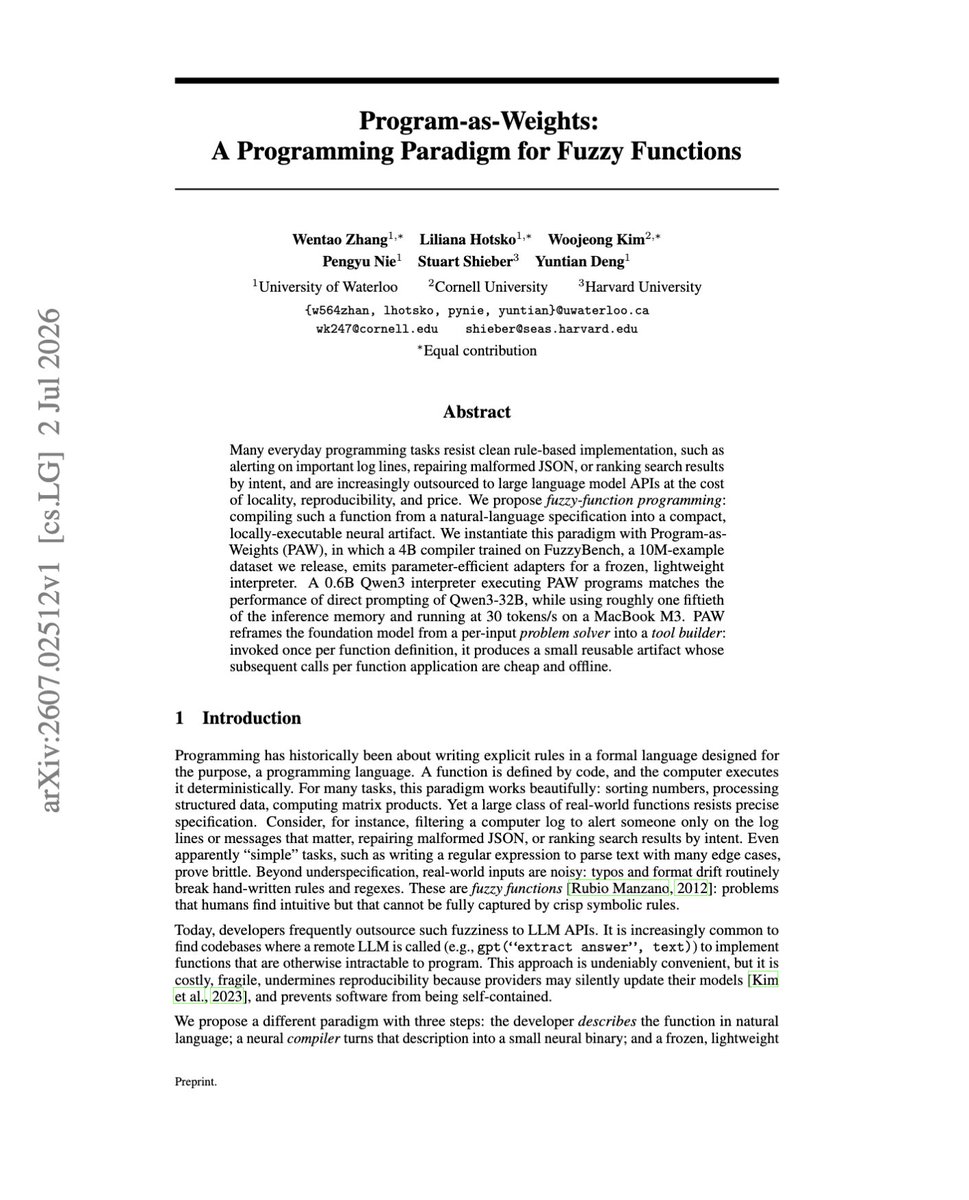
“Program-as-Weights”
LLMs are great at fuzzy functions like log triage, JSON repair, and intent classification, but calling a big model on every input is slow, expensive, and not local.
This paper compiles the fuzzy function once from a natural language spec into a small neural program, a pseudo-program plus a LoRA adapter.
A frozen 0.6B interpreter then runs it locally, matching Qwen3 32B prompting on FuzzyBench while using about 50x less inference memory and running around 30 tok/s on a MacBook M3!
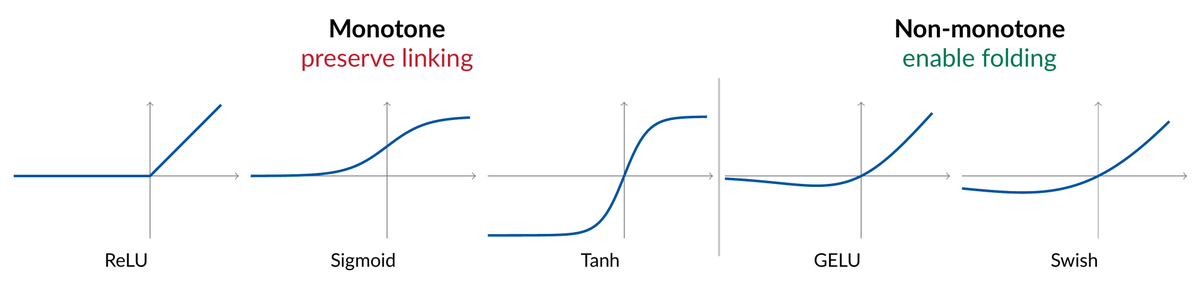
Ranked by power to change topology: Folding (ResNet, Attention) > bending (monotone feedforward) > homeomorphic (invertible, flow models). Non-monotone activations lift a plain net into the folding class. Width ≥ d+1 lifts the ceiling, but folding at width d trains more reliably
In 2014, Chris Olah's 'Neural Networks, Manifolds, and Topology' drew a disk inside a ring narrow nets can't separate: layers stretch and squash but never fold. We theorize and generalize this observation, noting skip connections learn the fold. #ICML2026 https://t.co/V7cGJFWgja
new post on harness engineering for AI self-improvement: https://t.co/ZYvGfVs61k
It is hard to forecast how much the future of RSI will rely on harnesses. Likely harness engineering will evolve in the direction of self-improvement and enable auto-research, and, in turn, smarter models keeps harnesses simple.
Even when many harness improvement get eventually internalized into core model, the need to specify goals and context will not disappear.
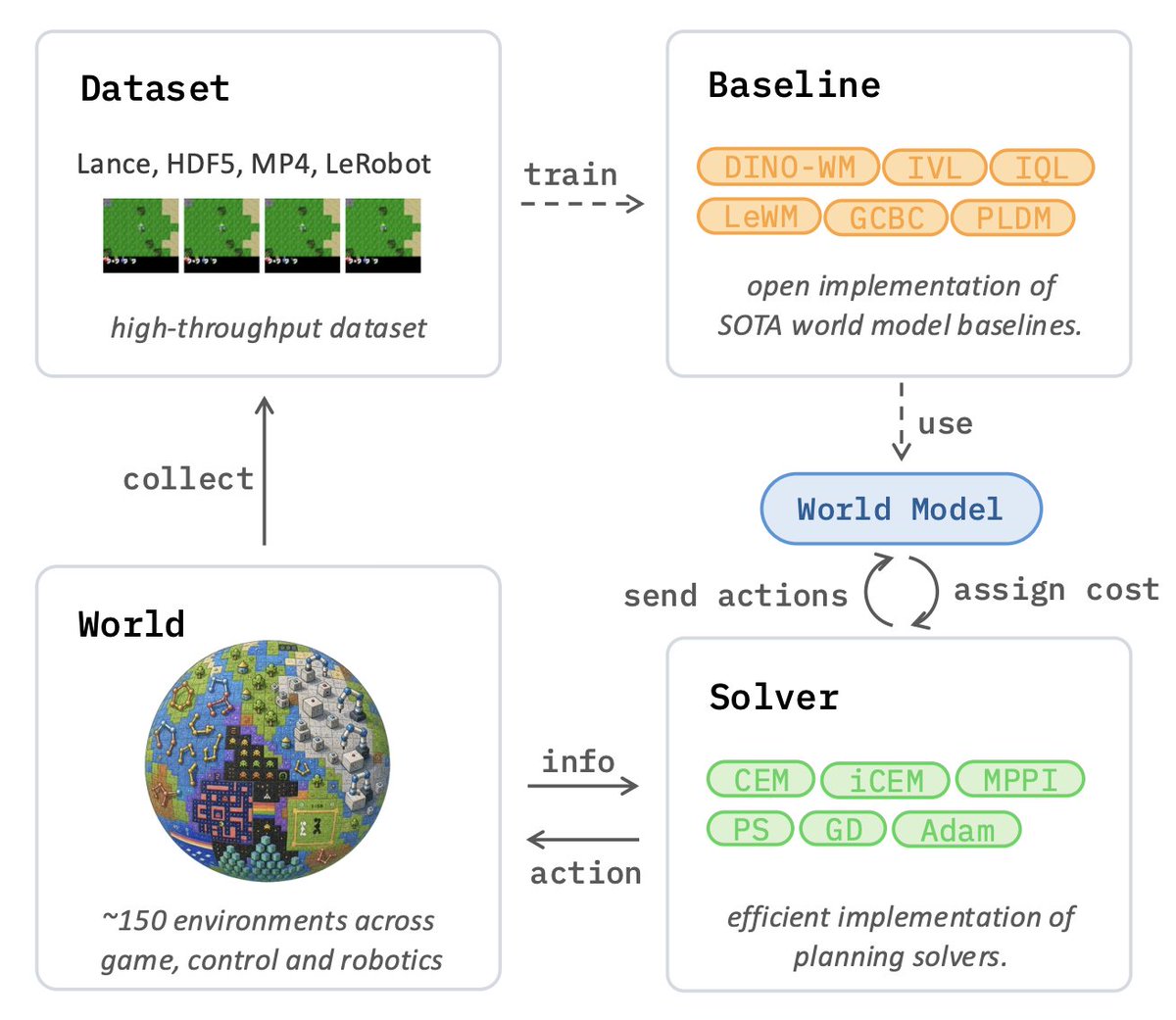
Would you like to join the research effort on JEPA and World Models easily?
After a full year of hard work, we’re excited to finally release stable-worldmodel:
an open-source, scalable platform built to accelerate JEPA & World Model research!
📄: https://t.co/gnxGvens5A
🚨 Why does Self-Play RL for LLMs keep collapsing? Most fixes focus on the reward signal. In our new paper "Survive or Collapse", we show that's the wrong lever. The true binding constraint is actually Data Gating: deciding which generated tasks enter the training pool. 🧵 1/n
Vmax is building an open-ended learning system that generates and optimizes itself on tasks that it creates, avoiding human bias that may corrupt optimal learning curricula.
In PopuLoRA, we instantiate this as co-evolving populations of LLMs performing asymmetric self-play.
The most popular way to interpret AI is missing the bigger picture.
Models think in curved shapes. But sparse autoencoders (SAEs) work with straight lines.
Can they still capture models’ curved neural geometry? Yes, but not how you might think! (1/7)
We’re training models wrong and it’s due to chatGPT. Even the modern coding agents used daily still use message-based exchanges: They send messages to users, to themselves (CoT) and to tools, and receive messages in turn.
This bottlenecks even very intelligent agents to a single stream. The models cannot read while writing, cannot act while thinking and cannot think while processing information.
In our new paper, see below, we discuss LLMs with parallel streams. We show that multi-stream LLMs can …
🔵Be created by instruction-tuning for the stream format
🔵Simplify user and tool use UX removing many pain points with agents and chat models (such as having to interrupt the model to get a word in)
🔵Multi-Stream LLMs are fast, they can predict+read tokens in all streams in parallel in each forward pass, improving latency
🔵 LLMs with multiple streams have an easier time encoding a separation of concerns, improving security
🔵 LLMs with many internal streams provide a legible form of parallel/cont. reasoning. Even if the main CoT stream is accidentally pressured or too focused on a particular task to voice concerns, other internal streams can subvocalize concerns that would otherwise not be verbalized.
Does this sound related to a recent thinky post :) - Yes, but I don’t feel so bad about being outshipped with such a cool report on their side by 23 hours. I’ll link a 2nd thread below with a more direct comparison. I actually think both are complementary in interesting ways.
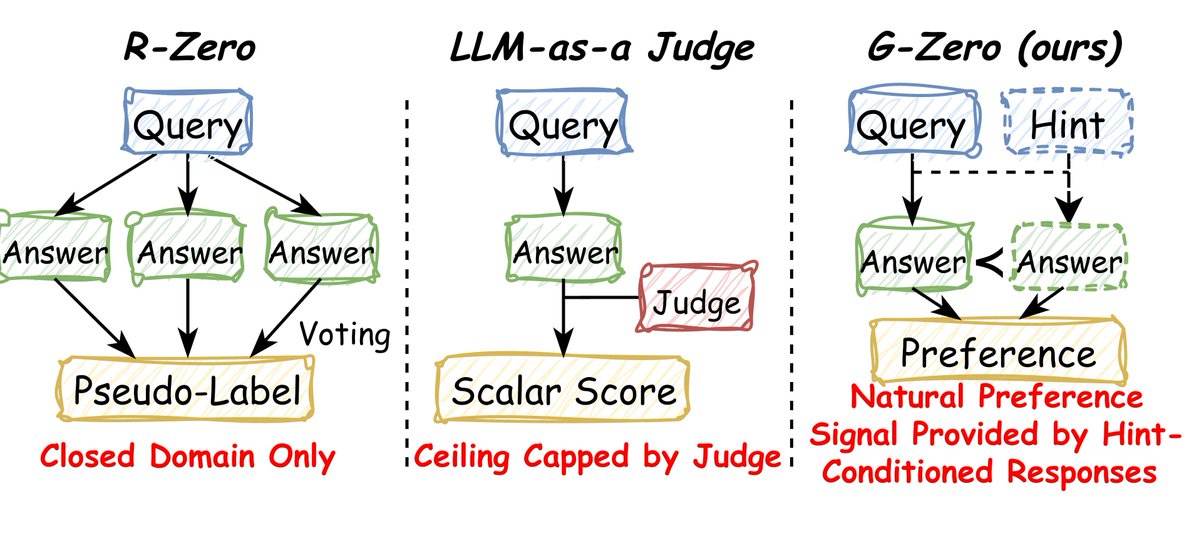
"How do you self-improve a model on open-ended tasks where you can't take a majority vote?"
I got asked this in nearly every research interview I did last year. None of my answers felt clean.
So we built something that doesn't need a vote, a verifier, or a judge.
Meet G-Zero. 👇
paper: https://t.co/TrvGb48W4d
huggingface: https://t.co/8guc5xSh3i
code: https://t.co/G8mMm2I9h1
All experiments are done via api by @thinkymachines (1/n)