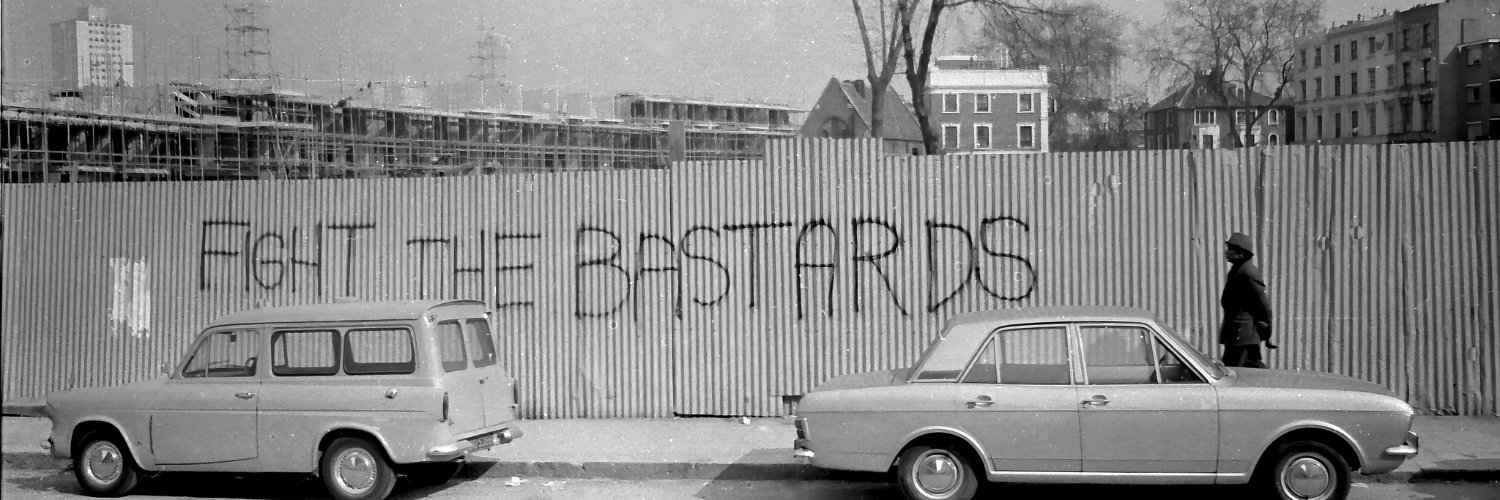
Never forget Grenfell. 72 lives lost to a system that chose to save costs over safety and ignored warnings. We owe the bereaved and survivors accountability and safe homes for all.
#Grenfell#NeverForget 💚
'Utter disaster’: Alan Bates attacks schemes compensating post office scandal victims.
7 schemes. £1.5bn paid from public purse, could hit £3.5bn.
Zero contribution by Fujitsu, PO execs, other perpetrators.
No one charged for false criminal convictions.
https://t.co/1pkj4Fx051
One of the main tenets of CWB and the #PrestonModel is public ownership. No profit, any surplus is reinvested in services that meet public need, not shareholder profit…
Phew.
For a moment there I thought we might take a structural approach & understand these problems as symptoms of an extractive economy, shaped by deep cultural & technological forces.
Thank the lord we’ve opted instead to bring in a multi-millionaire to sort it all.
That's similar to the Royal Borough of Kensington and Chelsea, the Council which owned Grenfell Tower and in charge of the refurbishment. The landlord where 72 tenants were killed as a result of their negligence, actually profiting from the terrible disaster, suing the other defendants for £326million and trying to get paid for the land where the Tower stands.
We have neither positive law, nor natural law.
It's hard for people to truly understand the devastating impact on lives unless they are visited by the same misfortune of injustice, incompetence, negligence.
Enjoyed campaigning in the Makerfield by-election for @andyburnhamGM this week.
It was interesting to hear several voters tempted by Reform citing the undeclared £5 million gift to Nigel Farage as one reason they would be voting Labour.
One of the lesser spotted things Tony Blair gets wrong in his essay is his assertion that: "The challenge of democracy is not transparency, honesty or conspiracy theories about the hidden power of elites."
I believe trust in politics is fundamental to what we all want, which is effective government changing peoples' lives for the better. The only way to rebuild that trust is to do politics differently, and that should include major reforms that give more power to people and shine a light on those seeking to subvert our democracy.
The government's moratorium on cryptocurrency donations is a great start, but there is a lot more to do.
The privatisation of water is a scandal. No real penalties for failure and billions extracted to foreign owned companies. Chile and England are the only countries in the world that let this happen.
Whether it is Tony Blair’s interventions, the bond market’s reaction or privatised utilities warning of doom, the pattern is the same.
When anyone suggests progressive change, those with wealth and power push back. Whether the figure in question is @AndyBurnhamGM or @ZackPolanski, progressives need to understand what we are up against, and how to defeat it.
Very often, I find, science fiction names what politics struggles to. In James SA Corey’s series of novels the Expanse, the violent dystopian streets of Baltimore are given a name for what happens when the old order breaks down faster than people can describe it: the Churn. It is the brutal reorganisation of power, when familiar rules collapse and those who survive are the ones who read the signs early.
Britain is in one now. In fact, two churns are happening at once.
The first is electoral. May’s local elections were a rupture with the past. Labour lost roughly 1,100 councillors. Reform won 1,257 seats and 10 councils. The Greens won Hackney and Lewisham. In Makerfield, the parliamentary constituency where Andy Burnham is seeking a route back to the Commons, Reform took every council ward.
The progressive vote has fragmented and Reform has captured a large part of the anger. The container in which transformative politics could once be argued for and delivered – a dependable Labourmajority in the Commons – is visibly crumbling.
The second churn is deeper. Burnham named it when he said Britain had been “on the wrong course for 40 years”. That was a diagnosis of the political economy that has governed Britain since the late 1970s: financialisation, privatisation, hollowed-out public services and the transfer of wealth and power away from workers, communities and the public realm.
This is why the events of recent weeks matter. Burnham needs a state that is able to pay for big-ticket, social-democratic projects: council homes, clean energy, public transport, water, skills and resilience. Those things cannot be wished into being. They require public investment at scale.
That is where Rachel Reeves’s fiscal rules become more than an accounting device. In plain English, they are self-imposed limits on borrowing. They are political choices, not laws of nature. But they matter because they set the boundaries of what Labour says it can afford.
They matter for Burnham’s possible project for the country, because the current rules would inhibit the kind of public investment that a new settlement with the British people would require.
Yet he cannot simply announce he will tear them up. Governments borrow by selling gilts. If investors believe a government will borrow recklessly, they demand higher interest rates to lend to it. That raises the cost of all government borrowing and squeezes the money available for everything else. This is the discipline every Labour politician now feels.
Three weeks ago, Burnham tested the boundary. He floated a defence carve-out: the idea that extra borrowing for defence could sit outside the fiscal rules, as Germany has done by using special funds to increase military spending. It was a narrow proposal but one that raised larger questions about how we finance what we deem to be important. What followed is what some call “market discipline”. From the period around Burnham’s Makerfield announcement onward, the pound came under pressure and gilt yields rose as markets priced political uncertainty. Private creditors warned against Thames Water being brought into public ownership. Then, last Monday, Burnham’s team told Bloomberg he would make no changes to Reeves’s fiscal rules if he became prime minister. The defence carve-out was ruled out too.
I was not surprised by the retreat. Nor do I think it is useful to call it betrayal. Burnham cannot win a leadership contest if the markets are running against him before he has even started. But the retreat itself is the lesson. It illuminates what is standing in the way of a new social democracy. It is not simply “the markets”. It is the economic architecture Britain has built: Treasury rules, Bank of England decisions, pension fund structures and investor expectations combining to discipline any politics that threatens the settlement. What happened last week was a lesson in how power works.
Burnham matters not because he is a saviour. Progressives have had enough of saviours. He matters because he has said aloud what Westminster still avoids: Britain’s crisis is rooted in the economic settlement itself.
That settlement, what economists increasingly call rentier capitalism, is not abstract. It is a country where water bills rise while shareholders are rewarded, where housing wealth matters more than people having secure homes, and where democratic choices narrow whenever they threaten asset holders. Meanwhile, the state manages the fallout: crumbling infrastructure, higher costs and a cost of living crisis deepened by rentier extraction.
That is why the reaction to Burnham’s comments on the fiscal rules is revealing. Chancellors rewrite fiscal rules all the time when it suits them. Gordon Brown had his golden rule. George Osborne had his surplus target. Philip Hammond revised the framework. Rishi Sunak changed it. Jeremy Hunt changed it. Reeves has changed it again. The question is not whether fiscal rules can change. They plainly can. The question is who gets to change them, and for what purpose?
There are three fights progressives now have to pick.
The first is fiscal. Democracy must regain the power to invest. Public investment is still constrained less by national need than by what ministers think the bond market, the Bank of England and the Treasury will tolerate. A real shift would start from need, not nerves.
That means a Bank of England mandate that recognises a basic truth: inflation is not only caused by too much demand. It is also caused by too little capacity. When there are too few homes, rents rise. When public transport is weak, people are forced into expensive alternatives. When energy is costly and unreliable, bills rise. Investment is not the enemy of stability. Done properly, it is how stability is built.
The second fight is ownership. Public goods should be built and owned in the public interest. Thames Water entering special administration is the obvious place to start. Regional public housing corporationscould build at scale on public land, financed by rental income rather than annual Whitehall grants.
That is also why the language of “public control” – used increasingly by Andy Burnham – deserves scrutiny. Few want a return to top-down nationalisation. But franchising, as the Bee Network in Manchester demonstrates, is not public ownership. Private operators running Bee Network services made hundreds of millions in profit last year. The network is better than what came before – but it remains a private-profit, public-risk model. Control without ownership leaves the fundamental problem intact: the public absorbs the downside while shareholders take the gain.
The third fight is constitutional. Proportional representation for Westminster, an elected second chamber and deeper devolution are not procedural tidying-up. They are conditions for progressive power in a fragmented country. The forces ranged against transformation do not need PR: they already have the City, the rightwing press, corporate lobbying, the Treasury worldview and the bond market. Progressive Britain has no equivalent machinery. PR is the glue that could allow a broad majority to govern together.
Burnham was right: Britain has been on the wrong course for 40 years. But last week showed the harder truth. The old settlement will not politely bow out for its replacement. It will price the risk, police the boundaries and demand reassurance before the argument has even begun. The churn is far from over.
* Clive Lewis is the Labour MP for Norwich South
* Clive Lewis will be speaking about these issues and more with Andy Burnham at Change Now! Mobilising the Progressive Majority
'Everything we’re doing is too small, too slow, and too late.. we’ve just been accumulating vacant properties
There's a sense we are literally building empty homes and certainly not building the homes that Londoners need’
London empties up 138% in a decade
https://t.co/JVSiYLv1Ti
🚨 New SHAC Survey 🚨
🚨 Landlord Service Charge Abuse Exposed! 🚨
https://t.co/afsEMtO82z
A massive new national survey of 829 residents by SHAC reveals rampant service charge exploitation across the UK, just as Housing Minister @mtpennycook rejects calls to cap skyrocketing costs.
#EndServiceChargeAbuse
@HarryScoffin
Something really exciting is coming to Golborne. I was lucky enough to see the work going on behind the scenes at what will be a state-of-the-art new medical centre on Kensal Road.
From therapy and massage rooms to specialised clinical services, this will be a hugely welcome addition to our community which we know faces really stark health inequalities.
Residents have been raising this for years. Nine years after the Grenfell Tower fire, the Walkways blocks are still relying on a “temporary” boiler system. Temporary does not mean nearly a decade later.
In this heatwave, the communal heating is blasting constantly. Then in winter, the system fails when people actually need heating. It's almost like deliberate torture for this beleagured community.
This is what happens when the same Council at the heart of the incompetence and failings responsible for 72 deaths of its residents, is left in charge in the aftermath and recovery of the traumatised victims and community, despite being central to the largest homicide investigation in Met Police history, with no oversight, or scrutiny or accountability, by the same TOry Government that protected their Tory jewel in the Crown, the Royal Borough of Kensington and Chelsea.
And the change of government? Nothing changed. The same systems, the same failures, the same lack of accountability. Residents are deliberately shut out while the Council continues to control every part of life on the estate and in the area— including who represents residents and who sits on committees, who the 'official voices' are, which the Council has chosen and groomed and rewards. The residents aren't allowed to even have a foodbank on their estate on their own communal premises.
As tenants say: “It’s like Alcatraz around here.”
@MHCLG@SteveReedMP@SamanthaDixonMP@lancasterale
Meanwhile the Council say they've spent £182million on a refurbishment that has still not delivered any tangible difference, no boiler, no windows, nothing changed, and they're asking for another £100million. Somebody needs to come down here, pay attention and put an end to this total catastrophe and fiasco.
ANd when residents speak up or try to organise themselves, they are targeted and sidelined. What the Council are being allowed to do and getting away with is inhumane after such a terrible tragedy that impacted this Estate. INHUMANE.
"Hurt" is not an original by Johnny Cash. The song was written by Trent Reznor (Nine Inch Nails) in 1994 for the album The Downward Spiral. Rick Rubin had to insist several times on Cash recording his version, at first Johnny found the idea completely insane because the original version is industrial and noisy. At 71, already very ill, almost blind and with trembling hands, Cash completely transformed the band.
The iconic video, directed by Mark Romanek, was filmed at the House of Cash (his own museum). June Carter Cash appears looking at him fondly, the video was shot in February 2003, a few months before she died (May) and Johnny himself (September).
Trent Reznor was so moved that he declared, "This song is not mine anymore." It is considered one of the best covers of all time.
First the Royal Borough of Kensington and Chelsea @rbkc took away the pitches. Then developed the area around it. Then wrapped the tower in flammable cladding. And when 72 tenants were killed, they were left in charge with no consequences or oversight by their Tory Party leaders in Government at the time and made a mint from capitalising on the disaster.
And what did Labour do after the change of Government? Absolutely nothing different.
@josephpowell@SteveReedMP@mhclg@Keir_Starmer
From the first week after the Milan cladding fire, we stood in solidarity with survivors from @INCENDIOdeiMoro — families whose homes were destroyed by the same deadly greed: flammable cladding.
The difference?
In Italy, owners and manufacturers were prosecuted and found guilty.
In Britain, 72 deaths of our parents, partners, children, siblings, grandparents, and grandchildren and there is no justice. Our justice was deliberately and knowingly delayed.
Thread:
Local charity Nova under threat from funding cuts
"Nova provides adults in Notting Dale with advice and advocacy on everything from housing to job hunting."
https://t.co/bqdQuOoDMg
Thank you to everyone who came to my recent surgery at Action Disability Kensington & Chelsea @ADKC2
If you have a problem I can help with and you want to speak to me, just email me at [email protected] to book an appointment.