Leftists still prefer a money backed by ruthless US imperialism than a money that had a few bad actors using coal plants at one point to power the peaceful machines that secure the money’s network.
Just saying.
Confession time: I used to think Bitcoin was just a speculative asset. As far as I could tell, it served no real purpose.
Sound familiar?
Looking back, I realize that my view came from ignorance and a lack of empathy and imagination. I simply couldn't see what Bitcoin offered to people whose circumstances were nothing like mine. Sorry.
In reality, Bitcoin belongs in the same category as the smartphone and the Internet when it comes to utility. But unlike those earlier innovations, it benefits people in the global South first, the West last.
That order of impact explains why so many of us in the West initially fail to see what it does for us, and then wrongly conclude it does nothing for anyone.
Bitcoin analyst @willywoo estimates 350 million people now use Bitcoin, with adoption growing rapidly. Here is a snapshot of who those users are and why they turn to it:
1.2 billion people are unbanked. Of them, 57% are women and 90% are people of color.
4 billion people live under autocratic or semi‑autocratic regimes, where governments can freeze accounts, track spending, and silence dissent through the financial system.
In Afghanistan, 8.1 million adult women are legally barred from opening a bank account, starting a business, or earning an income because of their gender.
More than 300 million people live in economies experiencing hyperinflation, including Turkey, Lebanon, Argentina, and Venezuela.
These are the people who see Bitcoin’s utility first. It is not those of us in the West who take stable banking, low inflation, and basic financial access for granted.
You might be asking: how exactly does Bitcoin help them?
For the unbanked, it removes the need for a bank entirely. A basic feature phone and a small amount of education are enough to start receiving, saving, and making payments.
Across Africa, we are watching a financial revolution unfold. The poorest communities are leapfrogging traditional banking and moving directly to internet‑native money. That is why Africa is adopting Bitcoin faster than any other continent.
For people living under autocratic rule, Bitcoin makes it possible to transact without government surveillance, censorship, or the risk of having funds frozen. That is why Nigeria has become one of the largest adopters; human rights activism is a major driver.
For women in Afghanistan, Bitcoin Lightning wallets offer a way around state‑imposed discrimination. They can and do use them to secure financial independence that the law otherwise denies them.
For those facing hyperinflation, Bitcoin provides a means to preserve savings that might otherwise lose half their value in a single year.
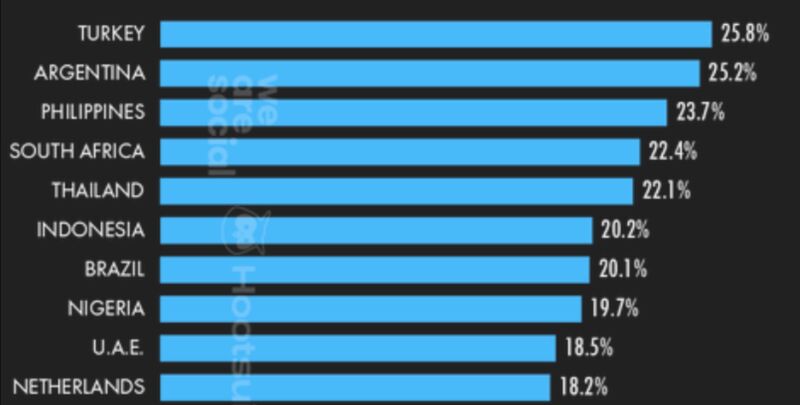
Look at the top 10 countries adopting Bitcoin:
The top 2 have hyperinflation
*7 of the top 8 were colonized and carry heavy IMF or World Bank debt
*8 out of 10 are autocratic or semi‑autocratic regimes
*7 out of 10 are in Africa, LATAM, or SE Asia
For over half the world, Bitcoin ranks as the most useful technology in a generation.
Bitcoin was never a hard sell for me.
Bitcoin is freedom money. My life’s working is focused on helping humanity in its global struggle for freedom.
This includes against tyrannical governments, and those most abused and disposed of by them.
Bitcoin. Resistance. Freedom.
While I've answered 100s (perhaps 1000s) of people spreading Bitcoin & Energy FUD, >90% of those misconceptions were recurring 9 claims
I lay them out here with their fact-based counters and suggested framing so that in 2026 we can help more people move beyond prior prejudice
To the 192 organizations who wrote the group coalition letter opposing Senate Crypto Legislation
I am writing because I believe we share the same core goals: to fight corruption, to protect the vulnerable from exploitation, and to build a financial system that is fair and just, not rigged for the powerful.
Your letter shows you want to shield people from harm. I am writing from Kenya to tell you that the way you are going about it is causing profound harm to the very people you say you want to protect.
Your letter asks for laws to protect people from financial harm. I am writing from Africa to ask you to get your facts straight, because the mistakes in your letter are causing real harm to people like me.
You talk about corruption and scams. This is a valid concern. Punish the corrupt. Stop the scams. Memecoins and influencer rug-pulls are a cancer. Write laws to protect people from them and hold everyone accountable, from celebrities to politicians.
But you must understand the difference. The scams you describe, the ones designed to enrich a centralized pool of founders and VCs, are not Bitcoin. Bitcoin was created after the 2008 crisis for the exact reason you cite: to stop the speculation and bank bailouts by creating a sound, transparent system no one controls.
This is why @Stella_Assange described Bitcoin as the "real Occupy movement," a tool for human rights activists and the unbanked long before any politician touched it. Do not blame the tool for the bad actors who misuse it. Target the bad actors.
You say crypto is for crime. Your own U.S. Treasury Department says “the use of virtual assets for money laundering remains far below that of fiat currency.” Why don’t you know this? The transparent, public ledger of Bitcoin is actually a powerful tool for tracing money and catching criminals, something traditional, opaque finance can't offer.
Your biggest mistake is about the environment. Your claims are old and wrong. They ignore reality:
>> Bitcoin mining profits are helping save Africa's renowned Virunga National Park - @gorillacd, which is home to half of our continent's biodiversity
>> In Ethiopia, they are using it to pay for power lines to reach people who have no electricity.
>> In my country as well as Malawi, and Zambia, Bitcoin is funding solar micro-grids and small hydro-power facilities (courtesy of @GridlessCompute) lighting tens of thousands of villagers.
>> Bitcoin has been shown in many peer reviewed papers, independent reports and case studies often highlighted by @DSBatten, to be speeding up the clean energy transition and stabilizing the grid. Africa feels the impact of climate change first, so this is critical to us. I was surprised that you are unaware of this.
>> When Bitcoin mining was added to the grid in my country, it didn't raise electricity prices for local villagers, it lowered them. The same has been shown in other countries like your own. How is it you are not aware of this?
When you repeat false claims about Bitcoin, Africa's often authoritarian governments, recycle your words (often verbatim) to try to ban it. They don’t like Bitcoin because it gives people freedom they can’t control.
When my brothers and sisters protest against authoritarian rule in Nigeria, they are able to do so because they fund their campaigns with Bitcoin, which their government cannot track or freeze. When you use your voice to repeat false claims, you are helping dictators without knowing it.
You warn that crypto could cause a financial crisis like in 2008. But the banks that failed in 2023 (Silicon Valley Bank and Signature Bank), failed from centralized mismanagement, not Bitcoin. True financial instability comes from centralized systems, not from a decentralized network that can't be bailed out. Your fear is aimed at the wrong target.
You want strong, enforceable rules. That's fair. But the "regulation by enforcement" you call for doesn't just scare scammers, it also kills the innovation I need. The wallet I use, the service that lets me receive my newsletter payment, the company that helps me convert Bitcoin: some of these tools are built by U.S. developers.
When U.S. policy is hostile and unclear, these innovators get "de-banked" or shut down out of fear. When you make it legally dangerous to build Bitcoin tools in America, you take those tools away from us. You are regulating my financial life and limiting my financial freedom from Washington.
For you, money is stable. For me, my national currency has consistently lost most of its value over the years. Bitcoin is how I save and get paid without losing half of it in fees. It is a lifeline. When you call it useless or dirty, you are calling my lifeline useless and dirty.
You want to help. Then help by learning. Do not spread misinformation that hurts us. Make sharp laws that stop real criminals, but do not kill the tool that is saving the marginalized you claim to protect.
Look at the evidence from Africa. See what Bitcoin is actually doing. Then use your powerful voice to fight for precision, not prejudice.
Sincerely,
Elvis Gwaro
A young African who uses Bitcoin to build a better life
I had another revelation about why many progressives and the left have such a hard time with Bitcoin (and something I plan to bring up with @IanCalderon in our chat for @TPB_Inc tomorrow)
Historically, and in recent decades, progressives still view govt as the solution and best assistance to peoples’ lives. They just believe *they* need to be in charge to make it work.
So, when they see this private, money separate from the state, option — they are up in arms and assume the worst. Only criminals use it, what about the risks of money outside of state control, systemic risks, etc.
They will not take the time to understand that Bitcoin was created precisely because of the issue everyday people face when it comes to government and central bank control of money, supply, issuance, and permission. Bitcoin is a human rights project, and much of their resistance and opposition to this is due to financial privilege and their assumption that the U.S. is the best possible actor when it comes to control of the money — which is laughable.
So, don’t dismiss Bitcoin with your preconceived notions of what the state should and should not control. Don’t assume advocating for Bitcoin means advocating for overthrowing the govt or some techno-anarcho hellscape (it doesn’t). Don’t dismiss it because you assume it’s a pet project for the dark web. When you look at Bitcoin, view it from the lens of millions and billions of people around the world who simply want control and ownership of their money, don’t want to be constantly debased by their governments, and don’t want authoritarians ruling their lives and removing financial freedom.
Bitcoin doesn’t have a technology or use case issue. Bitcoin has a perception issue.
Cc @gladstein@HRF@MyFirstBitcoin_@jdennehy_writes
After reading the @HRF report, @TheGuySwann has a great Guys Take outlining his thoughtful approach to freedoms from around the world and how simple but complicated things can be in different places.
From El Salvador, to Iran, to the US https://t.co/AsA1OfggVj
My BPI keynote, delivered in DC to a hall full of American leaders
"Bitcoin is the Most Important Human Rights Technology of the 21st Century"
Please share with anyone who doesn't think Bitcoin has a use case ✌️
Today's show is totally different. @BeccaAmilee came on to tell her story of adopting her son from Ukraine, uncovering a corruption ring and her current battle with cancer.
It's not a Bitcoin show, but it's an amazing story. Check it out here: https://t.co/MzhO4pgfK5
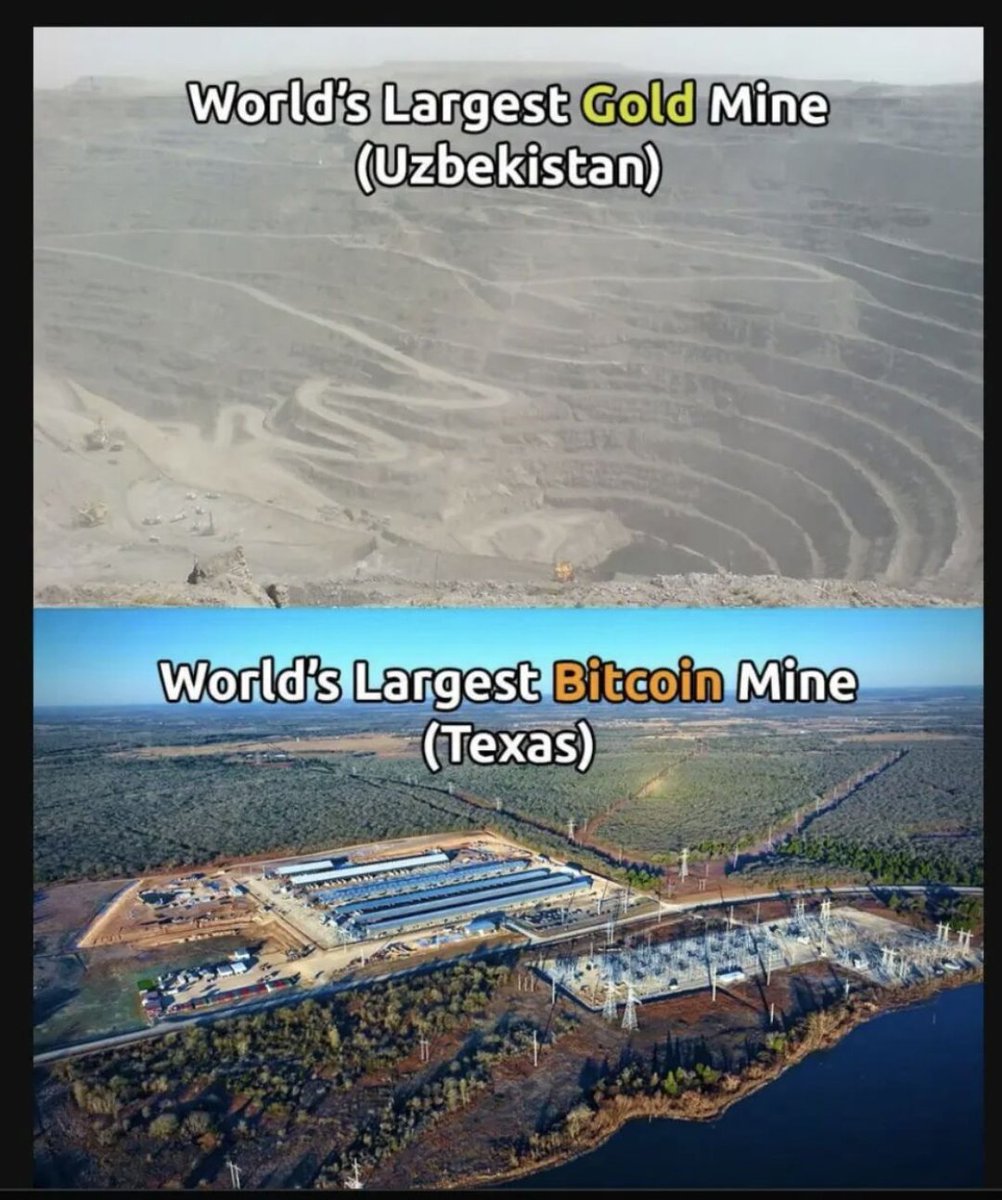
The path to Bitcoin obviating Gold as a store of value is as inevitable as other digital technologies taking over their analog predecessor.
As well as Bitcoin being far more portable, divisible, storable, and verifiable, the process by which it is produced has its own remarkable advantages.
Bitcoin mining is far less emission intensive than gold, meaning that when you choose Bitcoin as a store of value over gold - it is net emission reducing. It does not leave scars on the environment, rather it is positive for the environment: helping stabilize grids, reduce the cost of power for locals, mitigate methane, obsolete fossil-fuel heavy gas peaker plants and recycling heat energy that further obviates fossil fuels.
At the same time it has saved national parks (Virunga), taking rural villagers out of energy poverty (Africa) and helping a previously struggling economy to avoid a draconian IMF loan and instead build a strategic reserve and raise govt workers' salaries by 65% (Bhutan).
The story is only just beginning, and it keeps getting better.
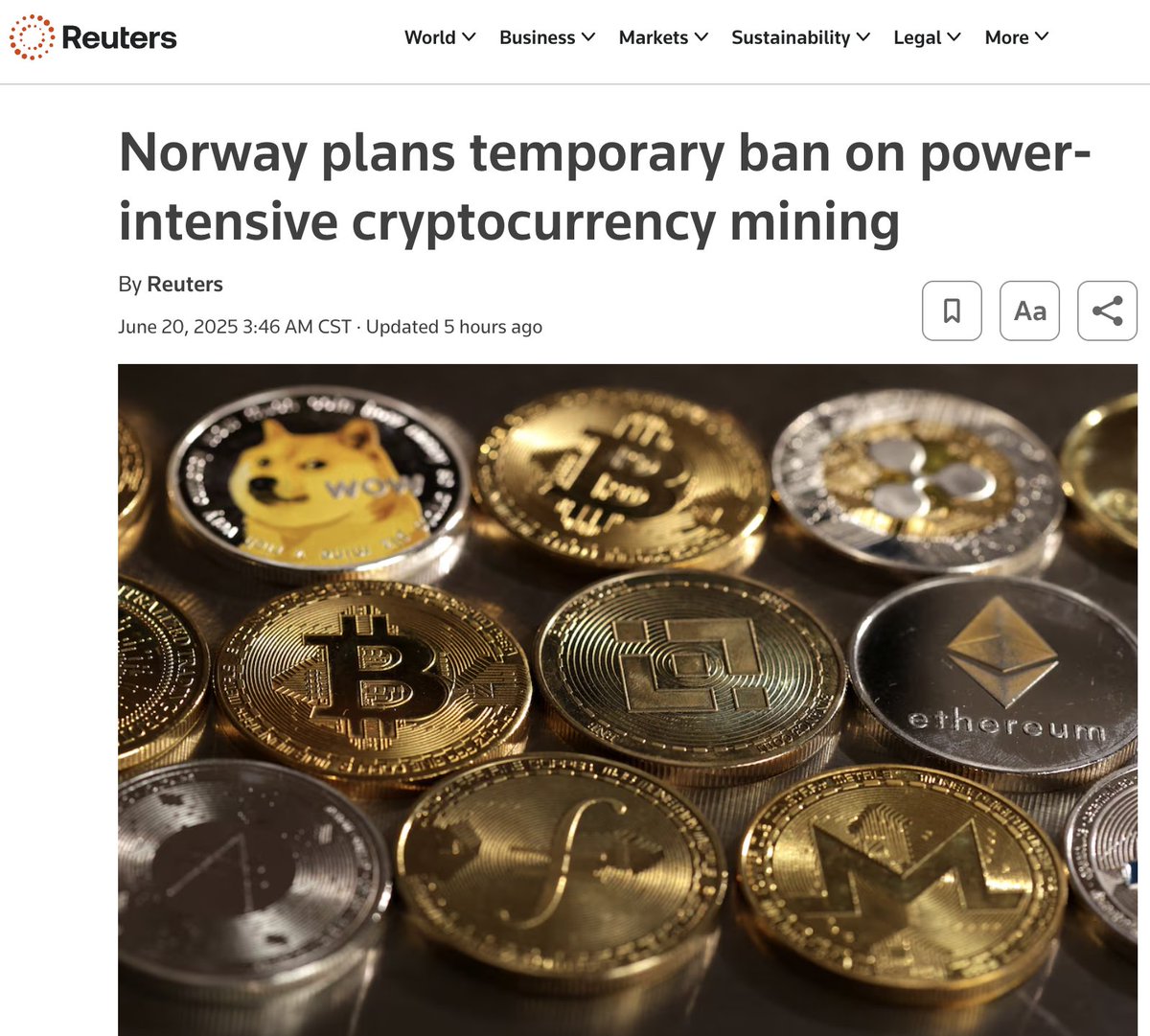
JUST IN: Norway plans temporary Bitcoin mining ban
Let's take a look at what this means for Norway =
Firstly, here is the government's stated reason for the temporary ban:
"Cryptocurrency mining is very power-intensive and generates little in the way of jobs and income for the local community."
~Karianne Tung, Minister for Digitalization
But we already know that the first part of the statement is misleading, and the second part is false.
In terms of power use, in places like Norway, where hydropower dominates the energy mix, Bitcoin miners have become key players in balancing supply and demand, ensuring that renewable energy remains profitable and scalable.
Much of the power that Bitcoin mining draws is hydropower that would otherwise have been wasted.
source: https://t.co/LDqC5lMTe6
Bitcoin miners in Norway are currently rewarded by the Norwegian govt for reducing CO2 because the heat they produce obviates the need for gas heating. Norway’s temporary ban removes a technology solution that Norway has recognized as decarbonizing ! source: source:
https://t.co/VQwcBuQstA
In terms of community benefit: this statement is not misleading, it is false
Firstly:
It keeps power prices low for the community. Norway discovered this the hard way when electricity prices rose 20% after Bitcoin mining was banned in one region of Norway
source: https://t.co/TUxFhi64Go
Second:
Bitcoin mining has been shown to be a technology that can help Norway, who import 70% of their food, to greater food independence - a considerable community benefit
source: https://t.co/O9ZddSJr8t
Third:
Aside from the community benefit of making energy more affordable and helping communities decarbonize, Bitcoin has been found to have considerable community benefits, both in independent reports just as this one which showed the community benefits of Bitcoin in US included creating 31,000 jobs, stabilizing electric grids due to their flexible power needs, and investing into their local communities
In real life case studies, these benefits include
employing locals, educating the workforce and even pushing down property taxes
source: https://t.co/CYOEzve3VE
Local mayor Ward Roddam called Bitcoin mining companies "deeply invested in the communities where they work" citing numerous specific examples of where they'd uplifted his local community.
source: https://t.co/byNVAcWMMK
So will Norway's temporary ban "help" the country? It depends on your definition of help. It will help Norway to maintain more fossil fuel based heat, waste a higher proportion of renewable energy, keep power prices high, while removing an important grid stabilization option.
This is not conjecture. It is what the data is telling us. This is why 16 countries who initially banned Bitcoin have now unbanned it after discovering the negative impact that the ban had
source: https://t.co/89lLmV09HH
As we can see from the charts in the link above, as the rest of the world is gravitating towards embracing Bitcoin mining as a grid stabilization tool, essential to maintaining energy security, energy stability and decarbonization goals - Norway's government's actions move them in the opposite direction.
Good luck Norway!
That Bitcoin mining is not only not harmful, but beneficial to the environment is now supported by
7 independent reports
20 peer reviewed papers
As a result
* 90% of climate focused magazines
* 87.5% of media coverage
on Bitcoin & the environment is now positive
source👇
7 independent reports
https://t.co/YcEpatcLtB
20 peer reviewed papers
https://t.co/Tdq6i0l9NB
10 climate focused magazines
https://t.co/lTq4CoreJf
16 mainstream media articles
https://t.co/1cSV1ie5Na
Dem leadership deceived the American people in order to enable an unelected shadow government. That sounds crazy but as best I can tell, it actually happened.
Question their lie?
Misinformation, said the media elite. Conspiracy theory!
Academics either piled on or stood by in silence.
Now we have tapes. Even at the time we had significant evidence but that evidence only appeared in “bad” outlets, I.e. outlets that made you a bad person to check.
We were all gaslit. But no mea culpas, no accountability.
“He’s fine. Trump is actually in worse shape.”
“All Presidents rely on staff”
“But Trump…”
No. He was in no shape to actually *be* the President. Everyone close to him knew it. But they thought this was a lie worth upholding because the alternative was worse.
What a massive failure of the knowledge system. Trust degraded for the foreseeable future.
I hope Obama’s speech at Stanford imploring the elites to save democracy through censorship—an idea that was on its face absurd—has been obviously debunked.
But I see the mis/dis-information complex within academia totally unfazed. They’re waiting to grab political power so the good guys are in charge once again. Not asking the obvious questions.
Were claims that Biden was in serious cognitive decline classified as misinformation? Should they have been censored? Who decides that and on what basis? How do we separate the personal politics and payoff of those arbiters from their judgments of truth?
Academics pushing for aggressive epistemic engineering won’t take these questions seriously. They won’t.
They also shouldn’t be shocked to be perceived by their enemies as enemies and defunded.
What a tragedy. Didn’t have to be this way.