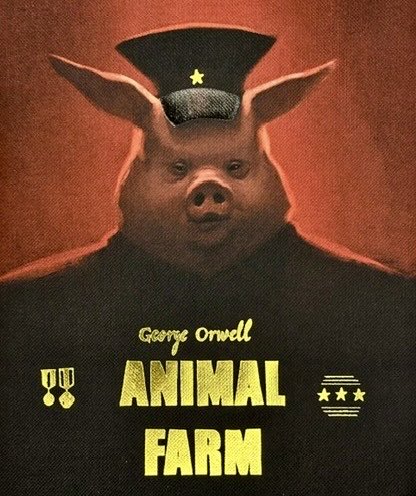
Animal Farm by George Orwell, in short:
1. Old Major, the fattest pig on the farm, delivers a sermon about "liberation." He has never missed a meal in his life – but he is the most envious of the Man – the producer, the entrepreneur…
2. “Whatever goes upon two legs is an enemy” – the ideology is manufactured from the start, designed not to free the animals but to direct their resentment away from the pigs and toward a useful target. Every revolution needs an enemy. The pigs chose the farmer.
3. The revolution’s commandments were never a constitution. They were a management tool – sacred enough to motivate, vague enough to rewrite, and controlled from the beginning by the only ones who could read – the pigs.
4. Boxer the horse, the most honest creature on the farm, decent, loyal yet naive, totally devoted, responds to every setback with the same answer: “I will work harder!” He means it completely. He works himself half to death. It is the most heartbreaking sentence in the book – because the new system is perfectly designed to absorb exactly that kind of devotion and give nothing back.
When he finally collapses from exhaustion, he is sold to the knacker. For cash. The pigs buy more whisky with the proceeds.
The other animals are told he died in a hospital receiving the best care. The most useful animal on the farm is the one who never once suspects he is the product.
5. The commandments get rewritten at night not because power corrupted the revolution – the rewriting was always the plan. Language was the weapon from the first speech Old Major ever gave.
6. “All animals are equal, but some animals are more equal than others” – this is not the system’s failure. It is the system’s true face, finally visible once the animals are too exhausted and confused to object.
7. Orwell’s message: the lie came first. And the "liberation" it promised delivered something far worse than what came before – because the fattest pig was merely selfish at the start, but by the end is selfish and fluent in the language of "justice." He took all the eggs. He took everything. And made the hens thank him for it.
The fattest pig knew what he was doing all along…
Your brain basically stopped recording your life around age 25. Everything since then is a blur for a reason.
Neuroscientists measured this so many times they named it: the reminiscence bump. Ask anyone over 60 to recall their strongest memories and almost every answer clusters between ages 15 and 25. The decade where everything was new. First job, first apartment, first real relationship. Your brain encoded each day because nothing had a template yet.
After that window closes, most people enter a repetition loop. Same commute, same office, same weekend rhythm. The brain stops recording repeated experiences as distinct events. A year with 300 novel days leaves 300 memory anchors. A year with 10 leaves 10. Both took 365 days to live. Only one of them will exist when you look back.
This is why people at 50 say "where did the time go." The time went into routine that felt like living but left almost nothing behind.
Your remaining years are fixed. How many your brain bothers to remember is entirely up to you.
"The mob is fickle, brother."
That enduring line from Gladiator (2000) came to mind again.
Context:
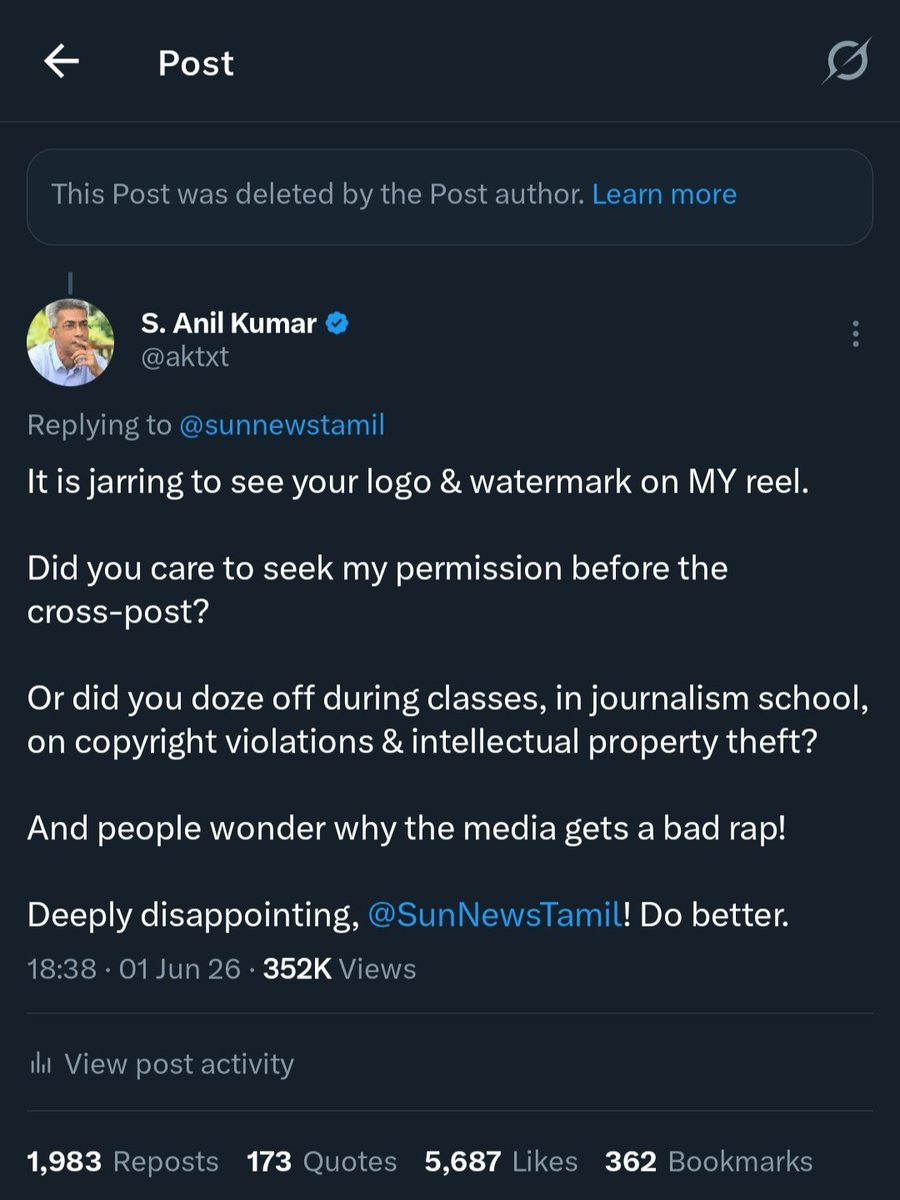
I rebuked a major media organization, @SunNewsTamil, for their unauthorized lifting of a reel I posted yesterday
Their cross-posted Instagram post had garnered 5000+ likes already when it was brought to my attention
You'd think I wouldn't mind, but I did, and I spoke my mind.
See QT and the screenshot of their since-deleted tweet.
To my surprise, even the rebuke has since garnered attention.
Evidently, it struck a chord with @TVKVijayHQ supporters who, I understand now, have had grievances against the media organization (closely affiliated with DMK/@arivalayam, the erstwhile ruling party) for unfavorable coverage.
That made this seeming enemy of an enemy a new friend!
Having long been apolitical and even far from clued into politics, this was an eye-opener.
It also tickled me!
Because before the fresh influx of bouquets, I have long been used to receiving the occasional brickbat instead from the same ardent fan base, for being closely related to their hero's "rival," despite the collegiality between them.
It is what brought the quote from Gladiator to mind, and I reminded myself that a fickle mob can easily turn against me, if I am not forgotten altogether.
I was touched by the CM's kind gesture in paying a visit and offering condolences to our family in person. At the same time, I have appreciated the warm messages of comfort from leaders across the political spectrum. (Thank you, all!)
As I continue to speak my mind – and I can because I speak for myself – I will likely butt heads against more people and rub more people the wrong way—on all sides! (I am, I like to say, my forthright father's son.)
Let's just keep politics out of this commoner's personal posts, shall we?
Be good, folks.
Better yet, get offline and hug a loved one tight.
How I wish I could this week!
Still investing your Rs.1000 in SIP and waiting for the 1 Crore future ??
In MP, around 50 IAS/IPS officers reportedly bought agricultural land on the same day … after 16 months 3200 Cr rupee western bypass was sanctioned in that area and land prices jumped 11x
Keep SIPing, Good Night
Modi and BJP leaders in last 1-2 months :
> Completed election rallies in Kerala
> Completed election rallies in West Bengal
> Completed election rallies in Assam
> Completed election rallies in Tamil Nadu
> Completed 50+ election rallies
> Sent every BJP leader for rallies
> Used thousands of cars
> Used lakhs litres of petrol and diesel daily
> Did all this in just the last one month
> Now giving gyan on global crisis
> Telling the public to compromise on everything
Masterstroke by Prime Minister Narendra Modi
Three people just died of hantavirus on a Dutch cruise ship. The strain kills nearly 40% of the people it infects. And yet no virologist on earth is panicking about a pandemic, because the reason it stays small is one of the strangest rules in disease science.
The rule is simple. The deadlier a virus is, the harder it is to spread.
If a virus kills you in days, you can't ride a bus, board a plane, or even leave the hospital. You're in a bed or a body bag. Either way, the virus killed its only ride.
Hantavirus has been around for at least 70 years, but fewer than 1,000 Americans have ever caught it. The CDC says it kills 38% of those who do. The cruise ship strain, called Andes, kills closer to 40%. If hantavirus spread like COVID, it would kill billions. But it can't.
Most hantaviruses spread only one way. You breathe in tiny dust particles from rat or mouse pee, droppings, or spit. No mice in your house, no virus. The cruise ship is the rare exception, because the Andes strain can spread between people, but it usually needs close contact like spouses sharing a bed. A Johns Hopkins virologist called Andes spread "unbelievably rare."
Compare it to the viruses that scared the world. Ebola kills 60 to 90% of people, but only through bodily fluids and only late in the illness, so each patient passes it to fewer than 2 others. SARS killed 10% before being wiped out in 8 months. MERS killed 35% but never spread far beyond the Middle East. None of them became pandemics, because the spread was always too slow.
Then COVID showed up. It killed about 1 in every 100 people who caught it. That is almost nothing compared to hantavirus. But COVID was mild enough that you could work for a week without knowing. You would ride the bus, hug your kid, eat lunch with a coworker, and infect four other people. It killed 7 million.
Flu works the same way. Mild fever, sore throat, but you still drag yourself to school or the office. The virus walks right into the next host.
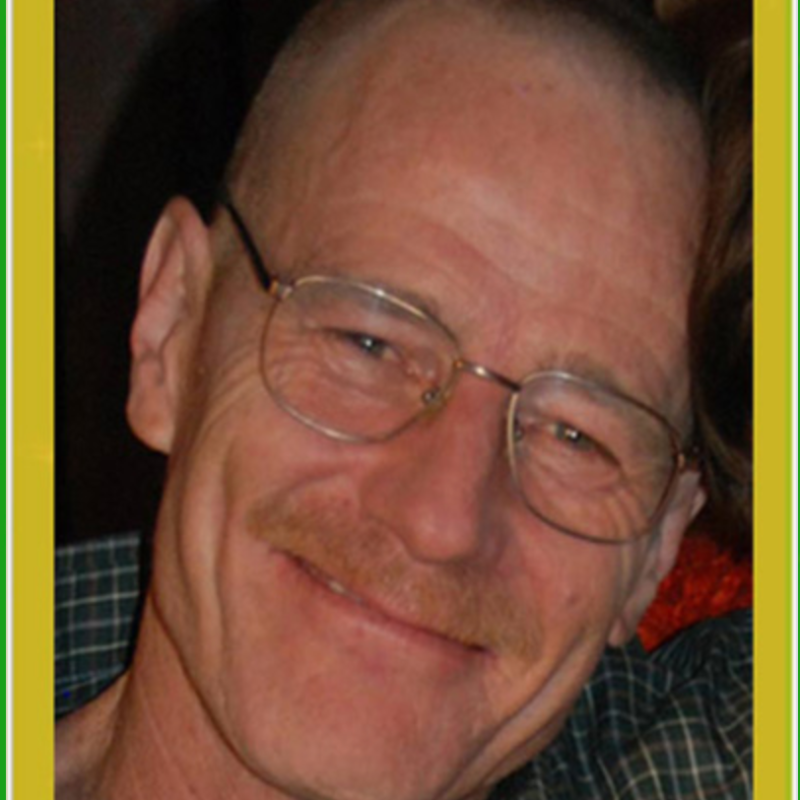
Hantavirus is the opposite. Within 4 to 10 days, your lungs fill with fluid. There's no medicine that fights it and no vaccine to prevent it. The only treatment is a machine that breathes for you, and even that just cuts the death rate from 50% to 20%. Every outbreak, from 3,200 UN soldiers in the Korean War, to the 1993 Four Corners cases, to Gene Hackman's wife Betsy Arakawa last year, traces back to mice.
The viruses that worry scientists are the boring ones. The ones that give you a sniffle for a week and let you walk around the city while you're contagious. Hantavirus, brutal as it is, never had the spread to do real damage.
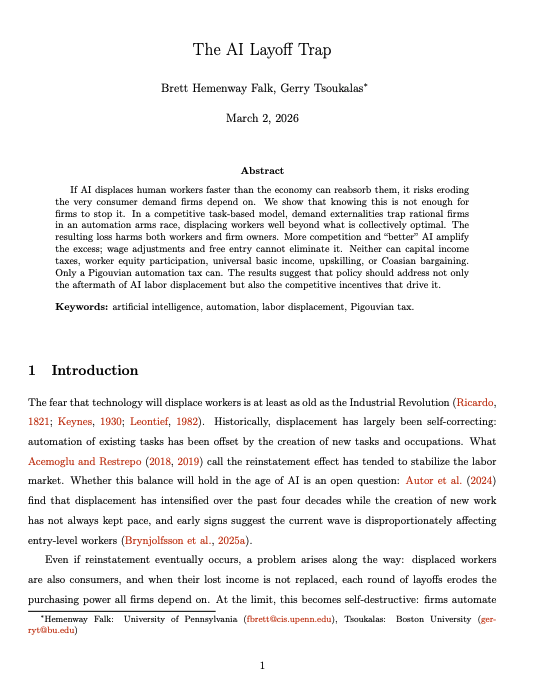
🚨BREAKING: Two researchers from UPenn and Boston University just published a paper that should be uncomfortable reading for every CEO automating their workforce right now.
The argument is straightforward. Every company replacing workers with AI is also eliminating its own future customers. Laid off workers stop spending. Enough of them stop spending and nobody can afford to buy anything. The companies that fired everyone end up selling into an economy with no purchasing power left.
Every executive can see this. The math is not complicated. But here is why nobody stops.
If you do not automate, your competitor does. They cut costs, lower prices, take your market share, and you collapse anyway. So every company automates knowing it is collectively destructive because the alternative is dying alone while everyone else survives. The researchers proved this is a Prisoner's Dilemma playing out in real time.
The numbers are already moving. Block cut nearly half its 10,000 employees this year. Jack Dorsey said AI made those roles unnecessary and that within the next year the majority of companies will reach the same conclusion. Salesforce replaced 4,000 customer support agents with AI. Goldman Sachs deployed a coding tool that lets one engineer do the work of five. Over 100,000 tech workers were laid off in 2025 and AI was cited as the primary driver in more than half those cases. 80% of US workers hold jobs with tasks susceptible to AI automation.
The researchers tested every proposed solution. Universal basic income does not change a single company's incentive to automate. Capital income taxes adjust profit levels but not the per-task decision to replace a human. Collective bargaining cannot hold because automating is always the dominant strategy.
They also identified what they call a Red Queen effect. Better AI does not solve the problem, it accelerates it. Every company chases faster automation to gain market share over rivals but at the end everyone has automated equally, the gains cancel out, and the only thing left is more destroyed demand.
The one thing the math says could work is a Pigouvian automation tax. A per-task charge that forces companies to account for the demand they destroy each time they replace a worker.
The conclusion is that this is not a transfer of wealth from workers to owners. Both sides lose. Workers lose income. Companies lose customers. It is a deadweight loss with no market mechanism to stop it on its own.
(Link in the comment)
Nike spent ten years trying to break the 2-hour marathon. They named a project after it. They built special shoes. They paid the greatest marathoner alive to chase it. Yesterday, a Kenyan runner finally did it in 1:59:30, wearing Adidas.
Sabastian Sawe used to be a pacemaker. A pacemaker is the kind of runner you hire to set the speed for the first few miles of a race and then drop out before the finish. In January 2022, Sawe got booked to do exactly that at a half-marathon in Spain. He'd never raced more than three miles in his life. He stayed in for the full 13 and won the whole thing. Adidas signed him not long after. Four years later, he became the first human ever to run an official marathon under 2 hours.
Nike, meanwhile, started this whole project in 2016 with a public goal called "Breaking2." They paid for the shoes, the pacemakers, the science labs, and Eliud Kipchoge himself. Kipchoge ran 1:59:40 in Vienna in 2019, but the event was a closed-course exhibition with rotating pacemakers and a pace car projecting a green laser line onto the road. The sport's governing body never recognized it as a real race. It didn't count.
Then Nike's running business cratered. Digital sales fell 26% in one quarter. Their share of footwear sold at Dick's Sporting Goods went from 39% to 32% in five months. On Running grew from $330 million to $1.8 billion between 2020 and 2025. Hoka nearly quadrupled. Roger Federer left Nike for On. Nike's board fired the CEO in October 2024.
Adidas spent the same period building a better shoe. The new Adizero Adios Pro Evo 3 took three years to develop. It weighs 97 grams, about 3.4 ounces, lighter than a deck of cards. A Wall Street Journal-cited study found that wearing a shoe 3.5 ounces lighter saves a runner around 57 seconds across a marathon. Sawe beat the third-place finisher by 58 seconds.
Adidas also did something Nike never did for Kipchoge. They wrote a $50,000 check to the official anti-doping body for track and field, asking it to test Sawe more aggressively than any other runner alive. He got tested 25 times in the two months before last year's Berlin Marathon, and Adidas signed up to fund this for the length of his contract. The logic: the moment Sawe ran a marathon this fast, the world was going to ask if he cheated, especially after his countrywoman Ruth Chepngetich got a 3-year doping ban in 2025. Adidas got out ahead of it.
The shoe retails at $500 and is barely available. Adidas's Adizero shoes won half of all major marathon races in 2024. Yesterday in London, four of the top five finishers wore the same Adidas shoe. Yomif Kejelcha crossed the line 11 seconds after Sawe and also broke 2 hours. The top three runners all beat the previous world record.
Nike's only response was an Instagram post. Three sentences long: "The clock has been reset. There is no finish line." That was their entire public reaction to losing a 10-year moonshot to their biggest rival.
Run the actual numbers on "SIM card gold" before you start dissolving things in acid.
A SIM card contains roughly 0.5 to 1 milligram of gold. At today's gold price of ~$4,500 per ounce, one milligram is worth about $0.15. Fifteen cents. Your SIM card's gold is worth less than the electricity it takes to read this tweet.
The video going viral right now is from a Chinese blogger who claimed to refine 191 grams of gold from SIM cards. Worth about $28,000 at current prices. What the video doesn't show: the creator later admitted the process required 2 tons of raw materials, not just SIM cards, and most of the source material was other gold-plated electronic waste that never appeared on camera.
The math on pure SIM card extraction is brutal. At 1 milligram per card, you need roughly 31,000 SIM cards to get a single troy ounce. The chemical process requires aqua regia, a mixture of hydrochloric and nitric acid that produces chlorine gas. One experienced refiner on a gold recovery forum bought 900+ pounds of SIM cards expecting 0.6-0.8 grams per pound. Actual yield: 0.1 grams per pound. He described it as a "big time" loss.
The world produces about 4.5 billion SIM cards per year. If you could magically collect every single one and extract the gold perfectly, the total yield would be roughly 4,500 kilograms. At $4,500/oz, that's about $650 million. Sounds large until you realize that's 0.003% of global gold production value. The entire planet's annual SIM card output contains less gold than a single mid-size mine produces in a year.
The real gold in your SIM card is the copper and nickel underneath. The gold layer exists because gold doesn't oxidize at room temperature, keeping the contacts functional for years. It was never there to store value. It was there to prevent a $0.50 part from corroding and bricking your $1,000 phone.
Every "secret gold source" video follows the same formula: show the shiny output, hide the input costs, skip the chemistry that can hospitalize you.
By far my biggest advice to anyone trying to adopt AI properly:
1. Pay a little bit of money to Anthropic
2. Download Claude Code
3. Open Claude Code
4. Press 'Shift-Tab' until it says 'plan mode on'
5. Open Voice Memo on your iPhone. Just talk about all the things you want to accomplish. When you think you are done, just keep talking. Make sure it is at least 10 minutes, hopefully longer
6. Send this Voice Memo to your computer
7. Download MacWhisper and use it to transcribe this voice memo. Trust me, you will want MacWhisper and will use it later a lot
8. Type into Claude Code: "I have never used you before but I talked about some things. I will paste those things in below. Please read the things and ask me any questions you need to in order to help me figure out how to use you to be awesome. Ask me lots of questions until I tell you I am done"
9. Then paste in the transcript
10. Then press enter
Then just let Claude take the wheel, and them please send me a DM if this works.
Also, if this just sounds crazy, just literally take this entire message and paste it into whatever AI you are using and say 'some weird person told me to paste this into you, I want to use it, but I don't know how. What should I do?'
I am just trying to help you get started. Curiosity and persistence are the most important things.
You received a photo on WhatsApp. It downloaded to your phone. It’s sitting in your gallery right now. So how does the sender tap “Delete for Everyone” and make it vanish?
It doesn’t actually vanish. That’s the trick.
When a sender hits “Delete for Everyone,” WhatsApp sends a silent command to your app an instruction that says: remove this from the chat thread. Your WhatsApp app receives it and replaces the message with “This message was deleted.” Clean. Gone. Done.
Except it isn’t.
WhatsApp cannot reach into your phone’s storage and delete files. Your operating system would never allow a third-party app to silently delete files from your gallery. What WhatsApp controls is only what appears inside WhatsApp. The moment that photo landed on your device and saved to your gallery, it left WhatsApp’s jurisdiction entirely.
If auto-download was on which it is by default the photo saved the moment it arrived. The delete removes it from the chat. The copy in your gallery stays exactly where it is. If you have Google Photos or iCloud backup enabled, that copy is already in the cloud before the delete command even reaches you. WhatsApp has no access to those backups at all.
“Delete for Everyone” was never a delete. It was always just a hide.
The sender thinks the photo is gone. The recipient’s gallery still has it. And they never had to do a single thing to keep it.
Went down the rabbit hole on this. One equation from 1926 explains why your lungs and that tree look identical.
A physiologist figured out that any system pushing fluid through branching tubes will naturally evolve toward the same shape. His rule is simple: when a tube splits into two smaller tubes, their sizes follow a precise ratio that wastes the least energy. Blood vessels follow it. Lung airways follow it. The water pipes inside trees follow it too.
Your lungs branch 23 times between your windpipe and the tiny air sacs where oxygen enters your blood. Each split shrinks the tubes by the same ratio. After 23 rounds, a single 2cm-wide tube becomes 480 million air sacs with a combined surface area bigger than a studio apartment, all packed inside your chest. Trees do the same thing in reverse, branching outward to catch as much sunlight and CO2 as possible.
Leonardo da Vinci noticed this 500 years before Murray. He wrote that all the branches of a tree at any height, when combined, are equal in thickness to the trunk below them. He used it to draw realistic trees. It took five more centuries for biologists to realize the same geometry applies inside your body.
But the tweet oversimplifies the gas exchange part. Trees are not our primary oxygen source. NOAA estimates tiny ocean organisms called phytoplankton produce roughly half of Earth’s oxygen. One single species, Prochlorococcus (so small that 20,000 fit in a drop of seawater), produces about 20% of all the oxygen in our atmosphere. That’s more than every tropical rainforest combined. The Amazon’s net oxygen output is actually close to zero because the animals and microbes in the rainforest consume almost as much as the trees make.
The real story behind that image: physics solved the same engineering problem billions of years apart, in completely unrelated organisms, and landed on the exact same answer.
Fuck it.
Prompt engineering officially died last month.
Anthropic dropped the 32-page internal guide that replaces it with “Skills” reusable workflow folders Claude learns once and never forgets.
Progressive disclosure + MCP = your personal AI employee that actually remembers how you work.
The era of re-explaining everything every chat is over.
Download the guide + my updated 2026 Skills starter pack here (free):
Comment “SKILLS” and I’ll DM both.
Our latest Claude Code hackathon is officially a wrap.
500 builders spent a week exploring what they could do with Opus 4.6 and Claude Code.
Meet the winners: