As you gear up for #BearWitnessDay, Cindy and friends have an important reminder about what the day is really about and how you can participate. Let us know how you plan to honour Jordan River Anderson and spread the word about #JordansPrinciple this Bear Witness Day 💙🧸
@Mad_In_America "[Pigott's FOIA re-analysis] finding was stunning: only 108 of 4,041 patients (3%) who had entered the trial had remitted & stayed well & in the trial to the end of the 1-year follow-up. All of the others had either never remitted, remitted and then relapsed, or dropped out..."
@jill_d35 Look up 100-day cough, AKA whooping cough. Lots of people in the UK and Canada have it this winter. Short-term tylenol helps with the rib, temporary control of sneezing and coughing.
@ReadReadj@PsychRecovery@MITUKteam 2023:
https://t.co/1EHky0WizI
"several reports of status epilepticus (SE) and/or persistent epilepsy after ECT [8-11]... Several studies suggested more extensive seizure spread after ECT is related to successful treatment of psychiatric symptoms...detection is challenging..."
@ReadReadj@PsychRecovery@MITUKteam Tardive seizures:
2022 Journal of ECT: 39 cases/"major complications were uncommon (<15% of cases)" and 20% had to take anti-epileptic meds: https://t.co/iBo1zzygcj
2016: "maintenance ECT is potentially hazardous. Focal seizures can be difficult to detect clinically..."
@ReadReadj@PsychRecovery@MITUKteam Numerous studies have revealed post-ECT prolonged seizures, tardive seizures & epilepsy. 2018 Danish study found that among 5875 patients, 32% were dxed with epilepsy https://t.co/TIeS6oALfJ 2023 study: dangerous tardive seizures occur in up to 2% of ppl. https://t.co/HGNWkoA2Mr
@OliNejad @jill_d35@luludiamonds7 @RayannaScoville @JailBre18534267 Systematic review: "Major adverse cardiac events & death after ECT occur in about 1 of 50 patients... 2 studies... showed that in 5–10% of ECT treatments, patients develop cardiac troponin elevation, which indicates myocardial cell damage..." https://t.co/Q58XUnoBEJ
@peterkinderman@GeorgeKirov1@ReadReadj ECT research, particularly adverse side effects & traumatic brain injury, is still in its infancy, in the animal research domain, much of it showing markers of TBI. People should know that this crucial phase of safety/efficacy research didn't happen before ECT was given to people
@GeorgeKirov1@ReadReadj Report data:
the majority of c-ECT cases were not in dire straits, even by subjective "carer" ECT docs: 14.5% "normal, not at all ill"; 17.7% "borderline mentally ill"; 17.7% "mildly ill"; 24.2% "mod ill."
Why no status data for mect? And what does "borderline mentally ill" mean?
@GeorgeKirov1 Lots of missing data in this report. These numbers could underestimate the reality:
57% given to "detained" ppl, 89% classified as "without mental capacity" (meaning they did not consent); 35% for c-ect; 16% for m-ect.
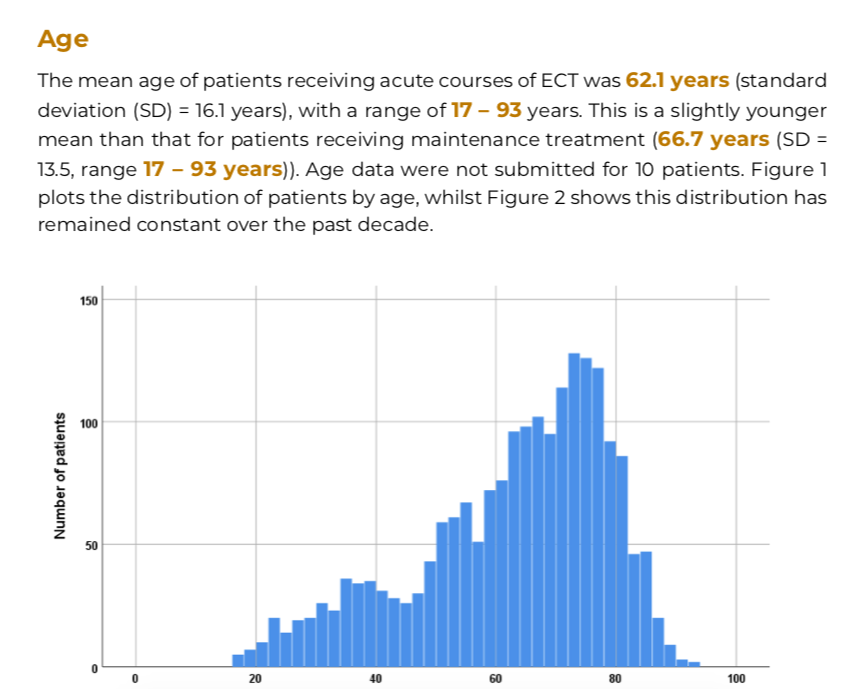
The sig majority are women, and elderly, aged mid-60s-93
@GeorgeKirov1 ECT recipients classified "normal, not at all ill": 14.5% c-ECT
"mildly ill": acute ECT 2.7%; c-ECT 17.7%
"moderately ill": 16.5% acute/24% c-ECT.
2 recipients "not at all ill."
12 acute & 17.7% c-ect were called "borderline mentally ill." What does that mean? No m-ECT data.
@ProfRobHoward As the report authors state, there's a lot of data missing - up to 55% - in this UK report on electroconvulsive therapy. But I have highlighted important data from the report in my replies to Kirov's tweet.
@GeorgeKirov1 Maintenance ECT:
Can be done for "indefinite period" & reason for 36% "carer choice”
consecutive mECT mean was 48.2 sessions (1 to 942 sessions)
44% data excluded/had no rating scales
2% "complete inability to remember” post-mECT
@GeorgeKirov1 Continuation ECT:
81.7% women
48.5%/14.5% of c-ECT rated "mildly ill"/not at all ill”
Excluded data: 32.2%
2% of c-ECT "complete inability to remember" pre/post cECT
@GeorgeKirov1 "not uncommon for an acute course to be longer than 72 treatments"
"The widespread use of zeros to signify missing data, resulted in marked challenges in data analysis.”
@sanilrege@psycheureka Yet another paper linking STMN1 upregulation to post-blast exposure among US military: mitochondrial dysfunction, neuro disease, membrane depolarization, traumatic brain injury. https://t.co/J4gCkkCfIp
@sanilrege@psycheureka The study conclusion is attached here. STMN1 and DCX are markers linked to traumatic brain injury in numerous research papers. Please review on pubmed. Including this paper on epilepsy linking DCX to "intellectual disability & abnormal neuronal migration." https://t.co/edsLkHwfyo








![moredegan's tweet photo. @ReadReadj @PsychRecovery @MITUKteam 2023:
https://t.co/1EHky0WizI
"several reports of status epilepticus (SE) and/or persistent epilepsy after ECT [8-11]... Several studies suggested more extensive seizure spread after ECT is related to successful treatment of psychiatric symptoms...detection is challenging..." https://t.co/xvumKl9u6m](https://pbs.twimg.com/media/GFGIX1rXIAAyO3T.png)