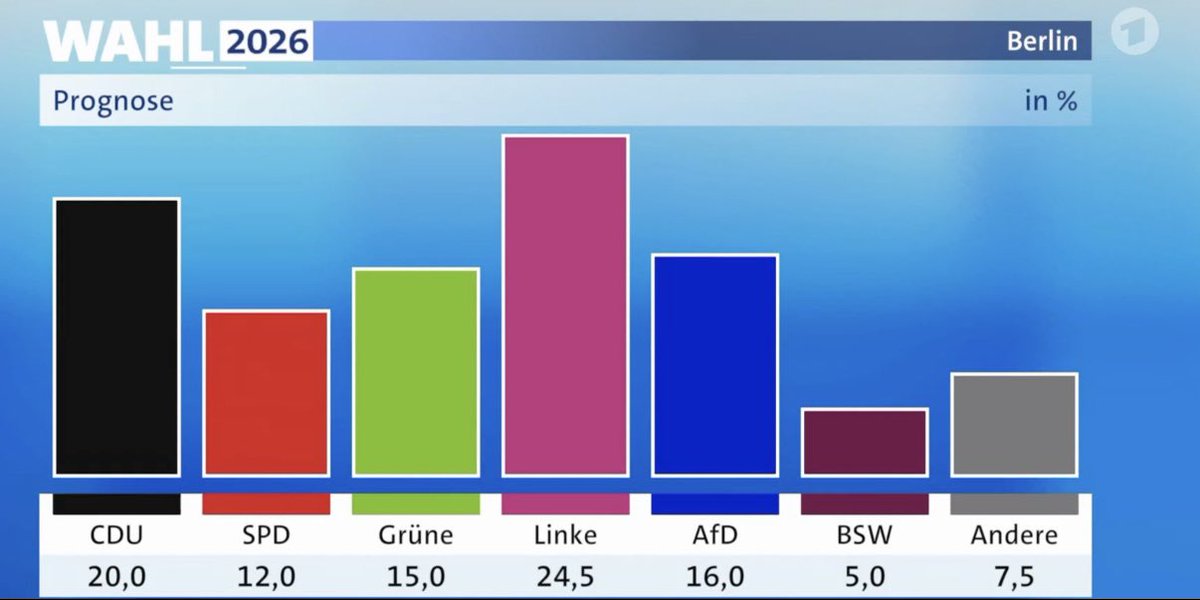
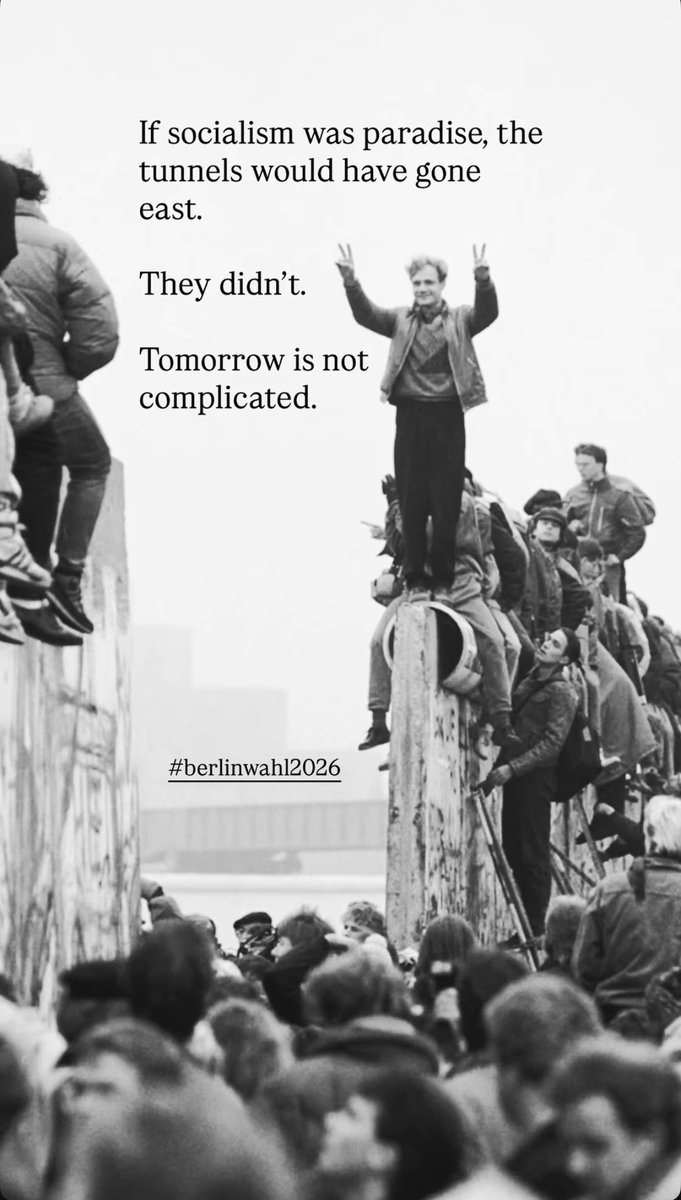
Bari Weiss just finished speaking at a ceremony in Berlin ahead of Peter Thiel being awarded the Axel Springer 2026 Award. (Sorry for the poor video quality.)
Weiss listed out some of her differences with Thiel. Among them: "And of course there's a difference in our attitude, at least sometimes, toward the press, and to the vital role that it plays in maintaining a liberal democracy. I view it as essential. It's my life's work. I see it as an instrument of liberty. And as an engine of progress that deserves to be in invested in and perfected."
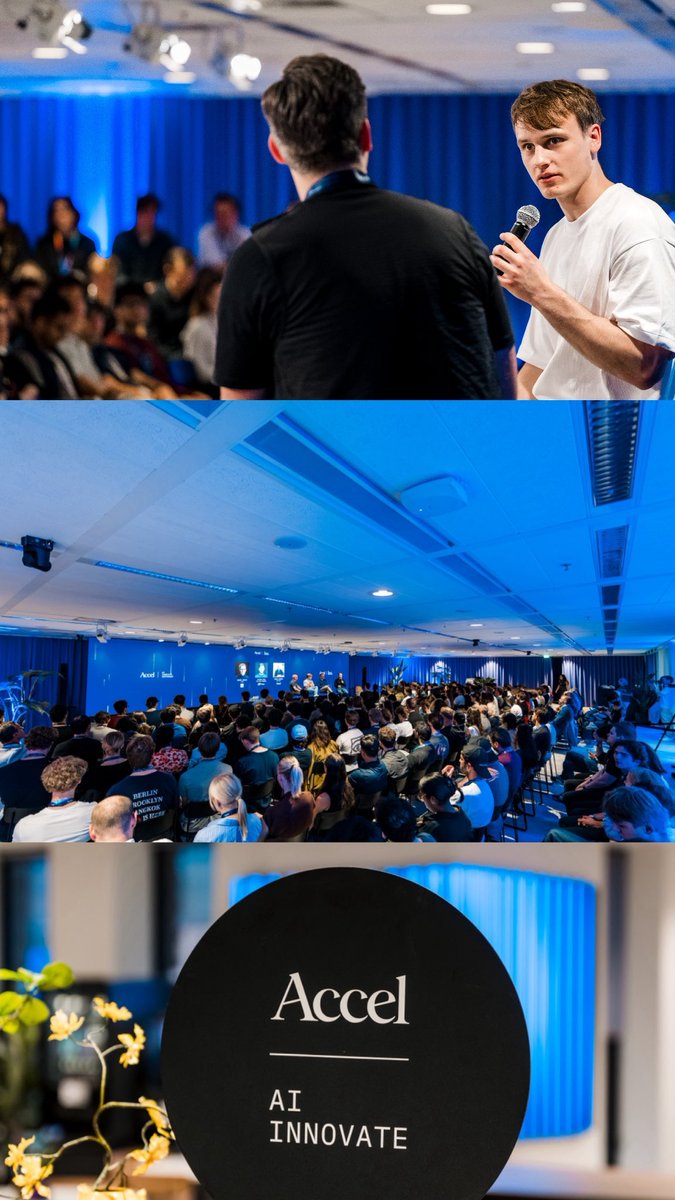
Amsterdam's startup ecosystem is on fire.
Yesterday's hackathon was next level.
And the speaker lineup at @Accel's Al Innovate Amsterdam was absolutely matching the level of extraordinary:
@FabianHedin (Lovable), @samstphenson (Granola),
@daniel_gebler (Picnic), @Ritchie Vink (Polars) & more.
Europe is cooking.
@Tulip_AMS @AISO @HackathonHub@greinerX
Most people think childhood cancer research is paid for by the government.
At @StAnna_CCRI in Vienna, most of it is paid for by private donations.
In the 1970s, one in two children with cancer died.
Today, around 85% of children in Austria aged 0–14 recover. For lymphatic leukemia, it’s 95%.
That took decades of research. St. Anna has been part of it since 1988, when its first lab was set up in the attic of the St. Anna Children’s Hospital.
Around 15% still don’t recover. That’s what the research is for now.
On September 8, Kids Future Unlocked at the Hofburg raised over €500,000 for this work. Thanks to @eric_demuth and the Ambassador Circle for making it happen.
Giving kids a future is how a civilization moves forward.
Philanthropy matters.
Let’s stop the VR/XR doomerism.
Every few months someone declares it dead, and we keep strangling the kid in the crib before it can walk. Here’s my story, and why Simon’s meetup matters.
Over the past year I’ve been testing my Oakley Meta glasses, and it’s becoming clear to me: nobody will use an iPhone in the near future.
They just got a major update (no, @finkd didn’t pay me lol) and they’re not even AR yet. They’re not just glasses anymore, they’re an actual operating device. You’re not staring into a screen, so you take in way more from your environment and turn that into more output. It stopped feeling like technology on one side and me on the other. It felt like one system, a bridge between software and my brain’s own computational power.
And that’s the point: this isn’t a dead end, it’s a bridge. Glasses today, brain interfaces tomorrow, through Neuralink but also through the brain power we’re only starting to tap into.
Which raises the real problem: agency. When technology merges this closely with us, who’s the agent?
That’s why rooms like Simon’s matter. The people building on glasses right now are the ones who get to answer that question.
San Francisco XR/Spatial Computing Meet-up prior to @Meta Connect.
With so much news in immersive tech (Steam Frame, Astra for VR dev, Specs launch, and new Meta devices being announced) there’s much to discuss!
For XR developers, creators, founders, and enthusiasts.
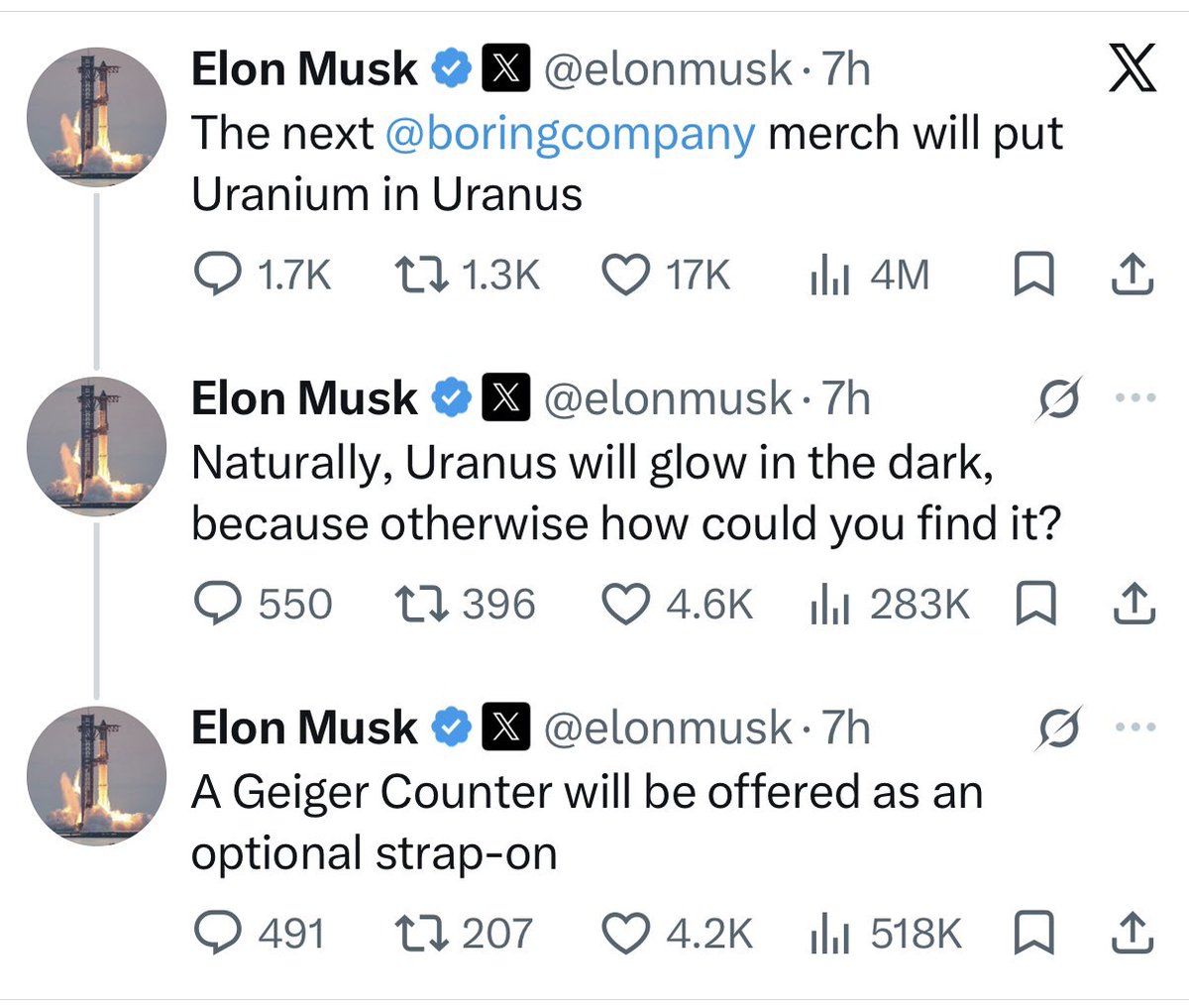
🚨🇸🇪🇵🇸 Greta Thunberg wants protests ahead of the iPhone Duo launch, calling Apple an “accomplice to genocide” in Palestine.
"We are saying NO to blood tech."
I wish I had as much free time as she does... 🤣
Writer: Samuel
My uni professor: “Why is it so hard for entrepreneurs to give up their company?”
Building a company is like giving birth.
It’s hard to kill the baby afterwards.
Wild thing to hear at 8am in university.
Learn Austrian Economics in one X post:
1. Humans act. Every choice a person makes traces back to an incentive, a trade-off, a cost weighed against a benefit. Remove the incentive and the action stops. Distort the incentive and the action warps.
Tax income at 90% and watch producers stop producing. Subsidize failure and watch failure multiply. The behavior follows the reward structure, always.
2. Value exists only in the mind of the person choosing. A glass of water is worth nothing to a drowning man and everything to a man dying of thirst. No central authority can calculate this, because it changes with every individual and every circumstance.
Nothing has value in itself, only the degree to which humans choose to value it. Diamonds and even gold only carry value because humans decided they do.
3. Money does not come from a government decree. It emerged spontaneously when traders needed something durable, divisible, and widely accepted to escape the limitations of direct barter. Gold won that competition across centuries and across dozens of independent civilizations because the market, not a ministry, chose it.
Fiat currency is the state hijacking that evolved institution and replacing it with paper backed by nothing but a legal threat. Every central bank on earth operates on this model right now.
4. Wealth does not fall from the sky. A farmer who eats his entire harvest produces nothing next season. The farmer who saves seed, plants it, and specializes in what he grows best accumulates a surplus. That surplus is capital. Capital funds everything that comes after.
Consumption without prior production is just burning down the furniture for warmth. Every welfare state eventually reaches this point.
5. Strip private property rights and production collapses. A farmer will work his own land until midnight. That same farmer, working collective land, stops at noon. The Soviet Union ran this experiment across seventy years and killed tens of millions, proving the point.
When you cannot own the outcome, you do not produce the outcome.
6. Voluntary trade generates wealth from nothing but mutual preference. When you pay twelve dollars for a meal, you value the meal above twelve dollars; the restaurant values twelve dollars above the meal. Both parties walk away wealthier in real terms. No politician, no regulator, no bureaucrat added anything.
Protectionism destroys this. The 2018 US steel tariffs raised steel prices for American manufacturers, killed more jobs in steel-consuming industries than existed in steel production itself, and transferred wealth from productive firms to a protected few.
7. Ludwig von Mises identified inflation as a tax. Every dollar the Federal Reserve creates without corresponding production dilutes every dollar you already hold. The new money flows first to the government and its contractors, who spend it at current prices. By the time it reaches you, prices have already risen.
The US M2 money supply grew from roughly 15 trillion dollars in January 2020 to over 21 trillion by early 2022. Consumer prices followed. Your savings took the loss.
8. Prices carry information. A price spike tells producers to produce more and tells consumers to use less. It coordinates millions of strangers without a single central command. Interfere with that signal and the coordination breaks.
Rent control in New York City is the cleanest example. Cap rents below market and landlords stop maintaining buildings, stop building new ones, and convert units to other uses. The people rent control was supposed to help pay the price through collapsing supply.
9. Interest rates are the price of capital over time. When the Federal Reserve pushed rates to near zero between 2008 and 2022, it told every investor that capital was nearly free. Businesses built projects that only made sense at zero percent. When rates normalized, the projects failed. The 2022 collapse of the US tech sector and the crypto market were not random events. They were the correction of a decade of artificially cheap capital.
The business cycle is not a mystery of capitalism. Central banks manufacture it.
10. Bureaucrats face no profit and loss. A businessman who misallocates capital goes bankrupt. A bureaucrat who misallocates capital writes a report requesting more funding. The feedback loop that disciplines markets simply does not exist inside a government agency.
The US Department of Education has spent over a trillion dollars since 1980. Literacy rates have not improved. No one at the department has been bankrupted by this outcome.
11. Every producer inside a local market holds knowledge that no bureaucrat in a capital city can replicate. A wheat farmer in Kansas tracks soil moisture, futures prices, local equipment costs, his specific buyer relationships, and a hundred other variables simultaneously. That knowledge lives in the price he sets.
Friedrich Hayek called this tacit knowledge in 1945. The Soviet central planners ignored him and spent fifty years proving him correct, producing chronic shortages of goods that private markets coordinate effortlessly. No model, no algorithm, and no committee can compress what millions of independent actors know into a single plan.
12. Every government intervention produces effects you see and effects you don't. You see the road the state builds. You don't see the factory the tax dollars never funded, the job that never existed, the innovation that never happened because capital was extracted at gunpoint and redirected by bureaucrats with no skin in the game.
Take the 2009 Cash for Clunkers program. Congress destroyed 690,000 working cars, handed dealers a short-term spike, and you saw the sales numbers. The used car market was stripped of affordable inventory, pricing working-class buyers out for years afterward.
13. Prices, supply chains, and language itself coordinate millions of strangers without any central planner issuing a single command. That coordination is spontaneous order: complex, functional patterns that emerge from individuals pursuing their own goals under rules they did not collectively design. No committee holds the dispersed local knowledge required to replicate what voluntary exchange produces every second.
Watch how English evolved. No king designed its grammar. Millions of speakers across centuries adopted words and structures that worked, dropped ones that didn't, and produced a language richer than any bureaucrat could have engineered. Central planners who believe they can replicate that process with price controls or production quotas destroy the feedback mechanism that generates the order in the first place.
Thanks for reading this long post! What would you add to this list?
Macron's former Prime Minister, who is candidate at France's next presidential elections, proposes to "build the United States of Europe" 👇
I've been hearing this discourse ever since I was a child, that we cannot compete with the US and China without a strong Europe.
Which, granted, makes a lot of sense on paper: if you're to compete against giants, you've got to be a giant yourself. Logical, right?
Except, in practice, the exact opposite occurred. Just look at the evolution of relative share of global GDP (https://t.co/X0iTKx9hcy): in 1992, the year of the Maastricht treaty (which officially created the EU), the countries making up the EU used to have 28.8% of global GDP which was actually more than the US (25.7%) and China (1.9%) combined!
Fast forward to today and both the US and China's shares have grown - in the case of China it's grown considerably - but Europe's share has shrunk to around 17%, the same share as China, losing about 40% of its economic weight in a mere 3 decades.
Which means that, very concretely, more Europe - and there has been, treaty after treaty, more and more Europe - has so far meant more and more economic irrelevance. The more we built Europe - this supposed economic giant on paper - the smaller we got economically.
And it's not a China story, it's not that simple: if it were, the US's global share of GDP would have shrunk alongside Europe, but it just didn't. Which means it's really a Europe problem.
And, unfortunately, it's not just the economy. More Europe has meant more irrelevance and weakness in just about all fields that matter.
Take foreign affairs for instance. There used to be a time when Europe's voice mattered in the world - or at least that of the countries making up Europe.
When, say, De Gaulle could, in the space of a single year, pull France out of NATO (https://t.co/asl494VdaU), ask American troops to leave French soil (https://t.co/7IM0R10bGi), and then fly to Phnom Penh to tell a packed stadium that the US had no business waging war in Vietnam (https://t.co/LMipIYWaKa). Try to picture a single European leader doing even one of those three things today.
Heck, in 2009 France got **back** in NATO, a sad illustration that the "strong Europe" we were promised as a counterweight to the US has in practice meant ever deeper subordination to it.
It's even written in black and white in the Lisbon Treaty itself (https://t.co/PRy91R7Dip), which states that NATO "remains the foundation" of its members' collective defence. So much for the independent giant...
Or take another critical dimension of power: technology. The countries of Europe used to sit at the technological frontier: Concorde, Ariane, the TGV, the World Wide Web invented at CERN, etc. A reminder that as late as 2007 a single European company, namely Nokia, sold 4 out of every 10 mobile phones on the planet.
Today look at the ASPI Critical Technology Tracker (https://t.co/JkfQboeBFn): out of the 74 critical technologies of the future, in how many is any European country in the lead? Answer: not a single one of them.
And I'm not even speaking about energy, culture, and a dozen other fields where the story is identical.
On energy alone: European companies now pay 2 to 3 times more for their electricity than their American and Chinese competitors, and just last year Brussels pledged to buy $750 billion worth of American energy as part of a trade "deal" for which it received, in exchange, 15% tariffs on its exports. Some giant...
Long story short, there is the logic on paper and then there is the logic in practice: when you see that the patient has been getting steadily sicker for 3 decades, and that the doctor's only answer, year after year, is to increase the dose of the very same medicine, at some point you have to question the medicine. Or the doctor.
De Gaulle, coming back to him because he was in my view one of the most prescient statesmen we ever produced, saw it coming clear as day: as early as 1962 he warned that a supranational Europe, having dissolved the only entities capable of having a will and a policy of their own - nations - would have no policy at all, and would end up following someone else's. He warned that "there would perhaps be a federator, but he would not be European" (https://t.co/hrhtRKUDd9).
In the same 1962 press conference he also beautifully said that "Dante, Goethe, Chateaubriand belong to all of Europe to the very extent that they were respectively and eminently Italian, German and French. They would not have served Europe much had they been stateless men and had they thought, written in some integrated Esperanto or Volapük."
That was his conviction: that Europe's genius is really the sum of its singular geniuses, and that you cannot add them up by melting them down.
If you make some sort of soup out of French, Italian, Greek, and Spanish cuisine, all thrown in the same pot, you don't get all the flavors at once. Instead, you've destroyed four of the world's great culinary traditions to produce something no one wants to eat.
I'm not anti-European, by the way, and neither was De Gaulle. I do believe - and so did he - that Europe should be a power in its own right. What De Gaulle called a "European Europe": independent of Washington, speaking with its own voice, master of its own destiny.
He simply understood that only nations can carry such an ambition, because only nations have a will. Which is the great irony of this whole story: those who claim to want a strong Europe are busy dismantling the only thing that could ever make it one - the sovereignty of nations.