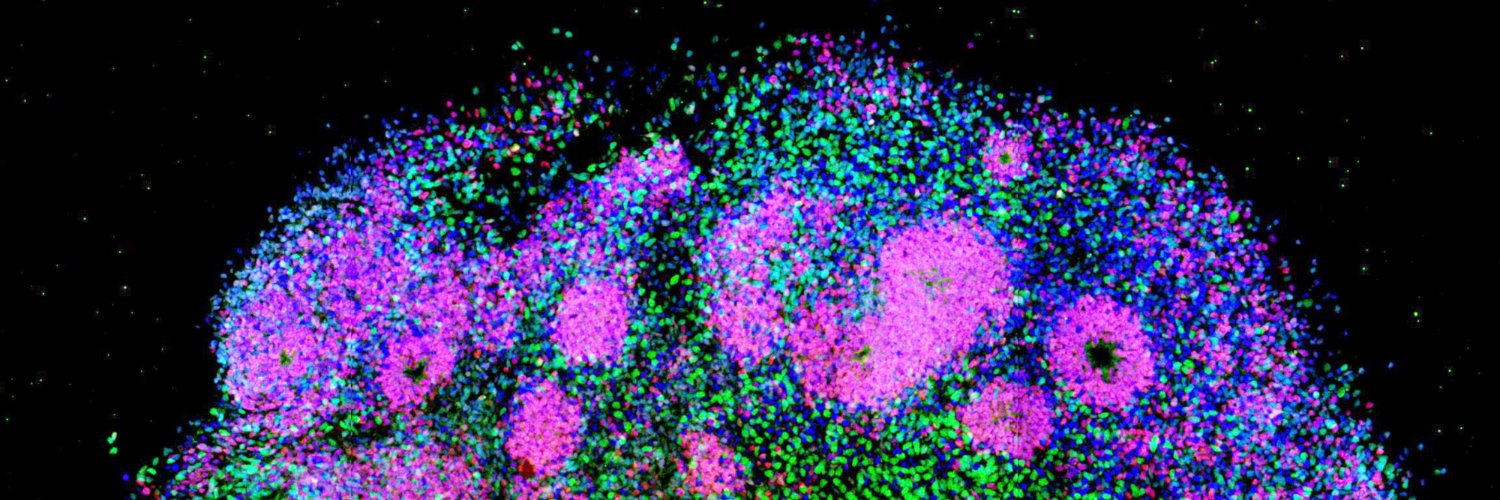
Can we keep a cancer cell from changing its identity?
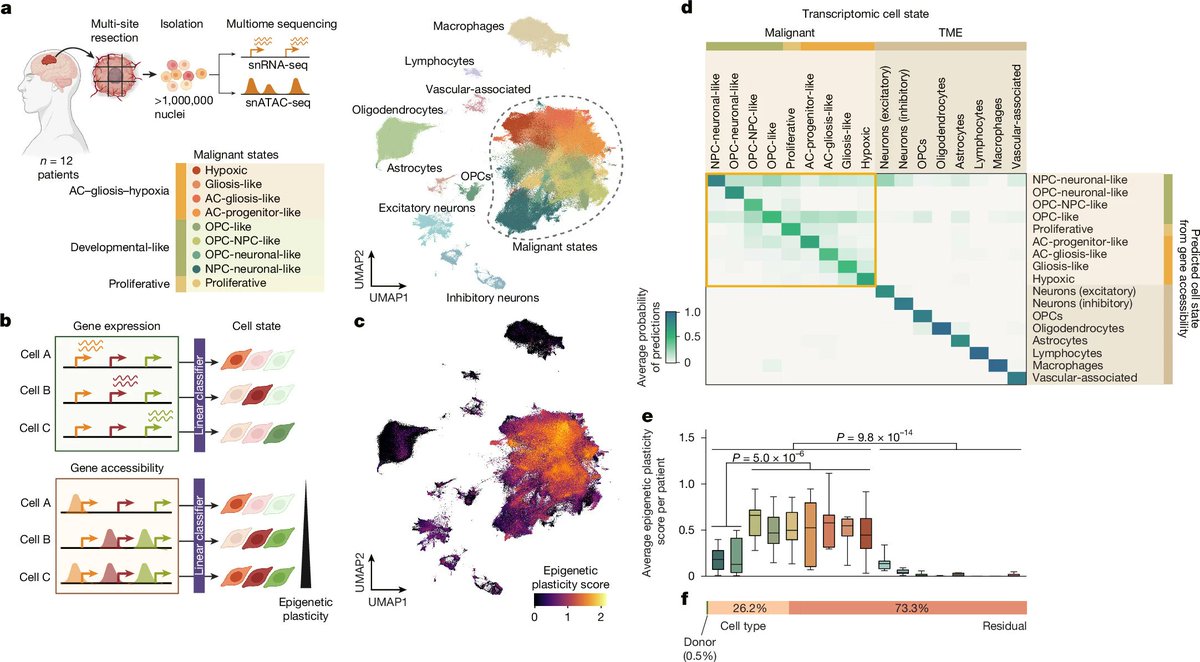
Our @Nature studies show that glioblastoma cells switch along predictable paths, and that the least plastic state is actively maintained by safeguard repressors led by MYT1L.
https://t.co/fCi78aiJ9h
https://t.co/FzqUq8ykbY
Can we use #AI to learn the rules of cancer cell plasticity and identify ways to constrain it? My core PhD work on "Decoding the regulatory programs governing glioblastoma plasticity”, is now published in
@Nature
Explainer from Claude 👇
https://t.co/hlxIhbr8TT
A special start to the Society for Neuroscience Meeting #SfN26 in Washington DC as the new issue of @NeuroCellPress is dedicated to human stem cell neuroscience, bringing together a collection of articles from leading scientists reflecting on the progress, opportunities, and challenges in this rapidly evolving field.
The issue includes contributions on brain evolution from Madeline Lancaster, Alex Pollen and colleagues; human brain development from Paola Arlotta, Christopher A. Walsh and colleagues; disease mechanisms and translation from Jürgen Knoblich, Guo-Li Ming and Sally Temple; and important questions about cognition, ethics, and oversight from Lucia Melloni, Stanislas Dehaene, Brie Linkenhoker, Alison Singer and others.
I had the pleasure of contributing an opening Perspective reflecting on how our ability to generate human neural cells, assemble them into circuits, and study their development and function in vitro and in vivo is changing the questions we can ask. What began largely as approaches rooted in stem cell biology is increasingly becoming an integral part of neuroscience, contributing to what we might call stem cell neuroscience.
Important challenges remain. Yet this is an exciting time for human neuroscience, as stem cell-based approaches, together with animal models, are expanding our ability to investigate human nervous system development, function, and disease in ways that were previously difficult or impossible.
Very grateful to the Neuron editors for bringing together this collection, to all the contributors for sharing their perspectives, and to the many scientists whose work over the years has made this progress possible.
All articles in this special issue are open access!
Link below
#stemcellneuroscience
Join @WashUGenetics next Thursday Nov. 12 at Noon in Connor Auditorium when Moritz Mall, PhD @MoritzMall presents, “Regulation of cellular plasticity in development and disease”, hosted by Dr. Joe Dougherty!
Glioblastoma is the deadliest and most common type of malignant brain tumour in adults.
New research from EMBL, DKFZ, and Wellcome Sanger Institute showed that glioblastoma cells follow predictable transitions between cell states that can be manipulated.
https://t.co/yA5MSg6OQc
@DKFZ@embl@sangerinstitute@Nature Thanks for the continued support that enables such interdisciplinary studies, which require excellent core facilities available at the @DKFZ
Forschende vom DKFZ, @embl, HITBR und @sangerinstitute haben in @Nature beschrieben, wie Glioblastomzellen zwischen verschiedenen Zuständen wechseln, einer der Gründe für die hohe Aggressivität von Glioblastomen.
https://t.co/BHNzxCeFC3
One of the reasons for the high aggressiveness of glioblastomas is their remarkable adaptability. Scientists from DKFZ, @embl, HITBR and @sangerinstitute now describe in @Nature how glioblastoma cells switch between different states.
https://t.co/aeTXorIf3K
Bei einem Besuch im Labor von René Jackstadt informierte sich der Minister über Forschung zur Metastasierung und Entwicklung von Therapieresistenzen bei Darmkrebs.
Anschließend besichtigte Minister Linnemann die Präventionsambulanz des Nationalen Krebspräventionszentrums.
Bundesgesundheitsminister Dr. Carsten Linnemann war heute zu Gast am DKFZ. Nach der Begrüßung der Teilnehmer der Intl. Conference on Cancer Prevention standen u.a. Einblicke in die aktuelle Krebsforschung und ein Besuch des Nationalen Krebspräventionszentrums auf dem Programm.
Nice collab spearheaded by the Zampieri lab! 🧬 Across 54 cancer cell lines, glutamine dependence reflects a trade-off between fast growth and metabolic flexibility. Happy that our stem-cell differentiation data helped reveal the tissue-specific twist. 👉
https://t.co/52bdIJ2kMv
We're hiring too! 🧠��� Two PhD projects in our lab: glioblastoma as a cellular ecosystem, and neurodevelopmental disorders modeled with patient iPSCs and organoids. Apply by 19 Oct!
https://t.co/M8hEEulhuv
How do you find what drives a cancer defined by what it lacks?
In TNBC, @shal_bahl, @nergizdgn & team uncovered tumour-specific regulatory programs and TF dependencies—and used them to repurpose drugs for tailored treatment.
https://t.co/NyM94YKI6G
Delighted to share our new study where we uncovered several key regulators controling the different EMT states and metastais formation. Congratulations Andrea Perez Gonzales @Andreapg_1998 and Gabriel Windels, the first authors for their amazing work. https://t.co/IKbFhFDOTi
I am happy to share the good news of a new Publication from our lab. Many thanks to Maxi, the Team and the great collaborators!!!
Manipulation of protein translation and stem cell self-renewal by CRISPR activation of rRNA transcription | Science https://t.co/wWYNMqrE4d
Für seine Forschung zur Plastizität bösartiger Hirntumoren und wie sich diese als möglicher Therapieansatz nutzen lässt, erhält Moritz Mall, DKFZ & Hector Institut für Translationale Hirnforschung, den Preis für Neuroonkologie der Sibylle Assmus Stiftung.
https://t.co/Y6cdGldDRh
Herzlichen Dank! 🙏 Ich freue mich sehr über die Auszeichnung der Sibylle Assmus Stiftung und bin meinem großartigen Team am @DKFZ, @zi_mannheim und HITBR sehr dankbar – ohne euch wäre diese Forschung nicht möglich.
Für seine Forschung zur Plastizität bösartiger Hirntumoren und wie sich diese als möglicher Therapieansatz nutzen lässt, erhält Moritz Mall, DKFZ & Hector Institut für Translationale Hirnforschung, den Preis für Neuroonkologie der Sibylle Assmus Stiftung.
https://t.co/Y6cdGldDRh
Moritz Mall, DKFZ and HITBR, has been awarded the Sibylle Assmus Foundation’s Neuro-Oncology Prize for his research on the plasticity of malignant brain tumors and how this can be used as a potential therapeutic approach. Congratulations! 👏 @MoritzMall
https://t.co/1wvAsLPcET
Thank you so much for the kind words! 🙏 I’m truly honored by this recognition from the Sibylle Assmus Foundation and grateful to my fantastic team at @DKFZ, @zi_mannheim, and HITBR – this work wouldn’t be possible without them.
Moritz Mall, DKFZ and HITBR, has been awarded the Sibylle Assmus Foundation’s Neuro-Oncology Prize for his research on the plasticity of malignant brain tumors and how this can be used as a potential therapeutic approach. Congratulations! 👏 @MoritzMall
https://t.co/1wvAsLPcET