@JoelSsenyonyi The last time i checked; competition is good for us users. We get data services at the best prices with utmost efficiency. Be worry if you have control in hands of the few @Airtel_Ug and @mtnug. Data in this country is so expensive
Entebbe X users. I have a plan. We need to meet, greet, know each other better. Can we empower ourselves economically? SACCO, invest in Unit Trust as a block, etc. Food for thought. Over to you.
Kabushenga’s Thoughts
Which Way Uganda’s Coffee
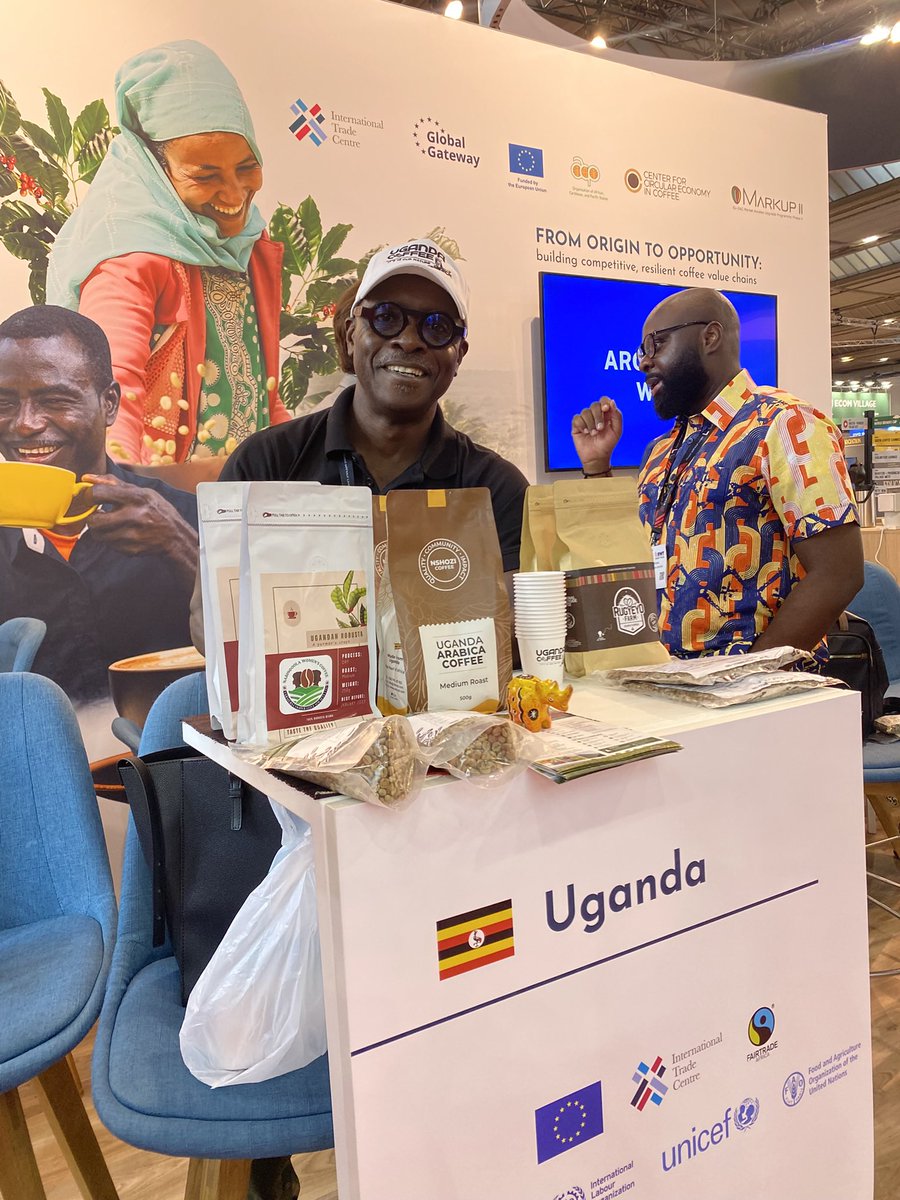
At the end of June we went to Belgium for the World of Coffee. I updated daily about our experience which you might have followed. But to recap. Uganda put its best foot forward. We made the most of our lead role at the event as the Portrait Country. This has solidified our position in the market as a desirable origin. The effect of this is to further drive up demand for Ugandan coffee. This has brought a fundamental question to the fore. How do we respond to the opportunity? If we stay the way we are, we cannot meet demand.
We have to fix two things. The first is crop production with a specific focus on yield and quality. This has a number. We need to move our national average annual yield per tree to a minimum of 600 kgs of Fair Average Quality beans per acre. It means each tree should do 1.5 kgs. Currently it is between 500 to 800 grams. On quality, we need to optimize on bean size and how we handle them from the garden to market. The second action is to enhance the value chain capacity. This simply means skills, liquidity and logistics to take the coffee to market. Apart from the growth in financial turnover that will accrue, jobs in the coffee sub-sector or in support of it will increase.Currently coffee provides a livelihood for approximately 12. It can go to 16 or even 17 million.
But perhaps the most compelling argument is that those who produce the coffee will be in a better position to command an even higher payback for their effort. Improved production means higher prices for more coffee. Considering the current business model, the money will go straight to the one who has the coffee to sell. No intermediaries. The current argument that middlemen are cheating farmers is false. The net effect of what we are proposing is to empower the producer and create access to the market.
This can deliver incredible results if policy formulation allows it to work. Here is why. I saw in Brussels how a collaboration between Government, Development Agencies and private coffee businesses can deliver powerful outcomes. The guys at the Coffee Production unit of the Agriculture ministry have spent the least couple of years working with support of International Trade Centre on a national brand. It was launched at the WoC to significant market awareness. To get the lead role at this event involved coordinating with the organizers at @SpecialtyCoffee and @ICOCoffeeOrg. The location and set up of the booth was an absolute winner. Most importantly they published geographic locations of the different coffees that Uganda produces. This speaks to profile, a major product differentiator in the coffee market. The @mofpedU availed money to make this possible, the @UgandaMFA deployed a team from head office and our local embassy. @ITCnews facilitated SMEs to attend. Hon. @DESIREtheFARMER the Minister of State for Agriculture came herself along with her @PS_MAAIF, @rggoobi the Permanent Secretary/Secretary to the Treasury and @Tybisa Permanent Secretary/Ministry of Foreign Affairs. As did our Ambassadors based in Brussels, Geneva and those from head office in charge of economic diplomacy. Solomon Rutega, the Ugandan who heads @coffee_inter made a prominent presence. It is this that gave Uganda positive status and gravitas.
We can use this template to drive the specific interventions into production and value chain improvements that can take us forward. It is worth trying.
Last year I accidentally did office hours with a startup that wasn't in YC. It turned out they were just there for interviews. But I did my best to advise them anyway. They didn't get in that time, but I just found out they were accepted into the summer batch!
🚨 Amad on Michael Carrick to stay permanently: “Everyone is delighted to have him as coach. Everyone supports him”.
“He's the kind of coach who maintains good relationships with all the players, so we're really thrilled to have him as coach, and we'll be thrilled if he STAYS in that role next season”, told Sky.
BUILDING SOCIAL CAPITAL
A Reflection on Teaching Boldness
There is a lesson I teach in the Entrepreneurship and Venture Development course at Joadah Design Institute that I look forward to every single cohort. Not because it is theoretically complex — in fact, the concept is deceptively simple. It is because of what it does to people.
I call it the Social Capital Assignment.
The task is straightforward: reach out to someone significant. Not a peer. Not a cousin who happens to run a small business. A big person — someone whose calendar is guarded, whose time is currency, whose influence extends beyond the room they walk into. Introduce yourself. Start a conversation. Build a connection.
Two weeks. That is all I give them.
I always brace myself before the presentations. Part of me expects cautious results — a polite LinkedIn message that went unanswered, perhaps a brief exchange with a middle manager presented as a breakthrough. Entrepreneurship students can be bold in the classroom and timid in the world. The gap between knowing what to do and actually doing it is where most people quietly surrender.
This cohort did not surrender.
One student reached out to the First Lady.
Another connected with Ham — one of Uganda’s most prominent and influential business and cultural figures.
Another sat down for a cup of coffee with the incoming Executive Director of KCCA — who, remarkably, gave her the time.
And those were just the highlights. Across the room, story after story of doors opened, conversations started, and relationships seeded in places most people spend their whole careers too afraid to even knock.
I will be honest: it was more than I thought they would go to.
And that admission carries its own lesson — not about the students, but about the nature of limits. We set expectations based on what we have seen before. We calibrate what we ask of others according to what we believe they are capable of. But human beings, when genuinely challenged and given permission to be bold, will frequently exceed every ceiling their teachers quietly erected for them.
What did this assignment teach?
First, that access is less protected than we imagine. The powerful are often more reachable than the merely busy. A well-crafted, sincere message to a high-profile individual will sometimes get further than a lazy email to someone three levels below them. Boldness itself is a form of credibility.
Second, that social capital is built through initiation, not waiting. Networks do not arrive. They are constructed — one intentional act of outreach at a time. Most people wait to be introduced. Entrepreneurs introduce themselves.
Third, and perhaps most importantly: the attempt transforms the person making it. Whether or not every message was answered, every student who sent that outreach became slightly different in the sending. They practiced seeing themselves as someone worthy of a conversation with greatness. That shift in self-perception is, arguably, the real assignment.
As an educator and entrepreneur, I left that classroom more energised than when I entered it. Not because my students performed well on a grading rubric — but because for two weeks, they went out into the world and acted like the founders, leaders, and changemakers they are being trained to become.
That is what education at its best looks like.
Not transmission. Transformation.
Joel Aita
When someone wants to exploit a woman, whether it’s a thief, a dishonest car dealer, a corrupt builder, or even toxic friends, they often first check if there is a man in her life who protects, advises, or stands with her.
A thief looks to see if she lives alone.
A dishonest mechanic checks if she came with a man.
A builder sees if anyone will question the work or the price.
Predators look for isolation.
Even harmful social circles sometimes test whether a woman is grounded in a serious relationship before pulling her into reckless lifestyles.
The easiest way to exploit a woman is to first separate her from the man she listens to—often disguised as “empowerment.”
They’ll say:
•“Your man wants to control you.”
•“He’s jealous of your success.”
•“He’s insecure for asking where you are.”
•“Don’t let any man tell you what to do.”
Slowly, the idea is planted that the man who cares about her is actually her enemy.
Once that influence is gone, the woman becomes easier to manipulate, scam, deceive, or exploit while being told it is all in the name of freedom.
Many people understand this: criminals, dishonest businesses, toxic friends, and opportunists.
Divide women from the men who protect and advise them, and you create vulnerability.
And if someone tries to speak about this reality, the easiest way to silence them is to turn women against the person delivering the message.
Courtesy….
@DailyMonitor Could you consider adding a free plan with limited features to your epaper? e.g., single access per week? This can help get users signed up and also helps them develop a reading habit, which later can turn them into paid customers.
@mtnug@genomuhoozi You're lying to the world in broad day light. We have it at office, and we've since switched to @Airtel_Ug. Be open and communicate data limits, so customers know.
Introducing your brand new @talkSPORT show, Inside Chelsea 💙
I’m so excited about this 🥰🥰 I don’t get to talk about Chelsea at work that much anymore so this makes me very happy.
You can watch it over on the talkSPORT YouTube channel 📺🫶🏽
@mtnug@mtnmomoug I went to a restaurant today and they had stopped receiving payments via MM. They told me the charges on them are high, and the service only serves to the advantage of the client. I am disappointed, but you should also be disappointed
What can be done to enable access to safe clean drinking water for all?
@ASEI_Uganda have risen to the challenge with their refreshing solution, a solar-powered ultraviolet-C water disinfection system.
Quench your thirst with our latest success story: https://t.co/ska9a7GzIF