conor mcgregor debunks the carnivore diet
& attributes adding carbs back in for his rematch win vs nate diaz.
“i was slow, i was sluggish, my gut was full. the next time I corrected it. my calorie intake has gone through the roof this week. I’m eating a lot, but correct”.
Never outshine people who have the authority to punish your brilliance. Talent without political sense becomes a threat, and threats get managed. Let insecure people feel taller while you build quietly. The goal is not to look superior in the moment. The goal is to keep rising.
Elon Musk: Without realizing it, we've all got a mental straitjacket on.
“Possibly the most common error of a smart engineer is to optimize a thing that should not exist. Why would people do that? Well, everyone's been trained in high school and college that you got to answer the question, convergent logic.
So you can't tell the professor your question is dumb, you'll get a bad grade. You have to answer the question. So everyone's basically without knowing it, they got a mental straitjacket on. That is, they work on optimizing the thing that should simply not exist.”
Starbase Tour with Everyday Astronaut, July 30, 2021.
An hour before his event at UVU, Charlie Kirk sat down for an interview which would become his final recorded conversation
The final question: “What is a quote that you live by?”
Charlie’s answer: “This too shall pass — If you’re going through the worst of times, this too shall pass”
“Romans 8:28 — God works all things for good for those who love Him.. when things can be really bad, God is working it for His good”
Charlie had no idea this would be his final day on earth. His words, wisdom, and legacy will live on 🙏🏼
Charlie Munger: "My advice would be if you have a fixable disadvantage, remove it. And if it's unfixable, learn to live [with] it. What else can you do? You fix what can be fixed and what can't be fixed you endure."
PALMER LUCKEY:
“IF THERE WAS A PRIVATE COMPANY THAT HAD THE SAME MONOPOLY THAT USPS DOES, AND THEY WERE USING IT TO SEND 100 POUNDS OF JUNK MAIL TO EVERY AMERICAN EVERY YEAR...
THERE’S NO WAY THEY’D SURVIVE.
THEY’D BE REGULATED OUT OF EXISTENCE.”
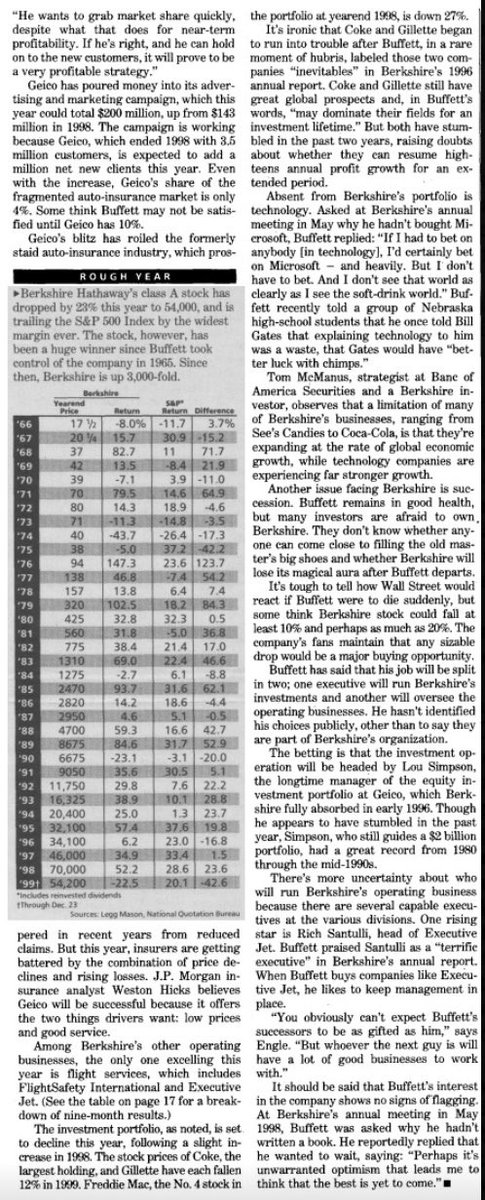
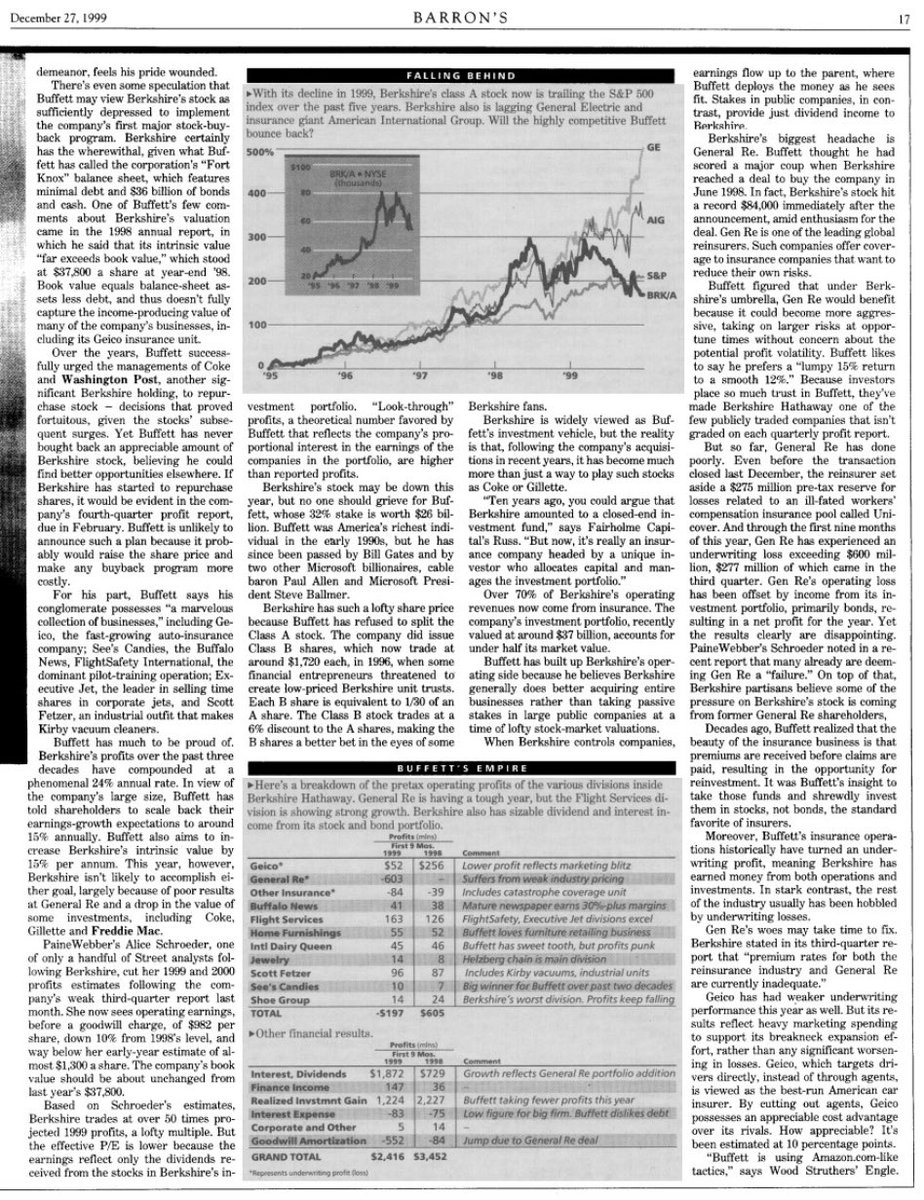
When asked about Berkshire's strategy toward potential shrinkage in the insurance industry.
Buffett responded with, "When you lose money at the horse races, you don't have to make it back at he horse races, and this applies to business."
He said there is no master plan at Berkshire except to "just keep playing the game."
Chamath Palihapitiya @chamath "Bro, there is no failure."
"That is what other people think of you to keep you down. There's no failure. If you were left on an island and it happened, you would just brush it off and move on. It's everybody else that you think is judging you. But then, here's the secret. They don't give a fuck about you. They are living their own lives. So it's your perception of what they think of you."
"There is no failure. There's do and learn. Do and learn. Do and learn. Do and learn."
@StanfordAILab
WE GOT VINTAGE CONOR MCGREGOR TRASH TALK 😭
🗣️ Conor: "I can destroy Max inside 10 seconds. If we go into these deep waters Max is going to be in a lot of trouble."
🗣️ Max: "What happened the first time?"
🗣️ Conor: "You were left in a wheelchair. That's what happened the first time. I WHEELED YOUR LITTLE BUM ASS OUT OF THAT OCTAGON." #UFC329
CHARLIE KIRK: "If the most important thing for you is just FEELING good, you're gonna end up miserable.
But if the most important thing is DOING good, you'll end up purposeful.
Purpose will give you happiness."
A Brown professor gave his students a take-home midterm exam. After suspecting many cheated using AI, he made the final in-person. The orange dots are the midterm scores and the gray dots are the final scores. Looks like all but 3 cheated on the midterm.
Ethan Hawke reveals he spending 15 years blaming everyone else and the moment he finally took responsibility
"I spent the first 15 years of my career saying I didn't do a good job cause that guy was a jerk or I didn't do a good job cause they changed the script or I didn't do a good job cause of the set and the other thing"
"And then you see people like back to our hero thing, you know, then you see people are really good and they don't"
"Robert De Niro doesn't give somebody the ability to screw up his work day, they don't have that power he takes responsibility for that power"
Joe: "Is that a Learned thing or is that you can certainly learn some of it from watching other people but is that just an experience thing?"
"I think it's the right manifestation of confidence"
"Young people have to fake confidence they just have to when you watch a young person in your craft they gotta fake it"
"Of course they're gonna have to go burn through their nerves, they are gonna have to but once you have experience you can have real confidence cause you fought this battle before"
Ray Dalio literally gave a 17-minute TED talk that explains how the world's largest hedge fund is run better than any business school on earth.
He's worth billions today, but the story he tells to prove his point starts with him broke and borrowing $4,000 from his dad:
1. Radical transparency is coming whether you like it or not.
Most executives treat radical honesty as a nice-to-have. Dalio opens his talk by framing it as inevitable. "Whether you like it or not, radical transparency and algorithmic decision-making is coming at you fast, and it's going to change your life." He isn't selling a management trend. He's describing a shift he thinks is unavoidable.
2. He didn't build the culture for output. He built it for relationships.
People assume Bridgewater's brutal feedback culture exists to squeeze out performance. Dalio says the real reason is more personal. "My objective has been to have meaningful work and meaningful relationships with the people I work with, and I've learned that I couldn't have that unless I had that radical transparency and that algorithmic decision-making." The honesty was never the goal. It was the price of admission for relationships he could actually trust.
3. He was a bad student who fell in love with markets instead.
Dalio doesn't pretend he was built for conventional success. "Since I was a kid, I've had a terrible rote memory. And I didn't like following instructions, I was no good at following instructions. But I loved to figure out how things worked for myself. When I was 12, I hated school but I fell in love with trading the markets." The trait that made him unemployable in a classroom made him unstoppable in a market.
4. Every mistake is a puzzle, and every puzzle hides a gem.
Most people just want the pain of a mistake to end. Dalio trained himself to want the mistake instead. "So I made a lot of painful mistakes, and with time, my attitude about those mistakes began to change. I began to think of them as puzzles. That if I could solve the puzzles, they would give me gems." That reframe, repeated for decades, is basically his whole operating system.
5. His biggest public call was also his biggest public failure.
He wasn't always the guy who gets it right. "Eight years after I started Bridgewater, I had my greatest failure, my greatest mistake. It was late 1970s, I was 34 years old, and I had calculated that American banks had lent much more money to emerging countries than those countries were going to be able to pay back and that we would have the greatest debt crisis since the Great Depression." He made the call loudly, in public, with total conviction.
6. The crisis never came, and it nearly ended him.
Being wrong at that scale had real consequences. "I mean, while the debt crisis happened, the stock market and the economy went up rather than going down, and I lost so much money for myself and for my clients that I had to shut down my operation pretty much, I had to let almost everybody go. And these were like extended family, I was heartbroken. And I had lost so much money that I had to borrow 4,000 dollars from my dad to help to pay my family bills." That is the founder of the world's largest hedge fund, flat broke, borrowing from a parent.
7. The lowest point rewired how he made every decision after it.
Instead of burying the failure, he let it change his approach entirely. "It was one of the most painful experiences of my life. But it turned out to be one of the greatest experiences of my life because it changed my attitude about decision-making." "Rather than thinking, 'I'm right,' I started to ask myself, 'How do I know I'm right?' I gained a humility that I needed in order to balance my audacity." One question, asked honestly, replaced a lifetime of certainty.
8. He went looking for the smartest people who disagreed with him, on purpose.
Most people surround themselves with agreement. Dalio built the opposite. "I wanted to find the smartest people who would disagree with me to try to understand their perspective or to have them stress test my perspective." Disagreement wasn't a threat to his ego anymore. It was the only quality control he trusted.
9. A junior employee grading his performance in public was the whole point.
To prove the system was real, Dalio shared an email from an employee criticising him directly, visible to the entire firm: "Ray, you deserve a 'D-' for your performance today in the meeting; you did not prepare at all well because there is no way you could have been that disorganized." His reaction wasn't defensive. "Isn't that great? That's great. It's great because, first of all, I needed feedback like that." If the CEO can be graded like everyone else, the meritocracy is real.
10. Radical transparency isn't for everyone, and he's fine with that.
He doesn't pretend this culture suits every personality. "It takes about 18 months typically to find that most people prefer operating this way, with this radical transparency than to be operating in a more opaque environment." "We found something like 25 or 30 percent of the population it's just not for." He'd rather keep the system intact than water it down to keep everyone comfortable.
Here's the thing though....
Dalio didn't have to hand any of this over. He could have kept the Dot Collector, the believability weighting and the Jim Haskel email as internal folklore. Instead he put it in a TED talk, then a bestselling book, then hundreds of interviews, and let a hedge fund manager's personal principles become one of the most quoted management philosophies on the internet.
The fund made him rich. Going public with exactly how it worked made him the person founders and CEOs actually study.
We build massive distribution and grow personal brands on X and beyond without our clients lifting a finger.
If you're a founder or VC looking for that kind of exposure, book a call below.
We average 1.5M views a week.
https://t.co/UoXuYll9FY
Elon Musk just exposed the most expensive physics failure in transportation history.
For a hundred years, nobody caught it.
Every diesel semi that crosses a mountain pays twice. Fuel to climb. Brakes to survive the descent.
At the summit, 80,000 pounds of freight holds enormous gravitational potential energy.
Free energy. Sitting right there.
Musk: “In a diesel truck, you actually don’t capture the energy of height or potential energy.”
Musk: “You have to actually spend a lot of money on expensive brakes going down the other side so you don’t run out of control.”
Diesel’s solution for a century? Destroy every watt of it as waste heat and burn through brake pads every few months.
Nobody questioned it. Not the engineers. Not the operators. Not Wall Street.
Because combustion made the loss invisible. You cannot turn momentum back into liquid fuel. So the entire industry mistook the limits of their engine for the limits of physics.
The Tesla Semi broke that assumption wide open.
Musk: “An electric semi truck is able to recapture the gravitational potential energy and in fact puts the energy back in the pack.”
Every descent charges the battery. The mountain stops being a toll.
It becomes a power plant.
Analysts keep running cost-per-mile models. Kilowatts versus gallons. Sticker versus payload.
Wrong equation entirely.
You don’t outcompete a machine that turns the terrain itself into fuel.
The trucking industry never had a fuel problem.
It had a hundred-year physics problem dressed up as the cost of doing business.
One man solved it. The rest are still buying brake pads.
Mayor Mamdani released his map of New York City’s “immigrant enclaves.” Except, he forgot a few spots.
Little Italy—one of the oldest immigrant communities in New York City—didn’t make the cut.
Here’s what the Italian-Americans whose families have been a part of Little Italy’s history told @IsabellaRedjai.
4 June 1985. Three traders in London, New York, and Hong Kong moved over $1 billion in deals in a single day.
In Hong Kong, 24-year-old William Wong was sitting on an open position of £21 million. He had to get out of it before the pound collapsed, but selling the whole amount at once would have given him away to the entire market.
He arranged for other dealers to sell smaller amounts at the same time. Then, with one casual wave of five fingers, he gave the signal. The market never even realized what happened. Wong exited his position with his profit fully intact.
"I'm here to make money. If the pound is falling, I'll profit from it"
This is real archival footage from the 1986 documentary "Billion Dollar Day", one of the most cinematic moments ever captured on a trading floor.
bookmark and watch this legendary trading floor footage ↓