Our work has been accepted at #ICRA2026 ! Huge thanks to my co-fisrt author (@kinam_0252), co-authors (@junhahyung , hyojin, hoiyoung, jooyeol, @hojoon_ai) and Prof. Jaegul Choo. See you in Vienna!
Introducing "3D HAMSTER", accepted to IROS 2026! 🎉
Hierarchical VLA planners draw waypoints in 2D, but robots act in 3D. Give the VLM a depth encoder, and it predicts metric 3D trajectories robots can execute.
Project page: https://t.co/5TiGDOmHLB
Paper: https://t.co/Rq3rIkUAP4
We found a general recipe for Solves: scale pretraining, then hill-climb with minimal in-house data.
For the first time, one fine-tuning example can teach a new behavior that generalizes. Below: 4 folding strategies, learned from one example each and tested on held-out setups.
Robot datasets come from many different camera viewpoints. By adding robot-centric pointmaps, VLA models can reason from the robot’s perspective and gain better spatial understanding—with just one extra encoder.
TL;DR: Add pointmaps for an easy ~5% VLA performance boost.
Introducing "See like a Robot"🤖
Robot data spans diverse camera viewpoints, making learning harder. Give a VLA robot-centric pointmaps, and it performs better with one extra encoder + one element-wise addition.
Project page: https://t.co/k5uBJOUBYa
Paper: https://t.co/ff2pwLLxxl
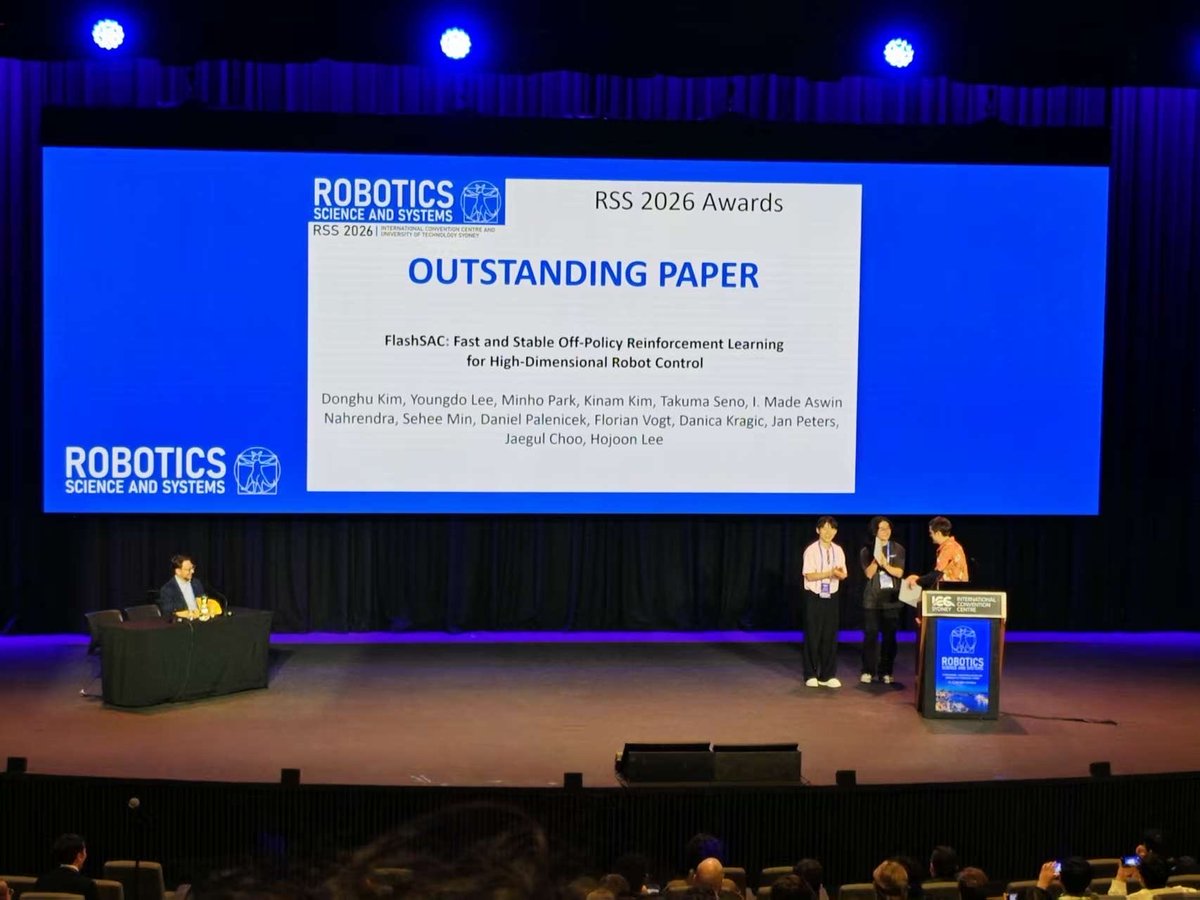
FlashSAC won the Outstanding Paper Award at RSS 2026 🎉
We got off-policy RL fast and stable enough to beat PPO and FastTD3 across 60+ tasks and 10 simulators with minimal tuning!
TL;DR: If you're working on dexterous manipulation, just try FlashSAC!
https://t.co/hYlhuLRTXn
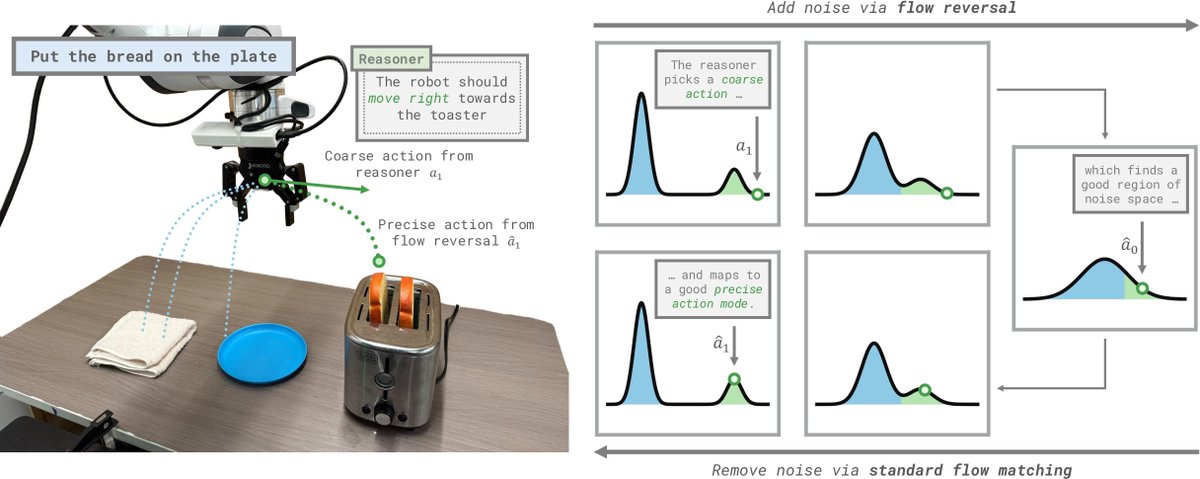
Generalist robot policies learn many useful skills, but struggle to select good behaviors for new tasks. To solve this, we introduce Flow Reversal Steering (FRS), a method to refine coarse semantic guidance into precise, in-distribution motions.
https://t.co/uCR6KmoDo8
1/N
Today, we're introducing SimFoundry, our real2sim2real framework at NVIDIA GEAR that automatically turns real-world scenes into simulation-ready worlds from a single image or video.
Website: https://t.co/JB3kf3GlYm
Paper: https://t.co/pVhE1qWXtU
This work marks a major step for our team toward leveraging simulations and synthetic data for foundation model training and systematic policy evaluation at scale. Code will be open-sourced soon. Stay tuned!
🚀 Introducing Object-Centric Residual RL: enhancing a VLA base policy with sim-only residual RL, no real-world adaptation ✨
From my internship at Microsoft Research Asia – Tokyo 🧵👇
1/ Introducing HIW-500 (Humanoids-in-the-Wild 500):
the largest open-source humanoid teleop dataset collected in real homes
Built w/ @UnitreeRobotics@huggingface across 12 homes in Southeast Asia, it covers:
> 500+ hrs
> 23K+ episodes
> 10+ TB
> 10+ household tasks
PPO has long dominated robot locomotion training in simulation. SAC, despite its sample efficiency, couldn't keep up.
We analyze why:
🔗https://t.co/w8cR5lgxjf
🔥Integrated into RSL-RL, our approach requires only minimal changes, making SAC a drop-in alternative out of the box.
Real-world RL is still too brittle and data-hungry for long-horizon, contact-rich tasks.
We introduce Simulation Distillation (SimDist), which turns large-scale simulated experience into reusable world-model priors for rapid real-world adaptation.
By combining online planning with dynamics adaptation, SimDist achieves high success rates on tasks requiring precision, force, and reactivity.
Play with our interactive visualization to see for yourself: https://t.co/qFGNySxdAl
(1/n)
We scaled off-policy RL to sim-to-real.
To our knowledge, FlashSAC is the fastest and most performant RL algorithm across IsaacLab, MuJoCo Playground, and many more, all with a single set of hyperparameters.
Project page: https://t.co/uaTcOoYtjt
Paper: https://t.co/PLu6ZGRKuB
Introducing GEN-1.
Our latest milestone in scaling robot learning.
We believe it to be the first general-purpose AI model to master simple physical tasks.
99% success rates, 3x faster speeds, adapts in real time to unexpected scenarios, w/ only 1 hour of robot data.
More🧵👇
Robotics: coding agents’ next frontier.
So how good are they?
We introduce CaP-X: an open-source framework and benchmark for coding agents, where they write code for robot perception and control, execute it on sim and real robots, observe the outcomes, and iteratively improve code reliability.
From @NVIDIA@Berkeley_AI@CMU_Robotics@StanfordAILab
https://t.co/MVcc6XWQhY
🧵
Fast Foundation Stereo + SAM2 basically = zero shot Foundation Pose😂
No CAD model, no object image, just click the target. Run directly on my 3070 at 13fps, with a 30$ stereo camera (calibrated in 10min)
Thanks @bowenwen_me for his contribution to the community!
1/ World models are getting popular in robotics 🤖✨
But there’s a big problem: most are slow and break physical consistency over long horizons.
2/ Today we’re releasing Interactive World Simulator:
An action-conditioned world model that supports stable long-horizon interaction.
3/ Key result:
✅ 10+ minutes of interactive prediction
✅ 15 FPS
✅ on a single RTX 4090🔥
4/ Why this matters: it unlocks two critical robotics applications:
🚀 Scalable data generation for policy training
🧪 Faithful policy evaluation
5/ You can play with our world model NOW at https://t.co/SBqVDzYn86. NO git clone, NO pip install, NO python. Just click and play!
NOTE ⚠️
ALL videos here are generated purely by our model in pixel space! They are **NOT** from a real camera
More details coming 👇 (1/9)
#Robotics #AI #MachineLearning #WorldModels #RobotLearning #ImitationLearning