Omubaka wa Uganda mu Germany H.E. Ambassador Stephen Mubiru atwanirizza bulungi, era atubuulidde ezimu ku nteekateeka eziteekebwako essira okulaba nti Bannayuganda mu Germany babeerayo mirembe.
Twogedde ku nsonga ez'enjawulo naddala ku ngeri bannayuganda gye basobola okusiga ensimbi mu Germany, basobole okwekulaakulanya ate n'okufuna bamusigansimbi okuva e Germany abasobola okukwatagana naffe mu Uganda okutumbula enkulaakulana.
Twebaza emirimu ekitebe kya Uganda mu Germany gye kikolera Bannayuganda era tubeebaza bulijjo okwanirizanga obulungi Ssaabasajja lw'aba asiimye okugendako e Germany. #BBECO2026
Hey you, Gooners: 22 years is a long wait, but it makes it the sweeter when our closest and strongest rival, (Man City) stumbles at the closing stages.
Muyogeeyoge abawagizi ba Arsenal!!
Kabaka yatugamba ku myaka 30 ng'ali ku Nnamulondo nti: katandika butandisi....😊😄😊😄💪🏾💪🏾👌🏾👌🏾 CPM
Long before written records, culture remembered what the sky revealed. This monument marks a rare moment in the early history of the Great Lakes region, a solar eclipse, the only event from this era that has been scientifically dated.
The eclipse lives on in the folktales of Bunyoro, Buganda and Ankole, passed down through generations. These shared stories helped historians trace royal lineages and understand how the ancestors of these kingdoms were connected in time and experience. In a region where history was preserved by word and ritual, the sky itself became a timekeeper.
According to tradition, the eclipse occurred as Olimi I Rwitamahanga, King of Bunyoro, was returning from a raid in Rwanda during the reign of Umwami Ruganzu II Ndori. Struck by fear at the darkened sun, he abandoned all his spoils, cattle, women, and captives along the way. These abandoned cows were later inherited by Ntare I Nyabugarobwera of Nkore and became known as “Empenda ya Munoni” and “Enduga Mwiguru” cows from heaven, a name that forever tied them to the moment the sky changed.
Some legends go further, telling that unwilling to return home empty-handed, Olimi turned his path toward Buganda, then ruled by Ssekabaka Nakibinge. A fierce battle followed in Bulemezi, where both Nakibinge and his great commander Kibuuka were killed after betrayal from within. Buganda’s throne later passed to Mulondo, marking another turning point.
An eclipse became a marker of kings, wars, inheritance and destiny proving that long before clocks and calendars, our ancestors were watching the sky and remembering.
#tribe56
Katikkiro @cpmayiga has officially announced the completion of the restoration of the Muzibwazaalampanga House, the main house @KasubiTombs following its destruction by fire in 2010. The Katikkiro declared that he'll soon announce the day for its grand opening.
He commended the different stakeholders that have contributed to this project and congratulated the people of Buganda, Uganda and the rest of the world for this milestone.
The site that is currently managed by @TourBugandaUG is a @UNESCO world heritage site, the only cultural of the three sites in Uganda.
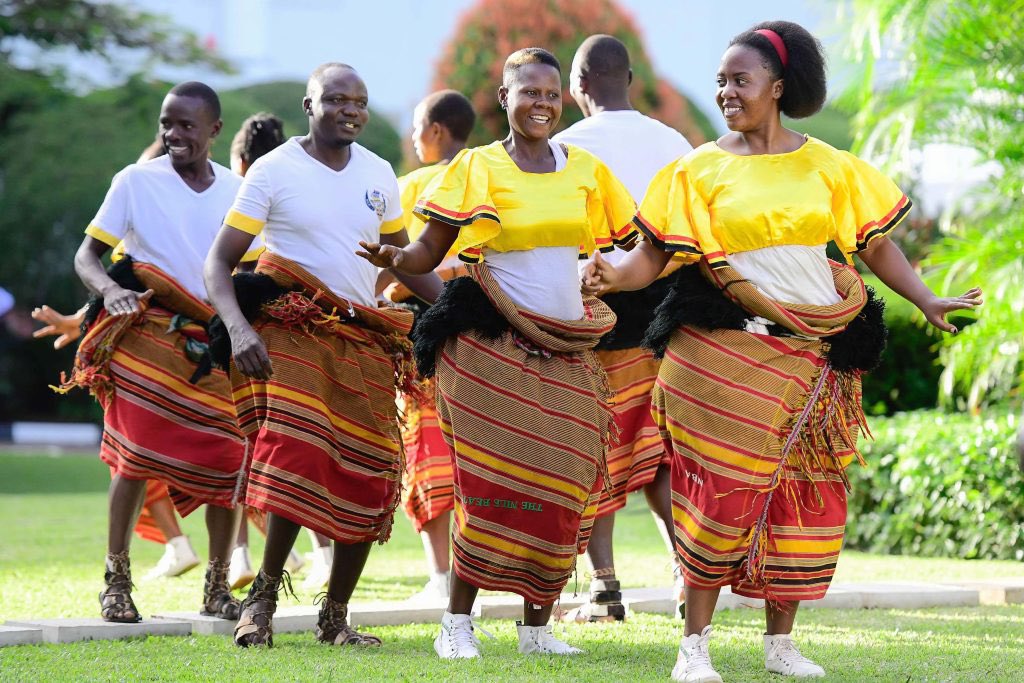
Did you know Busoga’s Tamenhaibuga dance?
Tamenhaibuga literally means “do not break the drinking gourd.” In traditional Busoga, elders enjoyed mwenge bigere (local beer) using a gourd (ibuga) as their drinking vessel. When someone got too excited and began dancing recklessly, they often dropped and broke the gourd. Their friends, who were singing, drumming and cheering, would warn them with the phrase “Tamenhaibuga!” a name that eventually became the identity of this vibrant Basoga dance.
How it is danced:
Tamenhaibuga is performed by both men and women, with smooth, circular waist movements at the centre of the dance. The upper body moves proudly, while the arms highlight the dancer’s waist or head, emphasising grace and control.
Costume:
Women wear a sleeveless bra-like top with an open midriff and a kikoyi wrapped just below the knee to allow free movement. A prominent, trough-like waistband accentuates the rounded waist motions.
Men dress similarly, either bare-chested or in a vest.
Instruments:
The xylophone (embaire) leads the music, supported by a rich ensemble of drums, the endumi (big drum), rhythm drums, and omugalabe (long drum) along with the endigidi (tube fiddle), ensaasi (shakers), and omulele (flute).
#tribe56
Kabaka Edward Muteesa II (1924–1969) succeeded his father, Daudi Chwa II, marking the beginning of a new chapter in Buganda’s history.
In 1953, a major disagreement arose between Muteesa II and Sir Andrew Cohen, the Governor of the Uganda Protectorate, over proposed changes to the 1900 Buganda Agreement. As a result, Muteesa was exiled to England but was later welcomed back home in 1955.
When Uganda gained independence on 9th October 1962, Kabaka Muteesa II became the nation’s first constitutional President. However, tensions between him and Prime Minister Apollo Milton Obote escalated, leading to the 1966 attack on his palace. The Kabaka fled into exile in England, where he lived until his death in 1969. His remains were returned to Uganda in 1971 and buried at Kasubi.
With four successive Kabakas now resting in the same tomb house, Kasubi has become a sacred and cultural landmark and the spiritual heart of Buganda. Princes and princesses descended from these kings are also buried within the outer fence behind the main shrine, making the site not only a royal burial ground but also a living symbol of Buganda’s heritage.
In 1967, Obote abolished Uganda’s kingdoms under a new Republican Constitution, ushering in years of repression for traditional institutions. The attack on Kabaka Muteesa’s palace, led by Idi Amin, deepened this crisis.
Two decades later, the return of Kabaka Ronald Muwenda Kimera Mutebi II from exile and his coronation in 1993 rekindled Buganda’s cultural pride which was a powerful revival of tradition, memory and identity among the Baganda people.
#tribe56
Kabaka Muteesa I (1835–1884) was crowned in 1856 and later established his grand palace at Kasubi in 1882. Known for his strength and authority, he ruled with a firm hand, often taking bold measures to secure his throne.
Muteesa I was a powerful and visionary leader and was the first Kabaka to open Buganda to foreign cultures. Through contact with Arab traders, he adopted aspects of Islamic practice and later showed great curiosity about Europe after meeting explorer John Hanning Speke in 1862 and Henry Stanley in 1875. It was Muteesa who invited European teachers and missionaries to Buganda, (Uganda) marking the beginning of a new cultural era.
Despite the growing influence of foreign religions, Muteesa I skillfully maintained his power, allowing both Christian and Muslim groups to exist without undermining his rule.
When he died in 1884, he was buried at his palace in Kasubi whole, not just his jawbone as tradition demanded breaking long-held royal customs and leaving behind a legacy that forever shaped Buganda’s path into the modern world.
#tribe56
Standing proudly on Rubaga Hill, Rubaga Cathedral is one of Kampala’s most iconic landmarks and the heart of Uganda’s Roman Catholic faith. Once the site of Kabaka Muteesa I’s palace, later destroyed by fire. The hill carries deep royal and spiritual history. In 1889, Kabaka Mwanga II donated the land to the French Catholic missionaries (the White Fathers), who went on to build this grand cathedral, completed in 1925.
Today, Rubaga Cathedral is a place of worship and a living museum of faith and heritage. Inside lie the remains of Archbishop Joseph Kiwanuka, the first African Catholic Bishop and Archbishop of Kampala, whose leadership inspired generations.
A walk up Rubaga Hill rewards visitors with stunning city views, timeless architecture and stories that link Buganda’s royal past with Uganda’s Catholic legacy. As the Cathedral marks 100 years of existence, it remains a beacon of faith and history at the heart of Kampala.
#Lubagaat100
Today marks Buganda’s Independence, 8th October 1962. A day that restored Buganda’s voice and leadership. It marked a new beginning of unity, identity and self-governance under the Kabaka. Buganda continues to stand strong proud of its heritage, culture and people.
#tribe56
Did you know the Lubiri Palace sits on 260 acres of land? Within its walls are 2 schools, 2 exhibition grounds, 150 houses and 4 gates making it feel like a small village of its own.
#tribe56
As we celebrate #WorldTourismDay2025 under the theme “Tourism and Sustainable Transformation”, we recognize that tourism is one of Uganda’s strongest drivers of growth, culture and livelihoods.
Tourism in Numbers (2024):
1.Contributes 5.7% to GDP
2.Generates $1.28bn in forex
3.4th top employer in Uganda
4.Provides 803,691 jobs (7.2% of total employment)
5.Accounts for 17.2% of total investment
6.Ushs. 370bn+ in taxes annually (2.6%)
7.12% of total exports and 52% of service exports
8.Domestic tourism reached 2.8 million travelers
https://t.co/2DkgW4u1Ze arrivals stood at 1.37 million
10.Hotel occupancy at 53.2%, with leisure travel up by 19.2%