$AAOI --- $AAOI announced the official groundbreaking for two new facilities on adjacent property in Pearland, Texas, adding nearly 400,000 square feet of manufacturing capacity. The core objective is to aggressively scale production of 800G and 1.6T high-speed optical transceivers targeted at AI and cloud infrastructure markets, directly addressing surging order demand from hyperscale data centers.
$AAOI confirmed it will release Q2 financial results after market close on August 6, 2026. Hefty investor expectations have built ahead of earnings, fueled by prior Q2 revenue guidance of $180 million to $198 million, representing explosive YoY growth ranging from 74% to 92%. The firm also projects net losses will narrow sharply by 72% to roughly $2.5 million.
Public market reports indicate notable increases in $AAOI holdings among hedge funds and institutional investors; certain metrics show multi-fold position expansion. Heavy institutional accumulation heading into earnings has formed a strong sentiment backstop for the stock price.
1.Structural Trend: Optical Takes Over Copper for AI Compute Infrastructure
As AI large model training and inference clusters scale exponentially, bandwidth bottlenecks for data transmission within server racks and across data centers continue to intensify. The transition from legacy copper cabling to optical communications is irreversible. Leveraging its technical expertise in 800G and 1.6T high-speed optical modules, AAOI is well-positioned within the core global AI infrastructure market.
2. Supply Chain Tailwinds from U.S.-Based Domestic Manufacturing
Expansion of its sizable domestic manufacturing footprint at the Pearland, Texas campus enables AAOI to meet stringent requirements from North American hyperscalers around supply chain resilience, local sourcing and accelerated delivery timelines. This creates a differentiated competitive edge versus select overseas rivals.
3.Explosive Momentum Toward the Profitability Inflection Point
Investors previously questioned AAOI’s profitability outlook. However, ramping volumes of high-margin high-speed optical modules have driven 70%+ revenue growth alongside steep loss contraction. This fundamental financial transformation sets the stage for valuation re-rating.
AAOI is the only vertically integrated indium phosphide laser maker in America and that's about to matter a lot (Save this).
Lumentum's CEO just said the exact same shortage that hit memory chips is now happening with a laser material called indium phosphide.
AI data centers move data between racks using fiber optic cables and those cables need tiny lasers inside them to send light signals and those lasers are made from indium phosphide, or InP for short.
Lumentum's CEO said demand has exploded from the hundreds of units telecom companies used to order to hundreds of millions now needed for AI data centers.
Scaling factories to make that many is no small feat because it requires completely different manufacturing than standard chips.
He thinks this InP shortage will get worse than the memory shortage everyone's already worried about.
That's a big reason Nvidia invested directly in both Lumentum and its biggest rival, Coherent, just to lock down supply.
Here's why this matters for AAOI specifically.
Almost every competitor has to line up and wait on suppliers like Lumentum or Coherent for these lasers.
AAOI grows its own indium phosphide material and builds its own lasers from scratch, so it doesn't have that problem.
Management has said openly on earnings calls that demand is running ahead of what they can produce, and expects that gap to stick around until at least mid-2027.
They're expanding laser manufacturing capacity by roughly 350% by 2027, with new facilities going up in Texas just to keep pace.
They've also said investors may be underestimating how bad this bottleneck gets, and that owning the laser supply chain is their biggest edge over everyone else.
Everyone needs this scarce material, almost nobody can make it themselves, and AAOI is one of the very few that can.
Bullish on AAOI, make sure to follow @MelvinInvests for more semiconductor insights and if you want to see exactly what I'm buying as an analyst at Milk Road Pro, you can check out the link below for more.
I'm super bullish on memory stocks because I believe the supply constraints will last until 2028... especially after recent commentary from CEOs of $AMZN, $GOOG, $MSFT, $META, $SKHY, $MU, $SAMSUNG and others.
These memory companies are trading at 3-5x NTM EPS (not including cash)... I understand that we might see peak earnings in the next 12-18 months.. but here's why that's okay...
1) these companies are signing LTAs with their biggest customers... this locks in price floors, visibility and certainty
2) even if earnings peak in the next 12-18 months, I don't think prices collapse because... even while more capacity starts coming into the market in late 2027 or 2028... I believe demand will still be growing faster than supply
3) even if net income for these memory companies only grows at 10% per year from 2027 through 2030 (4 years)... these companies will be generating insane piles of cash which means they'll be able to return capital to shareholders through quarterly dividends, special dividends and stock buybacks... if a company grows net income at 10-12% per year for 4 years... while buying back 15% of their float every year... it means EPS is growing at a 30% CAGR for those 4 years... which seems pretty amazing while these companies are trading at 3-5x NTM EPS (current prices not including cash)... it's more like 2-4x NTM EPS at current prices when including cash.
If you listen to Jassy last night (CEO of $AMZN) ... the capex into ai infrastrucuture is not slowing down anytime soon because they're seeing a big, fast payback on their capex spending. CEOs of $GOOG and $MSFT said similar things.
I believe capex spending across the hyperscalers will exceed $1 trillion next year and could reach $1.2 trillion.
$AMZN says they see a path to AWS doing $1 trillion in annual revenues... in order for that to happen they'd have to spend at least another $2-3 trillion in capex.
NFA.
DYOR.
*We are long Hynix, SK Square, Micron and Kioxia @FirstWaveFund
The only way to 2x-5x your portfolio in 6 months.
Is to buy strong companies when they're ON SALE.
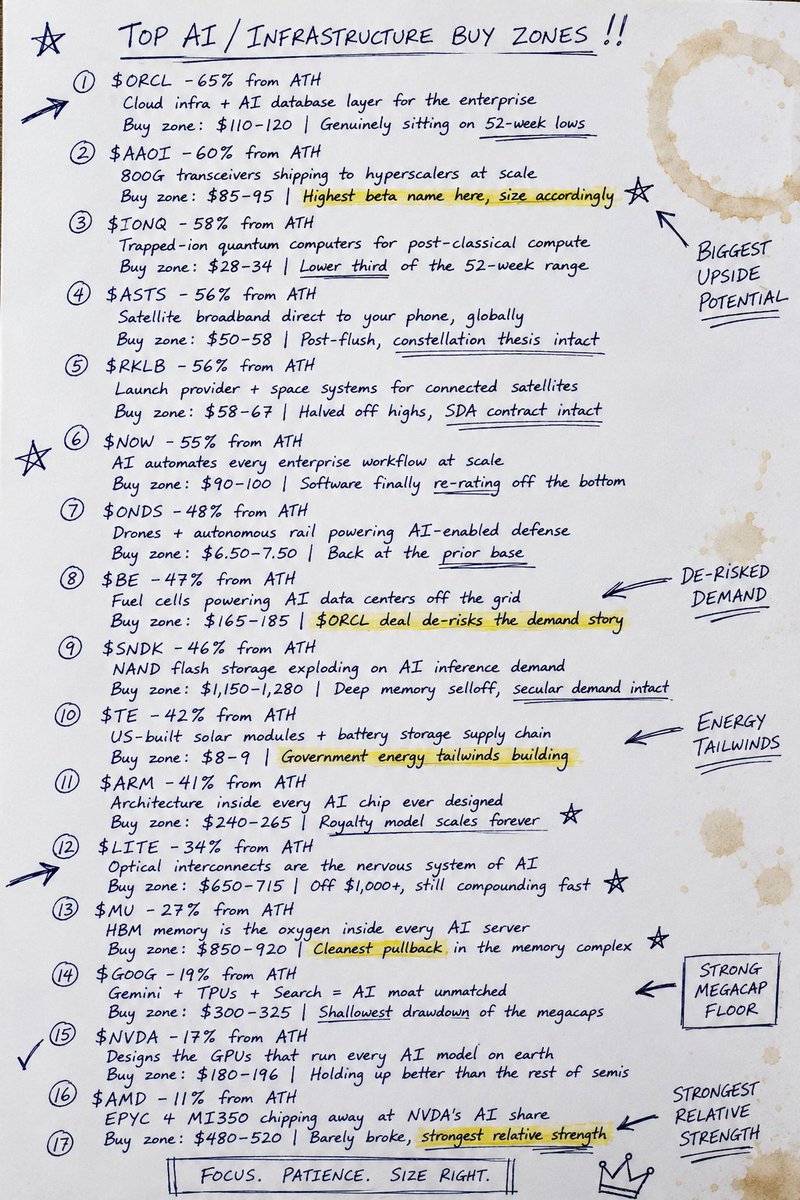
16 stocks sitting at massive discounts:
1. $ORCL -65%
Cloud infra + AI database layer for the enterprise
Buy zone: $93–102 | Genuinely sitting on 52-week lows
2. $AAOI -60%
800G transceivers shipping to hyperscalers at scale
Buy zone: $72–81 | Highest beta name here, size accordingly
3. $IONQ -58%
Trapped-ion quantum computers for post-classical compute
Buy zone: $24–29 | Lower third of the 52-week range
4. $ASTS -56%
Satellite broadband direct to your phone, globally
Buy zone: $42–49 | Post-flush, constellation thesis intact
5. $RKLB -56%
Launch provider + space systems for connected satellites
Buy zone: $49–57 | Halved off highs, SDA contract intact
6. $NOW -55%
AI automates every enterprise workflow at scale
Buy zone: $76–85 | Software finally re-rating off the bottom
7. $ONDS -48%
Drones + autonomous rail powering AI-enabled defense
Buy zone: $5.50–6.40 | Back at the prior base
8. $BE -47%
Fuel cells powering AI data centers off the grid
Buy zone: $140–157 | $ORCL deal de-risks the demand story
9. $SNDK -46%
NAND flash storage exploding on AI inference demand
Buy zone: $975–1,090 | Deep memory selloff, secular demand intact
10. $TE -42%
US-built solar modules + battery storage supply chain
Buy zone: $6.80–7.65 | Government energy tailwinds building
11. $ARM -41%
Architecture inside every AI chip ever designed
Buy zone: $204–225 | Royalty model scales forever
12. $LITE -34%
Optical interconnects are the nervous system of AI
Buy zone: $552–608 | Off $1,000+, still compounding fast
13. $MU -27%
HBM memory is the oxygen inside every AI server
Buy zone: $722–782 | Cleanest pullback in the memory complex
14. $GOOG -19%
Gemini + TPUs + Search = AI moat unmatched
Buy zone: $255–276 | Shallowest drawdown of the megacaps
15. $NVDA -17%
Designs the GPUs that run every AI model on earth
Buy zone: $153–167 | Holding up better than the rest of semis
16. $AMD -11%
EPYC + MI350 chipping away at NVDA's AI share
Buy zone: $408–442 | Barely broke, strongest relative strength
$SPY can easily break under $720 towards $700 by September FOMC.
♻️RESHARE this post and write 1 comment, I'll give you my favorite 3 plays to buy!
Looking at the current stock prices:
> Applied Optoelectronics $AAOI is now trading at 1.39x mid-2027 ARR as per management guidance, and approx. 20x 2027 EPS (analyst consensus)
> SanDisk $SNDK is trading near 6x FY2027 EPS and 4x FY2028 EPS
> Kioxia $KXIAY is trading at 4.5x FY2027 earnings and 3.4x FY2028 earnings
> SK hynix $SKHY is trading near 4x FY2027 earnings and below 4x FY2028 earnings
> Micron $MU is trading below 6x FY2027 earnings
> AmpliTech Group $AMPG is trading near 2.5x 2026 revenue (as per management guidance)
And so on. Looking at the valuation of some of these (but you could do the same for other stocks), it really looks cheap here.
$BE absolutely crushed it... https://t.co/d08akzlDGG
Q2 revs of $1.065B vs $827M est
Q2 revs up 165% YoY
Q2 ebitda of $253.4M vs $149.36M est
Q2 ebitda up 514% YoY
Q2 ebitda margins of 23.8% vs 18.1% est
Q2 eps of $0.78 vs $0.40 est
Q2 eps up 680% YoY
Raised full year revs guidance to $3.9-4.2B vs $3.7B est
New revs guidance implies 93-108% YoY growth
Raised full year eps guidance to $2.55-2.85 vs $2.17 est
New eps guidance implies 235-275% YoY growth
As a $BE shareholder I'm definitely happy with these results. Very excited for the earnings call at 5pm.
fwiw, I think $BE does at least $6 of EPS in CY2027 and possibly $10 of EPS in CY2028 in which case the stock is trading AH ($180) at 30x 2027 EPS and 18x CY2028 EPS with EPS growing by 1300% from CY2025 through CY2028 which is a 136% CAGR from CY2025 through CY2028 (ie 3years) and a 87% CAGR from CY2026 through CY2028 (ie 2 years)
The argument that $BE is expensive no longer holds water. Sorry.
NFA.
DYOR.
*We have a position in $BE at @FirstWaveFund
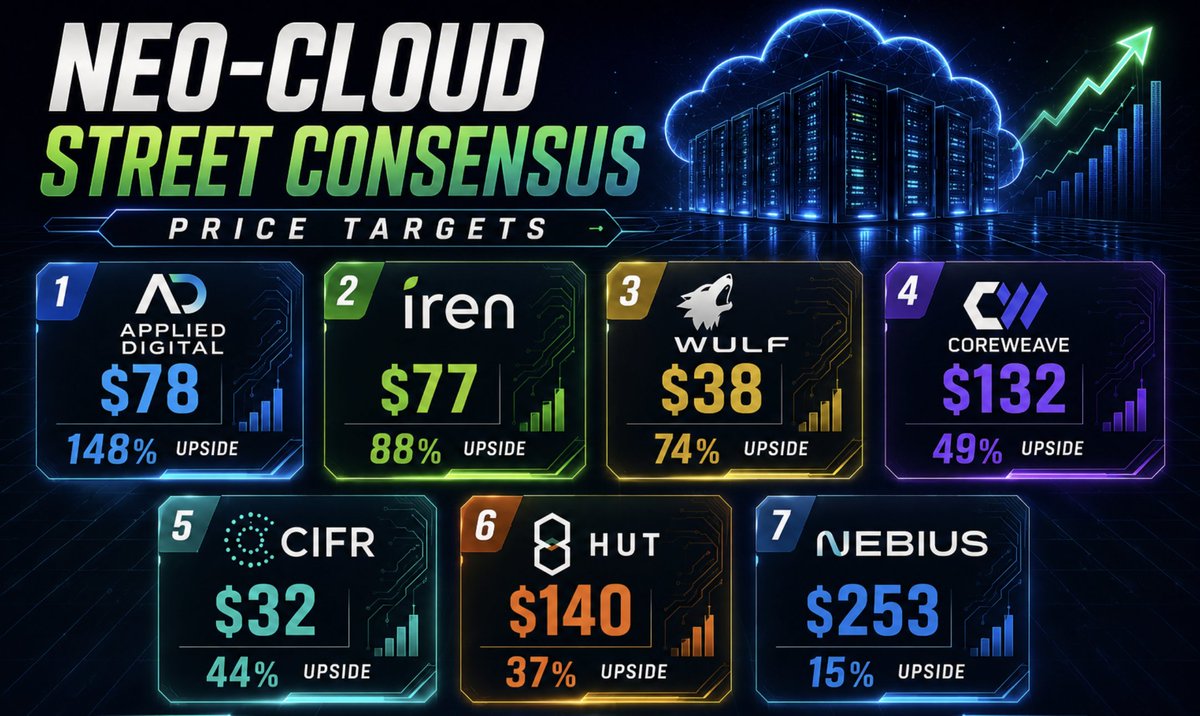
Morgan Stanley put out a really great 58-page report this morning as they began covering $APLD, $HUT and $RIOT.
They started $APLD at equal weight with $36.50 price target, implying 21% upside.
They started $RIOT at overweight with $36 price target, implying +53% upside
They started $HUT at overweight with $263 price target, suggesting 141% upside.
MS says their bull case price target for $HUT is $320 which implies 194% upside from yesterday's close.
Three other names mentioned in the report are $WULF, $CIFR and $GLXY.
$WULF price target implies 262% upside
$CIFR price target implies 105% upside
$GLXY price target implies 46% upside
MS is calling these companies "PSPs" which stands for Powered Shell Providers.
Obviously I can't share the full report but I want to highlight a few paragraphs...
What are the key drivers of our bullish stance with respect to these Powered Shell Providers?
(1) The magnitude of improvement in AI capabilities will continue to increase at a non-linear rate;
(2) the value creation for both AI Adopters and AI Enablers is high (with attractive ROIC for AI-related capex);
(3) the demand for compute is likely to be systematically much higher than the supply, with the result that
(4) the economic incentives (like powered shell leases) to eliminate key bottlenecks to the growth of compute will grow;
(5) in the US and Europe, data center (DC) developers face a significant power access bottleneck—especially with recent state-level moratoriums;
(6) Bitcoin-to-DC conversions represent the most attractive "time to power" option for DC developers; and
(7) even if data center developers secure all large US and European Bitcoin company power access, they would still be, in our view, short access to power.
We are seeing signs of increasing willingness among key AI players to pay higher "time to power" in the form of increasingly rich economics to powered shell providers for using their power access to serve DC developers.
In March, we introduced our 15/15/15 framework; the conviction that future powered shell deals would appear with terms of 15 year leases, 15% yields on capex, and $15/watt of equity value creation. Recent deals—like those by $HUT this week and $WULF earlier this month—exceeded our expectations, with terms of 15 years, 17% yield, and $17/watt for the former and 20 years, 18% yield and $19/watt of equity value creation for the latter.
Importantly, we expect future terms for $HUT and $RIOT close to those in the $WULF and $HUT deals, reflecting the strong past precedent and consistency of the former and the strength of sites for $RIOT. In our evaluation of $APLD, we lower our expectations on terms to approximately $10/watt, significantly below our 15/15/15 framework but aligned with $APLD's existing deal terms. If we see evidence that $APLD can replicate terms closer to recent $HUT, $CIFR, or $WULF deals, we would expect to increase our valuations of these stocks accordingly.
That's all I can share for now.
If you can get your hands on this report, I would highly suggest doing so. It's one of the better sell side reports I've seen this year on the DCs/HPCs/PSPs.
NFA.
DYOR.
*We are long $RIOT $CIFR $HUT $WULF at @FirstWaveFund
**Our favorite DC/NC name is still $NBIS
$AVGO Deep Dive 👇
The rise of AI has been fast and spectacular.
There is a company whose AI products have been highly successful and are at the core of the AI infrastructure strategies of OpenAI, Anthropic, and Google.
That company is Broadcom.
OpenAI’s ChatGPT grew from 0 to 900M weekly active users in 4 years.
Anthropic ARR grew from $9B in December 2025 to $44-47B by June 2026.
Google’s Cloud backlog grew from $92B in Q1 2025 to $468B in Q1 2026.
Broadcom chips are behind all of this.
Obviously $NUAI is finally getting the attention it deserves.
This isn’t a name I’m likely to sell until the full thesis plays out. There’s simply too much upside.
When the LOI converts into a signed Tier-1 hyperscaler lease, the first real re-rate begins. But that’s only the opening move.
Uncle Phil @PDphillyPhil is one of the OGs in this name and one of the few investors whose underwriting I take seriously.
His work gets him to north of $70 per share, roughly 15x from here.
Wild ride ahead.
Most AI companies are going to zero.
You can know the thing, and still lose all your money.
For example, you could have the insight that "cars will be a big deal" in the early 1900s, but making money from that insight was far from a sure thing.
Over 1,900 US car companies have been started.
Almost every single one has failed.
To date, only two American car companies have avoided bankruptcy (Ford and Tesla).
Right now, most people know AI is going to be a big deal. That is obvious.
Making money from it, that's the hard part.
Even a few months ago, the killer investment idea would have appeared to be to invest in the frontier labs.
But as you can see with the new Kimi model, that can flip on its head in a matter of days.
It's still unclear if there is value in the models themselves.
Mark Twain put it best:
"During a gold rush, it’s a good time to be in the pick and shovel business"
Trying to pick winners is near impossible.
What's easy, is selling picks and shovels: the GPUs, chips, electricity, and computing required to power the boom.
Jeff Bezos likes to invert: instead of thinking about what will change, he instead focuses on what won't change.
Here's a few things I believe will continue to be true in the the next five years:
1. People will use tools like Grok, Gemini, ChatGPT, Siri (lol) and Claude at increasing rates. The tools are undeniably useful, and history shows that making a technology cheaper and more efficient doesn’t reduce demand, it expands it.
2. Both training better models (training compute) and using them (inference compute) will require massive data centers.
3. We are majorly compute constrained and even before the AI boom, data center demand was growing rapidly.
The choke point for all of this isn’t GPUs, it's power.
Behind-the-meter generation, pre-existing high-voltage connections, and sites that can actually get energized in the next 24–48 months are scarce.
This makes assets with secured power and land in the right places insanely valuable.
And lucky for us, they all went on sale this week.
My companies have invested in four stocks that we plan to hold for the long-term:
$IREN - Previously misunderstood as a crypto miner. The stock re-rated after they signed a massive 10-year deal Microsoft. I talked about my investment on My First Million in January 2025.
$CRWV - Similar to IREN, CoreWeave is one of the leading AI cloud providers. It's already locked in ~$100B in backlog from labs and enterprises that need capacity now, not in three years. Same story as the IREN-Microsoft deal: long-term committed revenue.
$NUAI - Owns a huge portfolio of data center sites that are perfect for behind-the-meter development. See my post on this one from yesterday.
$SPCX - I'm bullish on orbital compute over the next 5-10 years.
And yes, before you yell into your computer any more, let's address some of your bearish points:
"WHAT ABOUT LOCAL OPEN SOURCE MODELS?"
I've thought about that, and while I agree that increasingly powerful workloads will be able to run locally, I think:
1. The cost of the hardware required to run frontier level models is still out of reach for the average person and will continue to be for some time (two year old Mac Studios with 512GB of ram are selling for $25-$35,000 on eBay).
2. Have you ever used your phone to edit photos in Lightroom or used Apple's AI image playground? Your phone quickly turns into lava. That is the GPU/CPU working overtime to run local models and it absolutely kills battery life. Given the huge portion of AI that occurs on mobile, the need for inference in the cloud (data centers) is going to continue to grow.
3. More and more tasks will be able to run locally with less and less compute/GPU. I won't argue that. But I believe our demand for intelligence is insatiable. If you're trying to win in business or create a life saving drug (or even just trying to file your taxes accurately), you want to use the best model. The question is, at what point does the return on intelligence end? Or do we just find increasingly wild tasks to give it?
4. Even "local" workflows are often hybrid. The heavy reasoning, tool use, retrieval, or multi-agent orchestration still routes to cloud.
"WHAT ABOUT DATA CENTERS IN SPACE?"
1. I am a SpaceX shareholder and think orbital compute will be huge if they can pull it off.
2. This will take years, and Elon usually delivers a few years late.
3. Even if orbital works at scale, latency and the multi-year timeline mean it’s additive, not a substitute, for the next wave of demand. Companies will still sign terrestrial leases as insurance.
Companies like IREN, Coreweave, and New Era Energy are finite resources that require upfront lock-in.
Think of them as the last available industrial warehouses in a crowded city with no other availability where tenants are required to sign 10-year leases.
If you want to play, you need to pay.
If AI compute is the most in-demand service in the world, and not securing it could cost a company its moat, are people really going to bet that Elon will deliver data centers in space and wait 3-5 years to secure their compute or are they going to hedge their bets and sign deals with terrestrial data centers? My bet is the latter.
"BUT AI ISN'T DELIVERING _____"
I’m currently spending $30–40k a month on Anthropic and OpenAI credits.
I treat it as payroll for an extra 30+ digital employees doing work that would cost $200–300k/month in human equivalents.
There is no scenario where this genie goes back in the bottle. The demand is real, it’s compounding, and it’s only getting started.
Mark Twain was right about gold rushes.
Billions will be made by prospectors chasing the next big model, but most of them will go broke.
The boring money is in the picks and shovels: the power, the land, the GPUs, and infrastructure that every serious AI effort will need more of for years to come.
So, are you a gold miner or a pick axe salesman?
PS: I'd love to hear any rebuttals if I've missed something.
---
Important disclosure: I (and entities I control) beneficially own shares of IREN, CRWV, SPCX and NUAI. I wrote this after establishing these positions. I may buy more or sell at any time without updating this post. This is not investment advice or a solicitation to buy/sell securities. This is a high-risk, speculative situation and you can lose all your investment. Forward-looking statements and scenarios in this post are speculative and may not occur. Do your own research and read company filings.
@TheBigBerbowski SEMI (ASX listed), DRAM and AIPO ETF's to provide broad cover of key themes. Then fill out with direct shares MU, SNDK, AAOI & LITE. Concentrated and carries risk but trade off for reward is good. Then exposure to OND and OUST as emerging themes.
Did you listen, anon? VERY Bullish for $WDC
AI Data Center Demand Revives HDD
Hard disk drives (HDDs) are regaining attention as AI data center operators seek cost-effective, high-capacity storage to support rapidly growing data volumes. According to The Elec, although HDDs gradually lost ground to solid-state drives (SSDs), they are now poised for a rebound. The report says Japanese HDD component makers, including TDK, JX Advanced Metals, Resonac, Nitto Denko, and HOYA, are expanding production capacity.
As the report indicates, the global HDD market is dominated by $WDC, $STX, and Toshiba, with Western Digital and Seagate each holding more than 40% market share, while Toshiba accounts for around 17%. The three companies are racing to commercialize HDDs with capacities exceeding 40TB for AI data centers.
Western Digital plans to begin mass production of its 40TB-class HDDs in the second half of 2026 and is targeting 100TB HAMR-based drives by 2029. Seagate is already shipping HAMR-based HDDs with capacities of up to 44TB and aims to enable 100TB drives by increasing per-platter capacity. Toshiba, meanwhile, is advancing MAMR technology with 30TB to 34TB HDDs and plans to introduce 40TB-class products in 2027.
As noted by a MoneyDJ report last month, citing Nikkei, strong demand from Chinese PC makers and AI data centers has tightened HDD supply and pushed contract prices higher. Nearline HDD prices reportedly rose about 10% quarter over quarter in April–June, while U.S. hyperscalers such as Google and Amazon, which account for roughly 60% of nearline HDD shipments, continue to struggle to secure sufficient supply.
According to TrendForce, the massive volumes of data generated by AI are placing increasing pressure on data center storage infrastructure. In the traditional tiered storage architecture, nearline HDDs have long dominated cold data storage due to their exceptionally low cost per gigabyte. Cold data typically includes backup files and historical records—datasets that are infrequently accessed but must be retained for long-term archiving. As inference AI applications rapidly expand, demand for cold data storage is also rising. By contrast, SSDs are valued for their superior read and write performance and are primarily used for hot and warm data that require frequent access.
The CEOs of the biggest, fastest growing and most important tech companies are telling you where to invest… are you going to listen? (see below)
We’re still in the early innings of a decade+ ai infrastructure supercycle… the world needs more compute…. which means more data centers, more chips, more memory, more cables, more optics, more retimers, more power and so on.
For any of you memory bears… do yourself a favor and research how much memory is needed for autonomous cars and robots… the world is already memory constrained and we haven’t even gotten to these two massive catalysts yet… why do you think Elon wants to build the TeraFab? capacity is only growing at 20-30% per year but demand is growing at 60-100% per year… with no capacity coming until 2028 and even when it does it won’t be enough because memory demand is going to increase by at least 10x over the next 4-5 years.
Kimi just reaffirmed the ai infrastructure thesis… doesn’t matter if we’re using open models or closed models… we need more compute which means you should be mega-bullish on the entire ai infrastructure theme.
Right now ai infrastructure is ~45% of our invested capital at @FirstWaveFund … something tells me that number is going higher in the coming days/weeks, especially after with these 30-60% pullbacks in many of the ai infrastructure names which now look extremely undervalued relative to where I think the fundamentals are going over the next several years.
My strategy is to own the 2-3 best names in each of the following groups:
1) data centers / neoclouds
2) chips
3) memory
4) optics
5) connectivity
6) power
I think we see some green this week 🎉
$CRDO price action and valuation is starting to get ridiculous... despite having some of the best fundamentals (growth and margins)... the stock has pulled back -33% from the highs and now testing the VWAP from the March lows.
$CRDO just started their FY2027... I have them doing $6.85 EPS (vs sell side at $6.13 EPS) which means the stock is now trading at 30x NTM EPS with EPS growing at least 80-90% but probably 90-100% or better.
NFA.
DYOR.
To the people selling their memory stocks and/or the people that don’t understand the current supply/demand dynamics… please watch the interview below.
Dylan from @SemiAnalysis_ says DRAM prices will increase another 100-200% from here because demand is increasing exponentially but supply is only increasing 20-30% per year and there’s no new supply coming until 2028.
Right now $MU (Micron) is trading below 5x 2027 EPS estimates and $SKHY (SK Hynix) is trading below 4x 2027 EPS estimates.
At the current prices these companies will generate profits equal to their entire market cap within the next 5 years.
Will be interesting to watch them buyback $100-150B of stock per year at 5x EPS.
NFA.
DYOR.
*we own $MU and $SKHY either directly or indirectly at @FirstWaveFund
Next year, 285,000 students will pay more than $54,000 for arts, law and commerce degrees, and more than $90,000 for double degrees. The government has long been critical of the Job-ready Graduates scheme, but it's been in place longer under Anthony Albanese than Scott Morrison. It's the worst tertiary education policy of this century, and it needs to go.
https://t.co/26tisgInE8
4 of my favorite stocks that I plan to own for the next 2+ years... all of which have strong fundamentals and compelling valuations that are pulling back to important support levels where the adds start to get much easier and more aggressive:
$NBIS - pulling back to the 100d, down -40% from recent highs to today's premarket lows
$CRDO - pulling back to the 30d, down -24% from recent highs to today's premarket lows
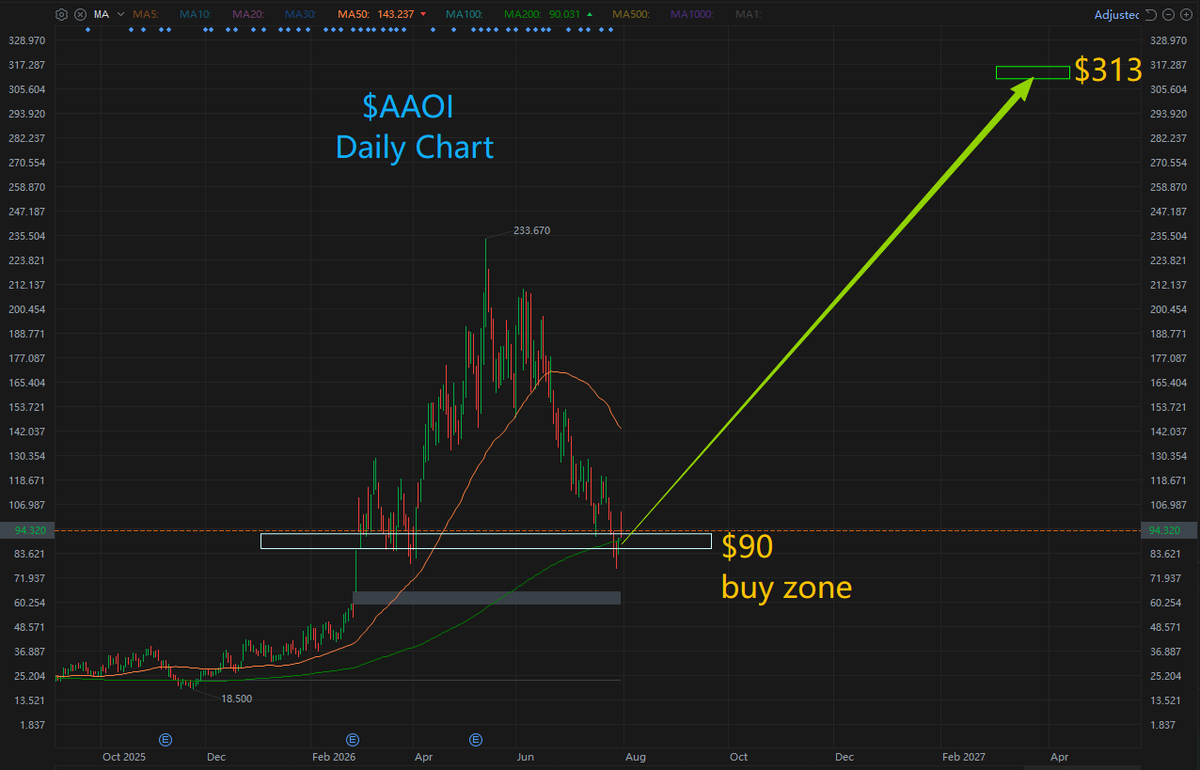
$AAOI - pulling back to the 200d and .618 fibs, down -54% from recent highs to today's premarket lows
$FPS - pulling back to VWAP from the IPO, down -36% from the recent highs to today's premarket lows
NFA.
DYOR.
**We own all 4 stocks at @FirstWaveFund and remain extremely bullish on each of them, pullbacks are never fun but it's part of the game and doesn't really matter over the long term as long as you still have conviction and able to average down, it helps if you trimmed your position at higher prices which we did with some of these.