Combinations of stepping intensity and daily step counts against all-cause and cardiovascular disease mortality: insights from a device-based prospective study https://t.co/W6nZ2xS0N9
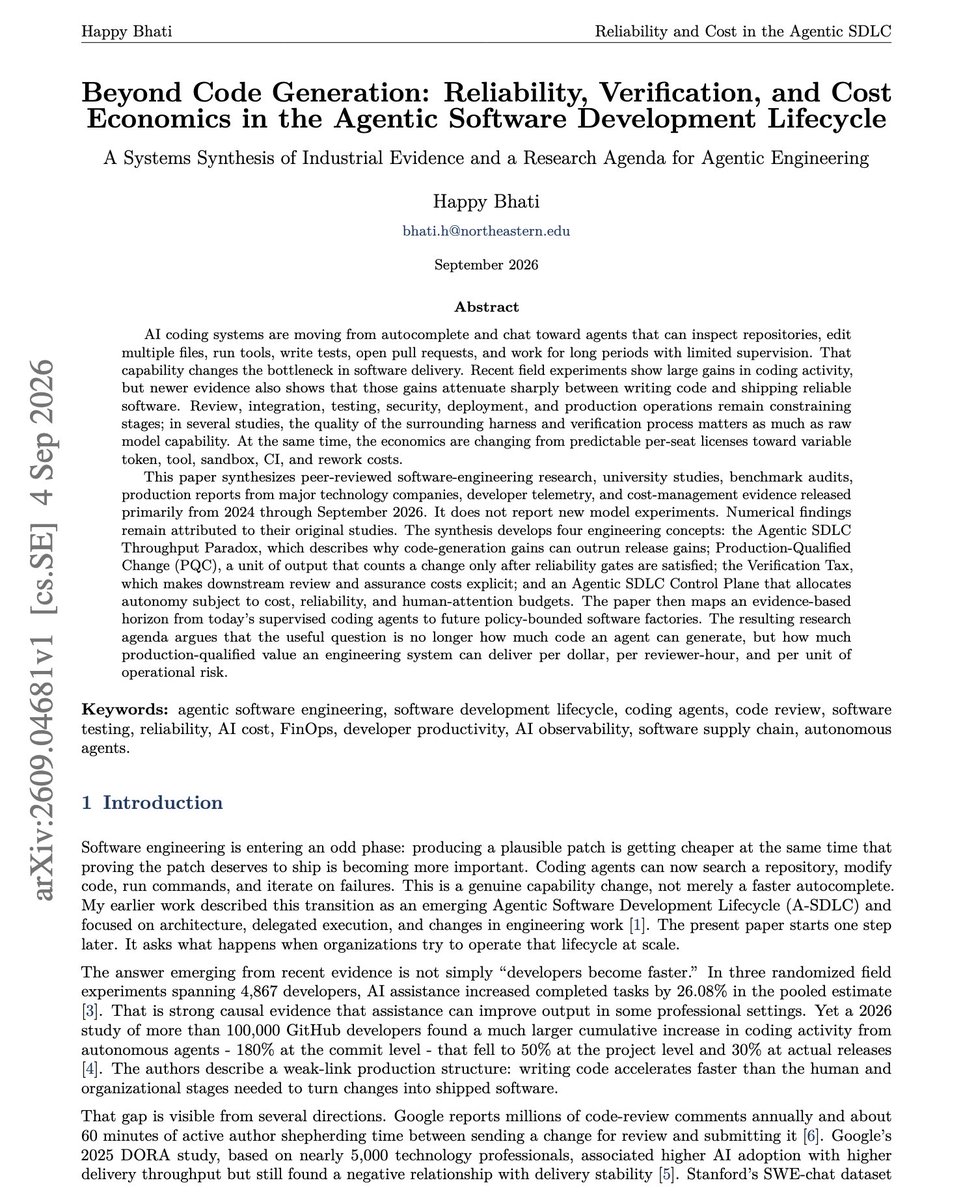
Nice report on agents beyond code generation.
Here is why it matters:
Coding agents raise how much code gets written. This report argues the gains shrink sharply between writing code and shipping reliable software.
It pulls together field studies, benchmark audits and production reports from 2024 through September 2026. What stays constraining is review, integration, testing, security, deployment and production operations.
The cost side changes shape too.
Predictable per seat licensing gives way to variable token, tool, sandbox, CI and rework costs, which is a different budgeting problem than buying licenses.
Four interesting concepts emerged in this report. The Agentic SDLC Throughput Paradox, Production-Qualified Change, the Verification Tax, and an Agentic SDLC Control Plane that allocates autonomy under explicit cost, reliability and human attention budgets.
Paper: https://t.co/xCSC1F2qOO
Hanuman Ansh: Why a quiet, Rs 2 crore film on Baba Neem Karoli has become an extraordinary success!
I can understand why Hanuman Ansh has found such an unexpectedly large audience- not through promotion but word- of - mouth.
For me, its greatest attraction was its peacefulness. Nothing suddenly explodes. There is no shooting, bloodshed or manufactured suspense requiring us to sit on the edge of our seats. The film moves quietly, almost serenely.
I was particularly struck by its depiction of rural life. These are not picturesque villages created for the camera, but extremely humble homes—mud floors and walls, rudimentary kitchens, cow-dung cakes being used as fuel, and people living with very little. I saw that kind of village life myself many years later, and the film captures it remarkably well. Yet it does not turn poverty into spectacle. The surroundings somehow add to the quietness of the film.
The spirituality, too, is accessible. Faith expresses itself through kindness, humility, feeding people, helping them and treating them with compassion. One need not be a devotee of Neem Karoli Baba to respond to that. Perhaps this explains some of the film's extraordinary success: it offers something increasingly uncommon in popular cinema—goodness without aggression and faith without confrontation.
The film does have weaknesses. Its episodic structure can become repetitive. In particular, the recurring scenes of the young Baba meditating, eyes closed, immersed in a village pond seemed overextended. After a point they added little; some could have made way for other aspects of his early life. More generally, the reverence for Baba if one is a devotee, leaves little room for complexity or doubt.
But I probably watched Hanuman Ansh differently from many others because I had actually seen Neem Karoli Baba.
When I was about nineteen, my mother took me to meet him at the Lodhi Estate home of A.D. Pandey, then a Joint Secretary in the Home Ministry. Many civil servants had gathered there. I still remember a tall, very fair man, smiling, and an extraordinary sense of peace around him.
My mother had lost my father only a couple of years earlier and was herself becoming progressively unable to walk. Unknown to us, a tumour was pressing upon her spinal cord. She was Cambridge-educated, an academic who later joined the Government of India—deeply religious and spiritual, but never attached to a particular sect. She had gone seeking solace.
When she tried, with difficulty, to bend before Baba, I remember him smiling and placing his hand over her in blessing.
There was no miracle. In 1967 she underwent major neurosurgery in Bombay, lost the use of her legs and endured months of being bed- ridden in hospital as money and my resilience ran out. Yet she recovered extraordinarily.
A few years later she was travelling with me to the Andamans, driving a car and running my household. She eventually lived to 102½. Her faith in Neem Karoli Baba never left her. And in some sense, has stayed with me.
There is another memory. In April 1979, heavily pregnant with my third child, feet swollen and delivery imminent, my mother insisted on taking me on what then seemed an interminable drive to a distant Hanuman temple associated with Neem Karoli Baba. The roads were poor, the driver repeatedly lost his way, and after reaching it I still had stairs to climb. I kept asking: why are we doing this? Let's go home.
My mother insisted that I must take Hanuman's blessings.
I reached the murti. My son was born the following evening.
I make no claim of cause and effect. I only know that he has been a great blessing in my life—and in my memory he arrived accompanied by the blessings of Hanuman, Neem Karoli Baba and, above all, my mother.
Perhaps that is why Hanuman Ansh stayed with me. It did not persuade me to believe something new. It quietly reopened a door to something very old.
What Pune marathoner’s death tells us about cardiac arrest: Top cardio explains how the heart can stop twice
Opening a blocked artery is only the first step —the heart can remain vulnerable for hours
https://t.co/VeACNTbKMy @IndianExpress
"The death of 65-year-old Pune runner Sanjay Kadam during the Satara Hill Half Marathon has raised an unsettling question: How can someone who is apparently fit enough to run 17 kilometres suddenly suffer a cardiac arrest, be revived and undergo angioplasty to open a blocked artery, and then suffer another cardiac arrest hours later?
The answer lies in understanding what happens to the heart after a major coronary blockage. Kadam, a retired scientist from the Centre for Development of Advanced Computing (C-DAC), was an experienced and enthusiastic runner. He had hypertension but trained regularly. He was participating in the Satara Hill Half Marathon for the first time and had completed about 17 km of the 21.1-km course when he collapsed. A cardiologist participating in the race, Dr Riyaz Mujawar, immediately began CPR (cardiopulmonary resuscitation). Kadam was taken to hospital, where angiography reportedly showed a blockage in a major coronary artery. Doctors performed angioplasty. He was initially stabilised, but later suffered another major cardiac arrest and died."
There’s a blog called "Journeys Across Karnataka". Not sure how many of you know about it.
This blog has inspired me to explore and visit as many historical sites across Karnataka as possible.
Attaching the blog link below 👇🏼
https://t.co/vBd5LPa9eq
Terence Tao just posted this really insightful thread which seems to have been written in reaction to the Navier Stokes announcement. Please give it a read. https://t.co/SiuLLyp8jQ
If you are baffled but curious about the Navier-Stokes news today, this article I tweeted about a few days ago is now more worth reading than ever. It gives a witty, insightful overview for a general reader, as long as you are willing to read about math. https://t.co/cDgOUExlch
What if students could explore their future before choosing it?
The IIT Madras School Connect Program is opening applications for its October 2026 cohort, welcoming students from Classes IX–XII.
For the first time, Class IX students can join the programme and get an early start on discovering their interests, strengths and possible career pathways.
Explore 17 future-focused disciplines — from Data Science & AI, Aerospace and Cybersecurity to Economics & Finance, Law, Design, Humanities, Game Technology and more.
Learn from faculty at IIT Madras and leading institutions through an 8-week online learning experience featuring lectures, live sessions, assignments and assessments. Successful students receive an official IIT Madras CODE e-certificate.
🗓️ Apply by: 30 September 2026
🚀 Courses begin: 5 October 2026
With 4,900+ schools and 1.75 lakh+ students already reached, School Connect is helping young learners make more informed choices about their future.
Learn more: https://t.co/TOEiFZLy4i
@iitmadras@CODE_iitm_
#IITMadras #SchoolConnect #CareerExploration #FutureReady
The clean and beautiful Kasaragod station, being redeveloped under the Amrit Bharat station scheme, and the effort that goes into it. #IndianRailways#stations#cleanliness
Video courtesy, Pestal!
A few days ago, Anthropic shared this brilliant prompt.
I was surprised by how it significantly improved writing with Fable 5.1.
Even more surprising, it also improved writing for GPT-5.6 Sol.
I have it as a rule everywhere I use AI for editing/writing.
Infosys started in Pune. One decision changed the course of India's startup story
https://t.co/o7AJbF8CMB @aviralbhat
"In this excerpt from A Billion Bets: The Making of India's Startup Ecosystem, Aviral Bhatnagar traces the early years of Infosys alongside the rise of telecom and the internet in India, and explains how choices made by fledgling companies helped shape the country's startup ecosystem."