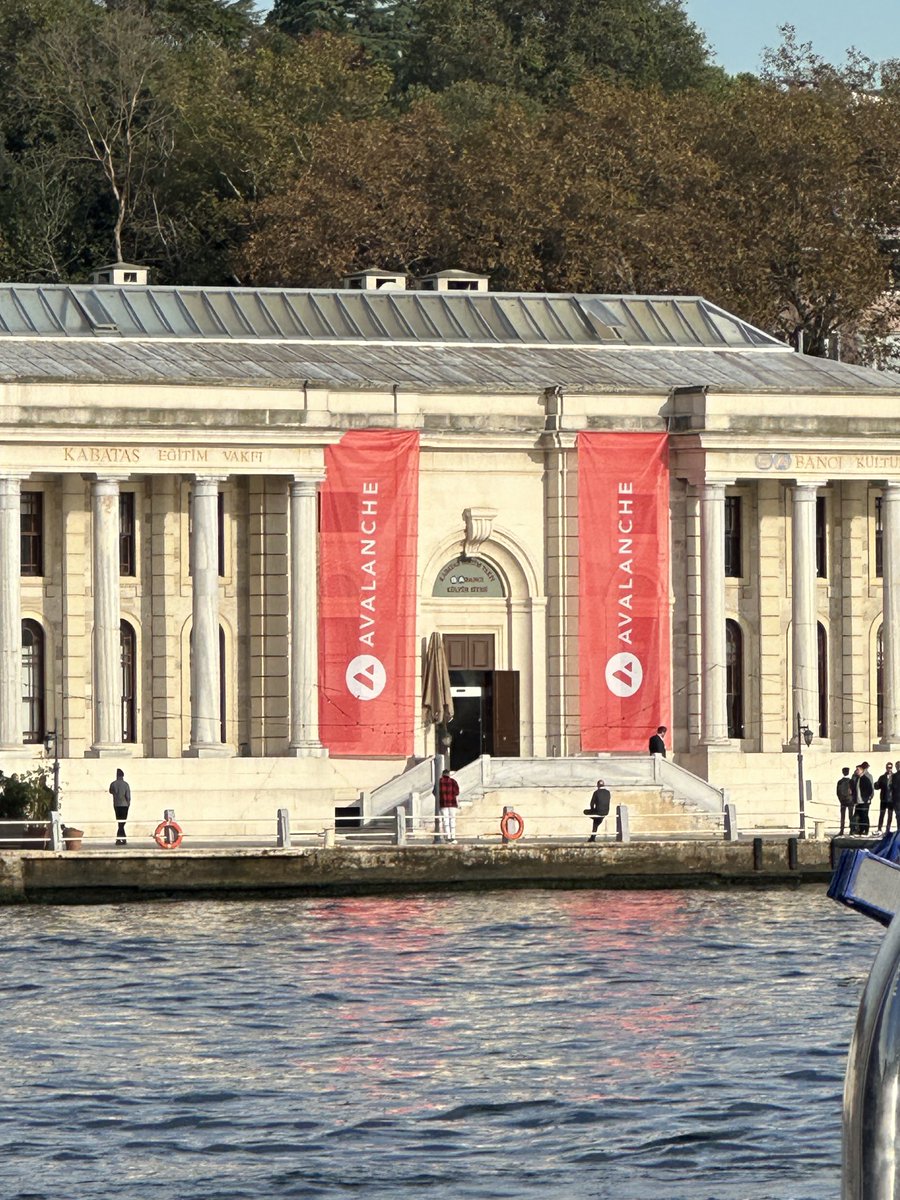
Summer on Avalanche, where much was built 🔺
Hyundai together with @Tether and @AxiymFinance, launches Stablecoin payment pilot on Avalanche.
@AvalancheFDN publishes research on blockchain tokenomics
@AvaxTeam1 launches their Builder Grants program with up to $30,000 in funding per project
@g1raffe_ launches a 100 supply 1/1 Giraffe collection.
@si_tickets_ issues 80k+ tickets on Avalanche for World Cup watch parties
RWAs (Distributed & Represented) on Avalanche touched ATHs
@FIFACollect issues 100k+ Rights-to-Buy on Avalanche in support of the World Cup
@nobsfud launches @makooor, an app to create memes (built for business).
@YourGrails reaches $700,000 in volume in beta.
@HalfMoon_Dex launches perps on Avalanche with $100,000 reward pool.
Avalanche Team1 applications close with 3,000 submissions, and introduce 300+ new collaborators.
@Ask_ORO launches DeFi learning lessons on Avalanche.
Avalanche unveils the Avalanche Payments Collective with 29 members, including @WisdomTreeFunds, @vaneck_us, @GoKiteAI, and more.
Summit NYC Early Bird tickets sell out.
@RiverRunGame game launched. Mine, raid, and breed Salmon.
@primitforall Perps dex launches on Avalanche with $100,000 $AVAX reward pool.
YourGrails receives first Team1 Accelerator grant
Avalanche Foundation hosts a community call for ACP-285
@Securitize tokenizes ~$300m of $SECZ on Avalanche
@Aave V4 expands to Avalanche, the first chain after Ethereum
@cavs wins Loyalty 360’s award for best rewards app, built with @uptop_xyz
Giraffe NFT Holders received an airdrop of a miner from @clubhashcash@DinariGlobal launches dShares on Avalanche C-Chain
@progmat_en completes migration of $2.7B+ in securities to its Avalanche L1
@plumenetwork’s nOPAL goes live on Avalanche
Avalanche worked with @Deloitte to create a stablecoin playbook for businesses
@BridgeTowerCap’s $11B DOM X Arizona Copper-Gold Project shows up on https://t.co/YMyQsMqWAU
And we spiffed up our brand, as you may have noticed.
Much more to come. Anything we missed?
The house. Now onchain.
Meet @CxChainOfficial, an Avalanche L1 reshaping the infrastructure behind digital games of chance.
Fairness enforced by code. And it’s verifiable. 🧵
@Atli_Ayb Gercekleri saptirmayin lutfen. Avrupa tarihinde ve arsivlerinde 2 adet Lozan Antlasmasi gecer biri 1912 italyanlarla yapilan 12 adanin verildigi Lozan Antlasmasi ( Bizde UŞİ Antlasmasi diye gecer) Digeri esas Lozan 1923 Turkiye Cumhuriyetinin tapusu ve basarisidir.
Eski ABD Başkanı Reagan'ın hukuk danışmanı Bruce Fein: “Asıl katliamı Anadolu'da 2,4 milyon insanı katleden Ermeni çeteler yaptı. Türkler arşivlerini açtı, Ermeniler reddetti. Ermeniler, tüm dünyadan ama özellikle de Türklerden özür dilemek zorunda kalır.“ 1/4
#TruthOf1915
@CryptoPNZ 1 saatlik mum grafigi ile genel piyasa yorumu yapip insanlari da yaniltmayin. 570 milyar dolardan soluksuz 1.1 trilyon dolara cikan total 3 grafigini ancak haftalik mumda net gorursun.
The blockchain of all blockchains.
We introduce, the BIGGEST & most INCLUSIVE claim you've ever seen.
Claim $DIAM for every action you've taken on top blockchains.
https://t.co/QASHFRFGWB
Bu bir Tesla model Y batarya. Aracın yolcu bölmesinin altındaki tüm boşluğu kaplıyor.
Bunu üretmek için ihtiyacınız olan:
Lityum için -12 ton kaya (ayrıca olabilir
deniz suyundan elde edilmiş)
-- 5 ton kobalt minerali (En çok kobalt yapılır
bakır işleme yan ürünü olarak
ve nikel cevherleri. Bu en zor materyal
bir pil elde etmek ve en çok
pahalı. )
-- 3 ton nikel cevheri
-- 12 ton bakır cevheri
Elde etmek için 250 ton toprak taşımalısınız:
-- 26,5 pound Lityum
-- 30 pound nikel
-- 48.5 pound manganez
-- 15 pound kobalt
Bataryayı üretmek için ayrıca gerekenler:
-- 441 pound alüminyum, çelik ve/veya plastik
-- 112 pound grafit
Tırtıl 994A temel mineralleri elde etmek için toprak taşınmasında kullanılır. 12 saatte 264 galon mazot tüketiyor
Sonunda "sıfır emisyon" bir araban oldu.
Şu anda, pillerin üretimi için gerekli minerallerin büyük kısmı Çin veya Afrika'dan geliyor. Afrika'daki mineralleri elde etmek için yapılan emeğin çoğunu çocuklar yapıyor! Elektrikli araba alırsak, en çok kar eden Çin olur!
Bu arada, 2021 Tesla Model Y OEM batarya (en ucuz Tesla batarya) şu anda internet üzerinden kargo ve kurulum dahil 4.999$'a satılık. Batarya 1.000 pound ağırlığında (kargo ücretini tahmin edebilirsiniz). Tesla pillerinin maliyeti:
Model 3 -- 14.000$+ (Araba MSRP 38.990$)
Model Y -- $5,000-5,500 (Araba MSRP 47,740$)
Model S -- 13.000$-20.000$ (Araba MSRP 74.990$)
Model X -- 13.000$+ (Araba MSRP 79.990$)
Elektrikli bir arabanın net sıfır CO2'ye ulaşması YEDİ yıl sürüyor. Pillerin ömrü 10 yıl (ortalama). Sadece son üç yılda karbon ayak izinizi azaltmaya başlarsınız. Sonra pillerin değişmesi gerekir ve o üç yılda elde ettiğin tüm kazanımları kaybedersin.
Gerçek, hepimize anlatılan kurgudan çok daha iyidir!
#arestax /Alıntıdır.
US banks have almost $700 billion of unrealized losses on the securities they hold.
And since the Fed has their back, then it’s not really a problem for the banks anymore.
But for sure that’s a problem for the Federal Reserve.
The Secret Avalanche Scaling Master Plan
(Super Duper Secret)
Note: This is simply my vision. Things may change.
The Avalanche vision has always been to build high-performance blockchain technology that is usable, reliable, and scalable well into the future. But few may know precisely how the vision gels out, and how I believe the Avalanche architectural design is the most future-proof one. In this post I want to provide an overview of what's ahead of us and how things interplay with each other.
At the highest level, this is the super-duper secret vision: many FAST blockchains that behave like ONE chain and that scale up in capacity without an upper bound. This is an extremely high bar, and while we're not there yet, the pieces all falling into place. The rest of this blog post will elucidate, at a high level, how I see this all working.
First, let's talk about where we are with the various scaling technologies. For the most part, we have two main approaches to scaling. The first approach tries to make the base layer as fast as possible. Many chains have tackled this path, including Avalanche, Solana, Ethereum, and others. However, there is one fundamental issue: even if we scale the base layer up in some finite capacity, there are paths where usage growth could exceed hardware and software growth, in which case we need other approaches. Here are some truths: a) while single chains will keep getting faster and faster, a single “global” chain is not sustainable due to storage growth risk; b) single-chain settlement is not sustainable due to execution risk; and c) the proper way to prepare for the future is to build systems that minimize both storage and execution risk. The first is the risk associated with state growth in a single chain that is faster than our ability to absorb it, and the second is the risk associated with cascading safety risks associated with reliance on settlement in a single chain. Fundamentally, then, this requires coming to terms with sensible conclusion: good design involves many fast and parallel chains that behave as one.
Let me repeat again. At a high level this is the secret sauce: make it all fast and make it all feel as one. Let's dive deeper. Please note that this is just a high-level overview, and I further details of the deep engineering work required to make this happen will come from the great worth coming out of the AvalancheGo client.
1. Make It All Very Fast
Avalanche introduced a powerful consensus protocol that gives you something that no other PoS protocol gives you: scaling up with arbitrary number of nodes. However, when building production-ready systems, building for decentralized validator set is not enough. You need to consider other things as well, including the biggest current bottleneck of all: state growth. As it currently stands, there's two big limitations with state growth. The first one is state access: as state grows bigger, accessing it becomes harder. The second one is state maintenance: as state grows bigger, simply keeping it around becomes harder. The solution to the first one is a matter of fairly easy iterative engineering, i.e. building better and better backend stores. This is what Solana has tackled already in some form, although what EVM-based chains are still behind. Avalanche, however, will soon become the first EVM-supporting network that addresses the state access issue directly by reducing the overhead by possibly orders of magnitude thanks to Firewood (performance metrics are currently pending). As a quick sneak-peek under the hood, here's how this bottleneck comes about on the EVM and how Firewood fixes it. After a block is processed, the EVM requires that the state root post execution is included in the block. This means that at the end of the block you end up having to do a bunch of changes to the trie to get that root. And since you can't do this asynchronously, you have to do it right then and there, incurring big overhead. Each contract has a tree, and as you may need to do a single update, you may need to reach many intermediate nodes per modification to be able to update the tree. What you basically have at this point is a randomized serial disk-bomb that is functionally based on the number of changes. Firewood solves this issue. Instead of storing data randomly on disk as is currently done in Geth, Firewood stores them on disk through a more sophisticated sequential layout that enables much rapid changes.
The solution to the second state growth challenge, i.e. how to store all this new data, is based on deeper architectural changes. As of right now there are only two systematic approaches: L2s and parallel chains. While L2s are great technical achievements, they do pose some challenges due to their fundamental requirements. Namely: they often rely on centralized sequencers; they pick up a non-trivial amount of cost of the expensive underlying settlement layer; they are generally more inflexible in the virtual machine diversity and require higher maintenance due to their cryptographic complexity; and -- most importantly of all -- they fundamentally put too much reliance on a single chain which can become faulty. This poses significant fault risks for growth. Despite this, however, L2s do have a role in the scalability play, and I do think they are here to stay for some types of applications. Nonetheless, I strongly believe that their settlement requirements, and subsequently withdrawal and deposit-related fragmentation, pose extremely high challenges to unified UIs. In other words, it is going to be challenging to allow us to make the network feel as a single chain, which is ultimately the goal. This is, in my opinion, a big limitation when taken holistically. Therefore, it is my opinion that parallel chains are the sounder approach. Done right, parallel chains (like subnets) can actually allow us to achieve sub-second finality in UIs, reduce fault risks, enable deep decentralization, lower the maintenance costs, and ultimately enable never-before seen experiences for users.
My topline performance capacity goals for Avalanche are simple:
a. End-to-end finality within a chain bounded by 250ms.
b. End-to-end finality within two chains bounded by 1 second.
c. Peak throughput on the C-chain at least 100x higher and cheaper than the next best EVM-chain.
d. Peak throughput of any Hyper-chain (WASM + Rust contracts enabled) at more than 1M TPS.
2. Make It All Feel As One
Deploying many mind-bogglingly fast blockchains isn't enough: they all need to feel like a single gigantic, unified operating system. Making the network interoperate and behave like a single chain, despite it not being a single chain, involves a strong interplay between the Avalanche Warp Messaging (AWM), the base technology, and the Teleporter smart contracts that enable the AWM. By the end of this engineering work, one should be able to issue a transaction that initiates on, for example, the Dexalot chain, routes to the C chain, and then route back, all in a single unified transaction that takes under 1 second to complete. And that's not all. One should be able to move a token, for example, from the C chain to the Dexalot chain, stake it there or even use it for paying gas in that chain. This kind of UI pattern can unlock tremendous new opportunities for blockchain design that we simply have not explored yet.
Anyway, that's the secret sauce. Well, maybe not so secret. A a unified blockchain network that will simply, under no circumstances, ever bog anyone down. It'll just simply work, under any dang load. We're still not there, but the work being put towards AvalancheGo by both the Ava Labs engineering team and the community at large is simply tremendous. If you want to get involved, please contribute to the ongoing public list of ACPs.
Over the next few months, I will post more detailed metrics about all the scaling work. Stay tuned.
Dünya futbol tarihinde eşine çok nadir rastlanan olaylardan birisi 2 Mart 2000 tarihinde Almanya’nın Dortmund kentinde Borussia Dortmund- Galatasaray maçında yaşandı.
Sürecin perde arkasında ise futbolun çok ötesine geçen bir hikaye gizliydi.