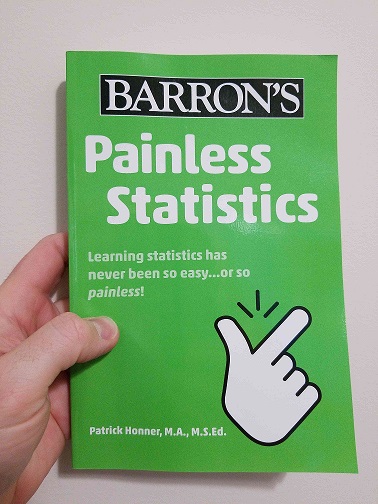
I wrote a book! Introducing "Painless Statistics".
https://t.co/sTrLWHrcPs
Info on the book, the target audience, links to order, and a Table of Contents.
#math#mathchat#statschat
I'll be at NCTM later this week giving two talks:
So You're Teaching Precalculus, with @garyrubinstein, on Thursday
A Case for Linear Algebra, on Friday
https://t.co/ibNVdvLM9f
#NCTM#NCTMAnnual#NCTMDC23
The region swept out by the line segment in this animation is called a deltoid. It was once thought that the area of this shape is the smallest that could be made while turning a line in every direction, but it’s possible to do infinitely better. https://t.co/YHQVJRt2vn
What does a three-point turn have to do with a century-old geometry problem? No need to wait on pins and needles. @MrHonner will point you in the right direction: https://t.co/FHafFjQk0E
I really enjoyed diving into Kakeyas Needle Problem with a new @QuantaMagazine article! A huge shoutout to the writer, @MrHonner, for highlighting the brilliant minds of mathematicians around the world! #Math#Innovation
https://t.co/SdPb59FXvL
How much space do you need to turn your car around on a narrow road? Mathematicians have been working on an idealized version of this problem for over 100 years. https://t.co/YHQVJRt2vn
A look at the simple geometry that makes Kakeya’s needle problem so interesting and surprising that mathematicians are studying variations of it over a century down the line. https://t.co/IQlUazhTdR
Lay an infinitely thin needle on a flat surface and rotate it so that it points in every direction. What’s the smallest area the needle can sweep out? This month’s Academy column explores some of the angles for solving Kakeya’s needle problem. https://t.co/YHQVJRt2vn
If you’ve ever backed a car out of a tight spot, you have engaged in geometry similar to the famous Kakeya conjecture. @MrHonner explains the finer points of Kakeya’s needle problem in a new Quantized Academy column: https://t.co/YHQVJRt2vn
If you are learning or teaching statistics this year, consider picking up my book Painless Statistics! Don't be deterred by the reviewer who said there are a lot of words — most are repeats. (And even they gave it ⭐⭐⭐⭐⭐!)
#math#stats#Statistics
https://t.co/w618w8WPme
Excited to be chatting with mathematician & novelist (!) @ManilSuri at the Jaipur Literature Festival New York next week! We'll be talking about his excellent new book "The Big Bang of Numbers" on Wed 9/13 at the Asia Society. Details here: https://t.co/ptHqVAIO3y
@JLFLitfest
Break up your morning with a few quick puzzles 🧩
Can you explain why it’s impossible to get anything other than a star in a connected graph with no paths of length 3 or longer? Find out.
https://t.co/a2c4XA24tJ
In graph theory, cliques identify areas of maximum connectivity and dependence, while anti-cliques identify areas of maximum independence.
https://t.co/X0C8IfjM7U
Knowing a little about the local connections on flight maps and other networks can reveal a lot about a system’s global structure.
https://t.co/wKjEm1aCEx